Bug-out and evacuation
Bug in or bug out?
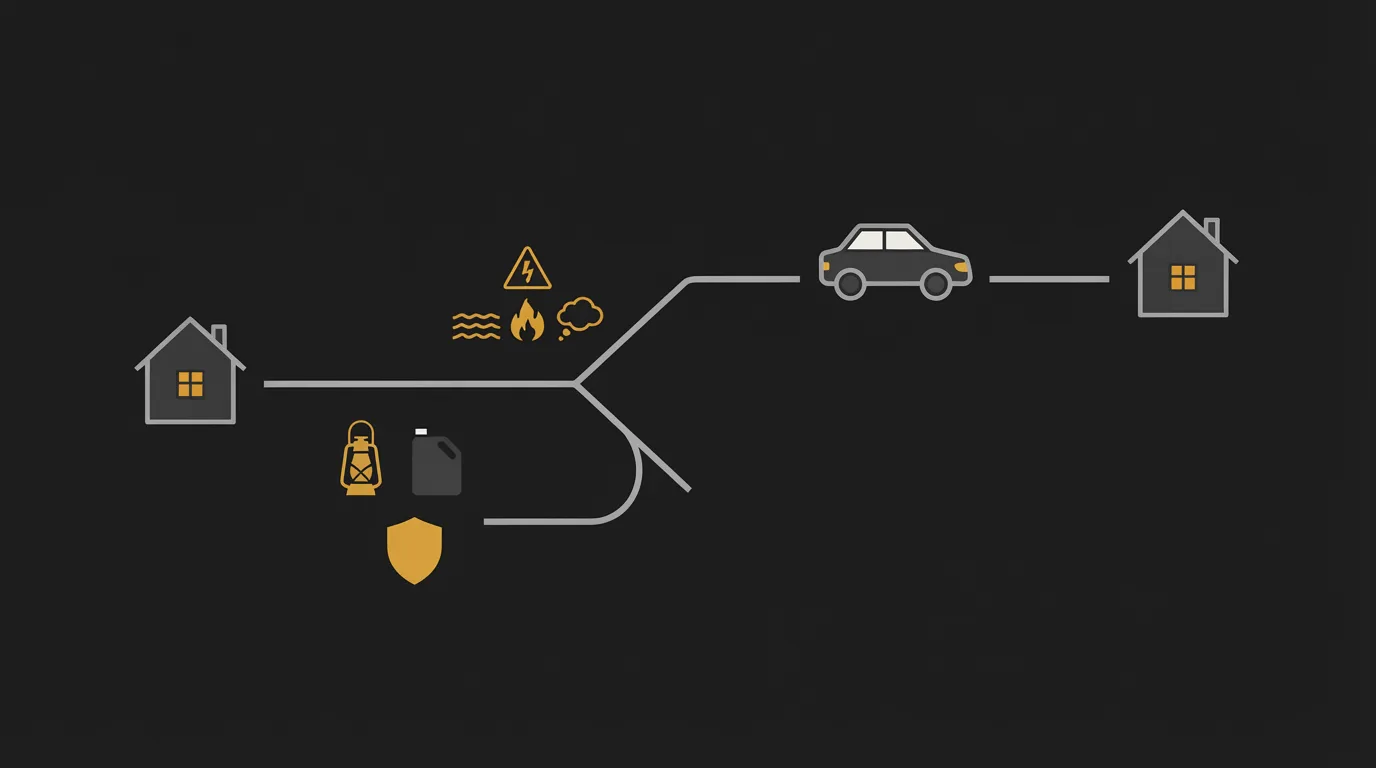
Stay home, unless rising water, fire, poisoned air or an official evacuation order makes the house itself the danger. Decide which of those you face now, write the triggers down, and when one of them trips, leave early.
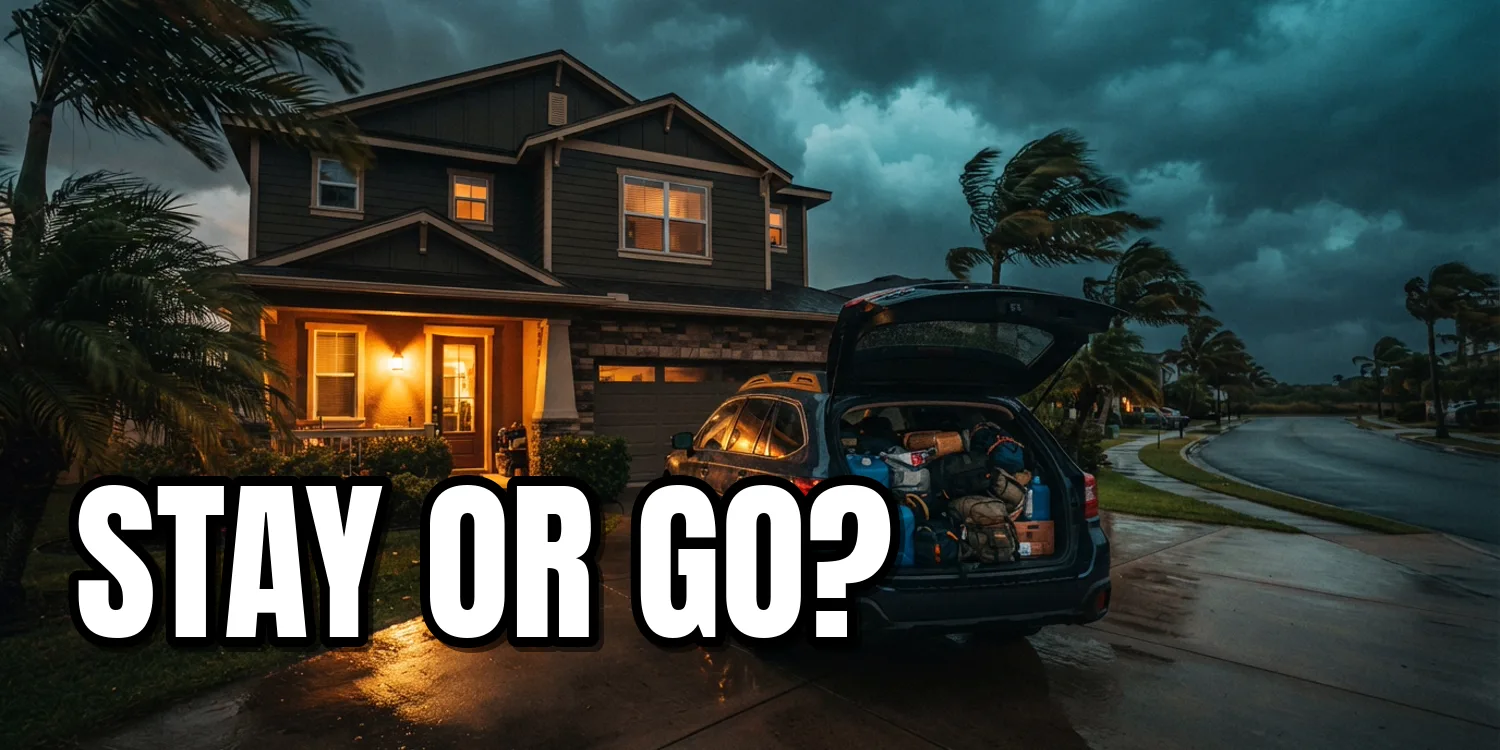
You have a stocked pantry, a few cases of water and a bag in the closet. Then the radio says a storm is turning toward you, or there is smoke on the ridge, and the question you never settled arrives with a deadline: do we stay or do we go?
Most families answer it badly because they answer it late, tired and scared, with the whole street arguing about the same thing. This guide gives you the rule, the exceptions, and the short list of decisions to make at the kitchen table this week so the real decision takes minutes.
Write your stay-or-go triggers into your family plan
Home is the default for most emergencies
Your house holds everything a bug-out bag is trying to replace: walls, a roof, beds, every gallon of water you stored, your medicine, your tools and the neighbors who know your name. A pack on your back carries a few days of a much worse version of that.
Prepper writers who have argued this for decades land in the same place. Kylene Jones of The Provident Prepper, writing for The American Civil Defense Association, puts the rule this way: leave only "when the dangers of hunkering down at home outweigh the risks of evacuating and becoming a refugee" (TACDA). The same article says most scenarios are best faced from a well-stocked home.
Official guidance agrees for a different reason. Ready.gov describes three ways of sheltering: staying at home, sheltering in place in a sealed room, and going to a mass care shelter. It warns that the last one can mean living with many people in a confined space (Ready.gov, shelter). A blackout, a winter storm, a pandemic, a run on the stores or unrest across town all fall in the first group. You ride them out where your supplies already are.
The situations where you leave
The exceptions are short and specific. Each one is a case where the house stops protecting you.
- Rising water. Storm surge, river flooding, a failing dam. Water reaches houses that wind leaves standing, and a family on the second floor with no boat has nowhere left to go.
- Fire. A wildfire front moves faster than a family can pack, and a house in its path is fuel.
- Toxic air you cannot seal out. A chemical release upwind, when officials say to evacuate. For a brief release they may tell people to shelter in a sealed room instead, so this one follows whatever the radio tells you.
- An evacuation order for your zone. Officials draw zones from data you do not have at home. If yours is called, it is your answer.
- A house that has failed. Structural damage, a gas leak, no way to keep a medically fragile person alive there.
- Violence that has reached your street. Unrest across the city is a reason to stay quiet at home. Unrest that has reached your block, with no way to defend the house, is a reason to go.
Notice what is missing from that list: the grid going down. A long blackout is miserable, and it is also the event a stocked house handles better than any car trunk. Our guide to a long-term power outage at home covers how to ride one out.
Where leaving is the bigger risk
Some threats feel like reasons to run and are reasons to stay. The clearest case is radiation. Ready.gov's instruction for any radiation emergency is to "get inside, stay inside and stay tuned," to shelter in a basement or the middle of a large building for the first 24 hours, and to leave only if fire, a gas leak or a collapse forces you out (Ready.gov, radiation emergencies). Fallout levels drop fast in that first day. A family on an open highway is exposed the whole time it sits in traffic.
Disease is similar. In a pandemic the stay-at-home guidance keeps you away from crowds, and an evacuation puts you in them: gas stations, motels, shelters.
Civil unrest and economic collapse are where most bug-out talk lives, and where it is weakest. Jones lists four questions for unrest: is there an immediate threat to your home, is it escalating, can you defend the house, and would you be safer somewhere else. If you cannot answer the last one with a real address, you have no reason to leave. Our home defense section covers the staying side of that question.
Hurricanes: go by your zone, not the category
Hurricanes are where this decision gets made most often in America, and they come with a clear rule. The National Hurricane Center says storm surge is currently the leading cause of fatalities from hurricanes, that every location on the East and Gulf coasts is vulnerable to it, and that surge can travel up rivers and canals well inland (NHC, storm surge overview). It counts 41 lives lost to surge from Hurricane Ian in 2022.
Local evacuation zones are drawn from that surge risk. They do not follow the storm's category. Besides wind speed, the NHC lists forward speed, the storm's size, its angle to the coast, the slope of the sea floor and the shape of the shoreline, and notes that a slower storm drives surge farther inland. A weaker storm can still put your street under water, so the category on the news is the wrong number to decide by.
Coastal Florida has a short saying for it: run from the water, hide from the wind. If your house sits in an ordered zone, you leave. If it sits outside every zone and was built to code, you probably ride out the wind at home, in an interior room, and let the people from the zones have the highway.
Look up your zone this week on your county emergency management website, while nothing is spinning offshore. Write the letter on the card that lives with the go-bag.
Five questions that settle it in minutes
When something is coming and you are unsure, run through these in order. The first "yes" in the leave column decides it.
- Is the threat water, fire or air? Those three are the ones a house cannot stop. Wind, cold, darkness and empty shelves are things a prepared house can stop.
- Have officials ordered my zone out? If yes, the debate is over. Officials also see the bridge closures and shelter openings you cannot.
- Can we last two weeks here with no help? Count water in gallons and medicine in days. A house with three days of supplies is a weaker shelter than a relative's house with power three counties away.
- Does anyone here depend on power or a pharmacy? Oxygen, dialysis, insulin that needs a fridge. If the plan for that person runs out before the event does, leave while leaving is easy.
- Can we still get out? If the roads are already jammed or flooded, the safer choice may now be the strongest room in the house. That is the cost of deciding late.
The real mistake is leaving late
Almost every bad evacuation story is a timing story. Jones's advice is to leave before a situation peaks, "before you are fighting traffic with thousands of other desperate people." City Prepping makes the trade plainly: an unneeded evacuation costs you a weekend and a motel bill, while waiting until the roads gridlock can trap you in the storm. Ready.gov's evacuation page says the same thing in government language: leave early enough to avoid being trapped by severe weather (Ready.gov, evacuation).
The fix is to decide your triggers before the event, so the moment is a lookup and no longer a debate. A trigger is a fact you can observe: a mandatory order for zone B, smoke visible from the house, a pre-evacuation notice, a forecast surge above a number your county publishes. The TACDA article describes a student on "pre-evacuation notice" with 20 minutes to leave once called, who had already loaded her camper and parked it away from the danger. That is what a trigger plan looks like when it works.
Write three lines on one card and tape it inside the closet door: what makes us leave, where we go, and who grabs what.
If you go: a destination, half a tank and one car
Bugging out works when it means driving to a known address with a full tank. It rarely works as hiking into the woods with a rifle and a pack.
- Several destinations, in different directions. Ready.gov suggests a friend's home in another town or a motel, picked in more than one direction so one closed road does not strand you. Jones adds tiers: outside the house, outside the neighborhood, the next town, and somewhere at least 100 miles away.
- Half a tank, always. Ready.gov's rule is to keep at least half a tank at all times and fill it when an evacuation looks likely, because stations may be closed or unable to pump without power.
- One car per family. Ready.gov asks for this to cut congestion. It also keeps your people together.
- Pets planned for. Most public shelters take only service animals, so the destination has to be one that takes your dog.
- A note and a call. Leave a note saying when you left and where you went, and tell your out-of-state contact.
- A bag for the car and a bag for your back. The car may stop. A go-bag each person can carry on foot covers the gap.
The common objection is cost: a motel for a family of four, two nights, for a storm that may turn. Set that against a flooded car on an interstate. A cheaper option is a standing arrangement with family inland, where each house agrees to take the other's people when the weather points the other way.
If you stay: make the house worth staying in
Staying is a decision too, and it only beats leaving if the house can carry you. That means water for every person for two weeks, light, a way to cook outdoors, sanitation, medicine and a carbon monoxide detector with battery backup. Our stockpiling section covers the amounts, and the outage guide linked above covers the order things fail in.
For toxic air with an order to shelter in place, Ready.gov describes sealing one interior room: close windows, vents and fireplace dampers, shut off fans and forced-air systems, and tape plastic sheeting over openings. It suggests cutting the sheeting in advance, several inches wider than each opening, and labeling every piece. Do that on a quiet afternoon. Nobody measures windows well with a siren going.
The bug-out fantasy versus the real one
Much of what is sold under the bug-out label assumes a fit, solo adult walking into a national forest. Jones is blunt that the wilderness is not a safe option for most people, and that children, older adults, pregnant women and anyone with a disability may be unable to evacuate on foot while being perfectly able to ride in a car to a stocked destination.
She also raises the risk most plans skip: you arrive and the destination is gone, taken or occupied. That is the reason for more than one address. Her other advice is to look ordinary on the road. Neutral clothes and an unremarkable vehicle draw less attention than camouflage and a rifle on display.
For most readers here, the honest bug-out plan is a drive to a relative's house. Pack for the drive, plan for the car to quit, and spend the rest of the money on the house you will be in most of the time.
What I would do this week
I'd skip the next gear purchase and start with paperwork. My pick for the first evening is a sit-down with everyone in the house to settle four things. Our evacuation zone, written down. Two destinations in two directions, with a phone call to each to make sure they would take us. The three triggers that send us out the door. And the rule that the gas tank never drops below half.
None of that costs money, and it is the part almost everyone skips while they shop for gear. With it done, the next storm warning becomes a lookup: is our zone called, is the trigger tripped, then load the car or stay put and lock down the house. That is how a family decides before it has to.
Frequently asked questions
Is it safer to bug in or bug out?
Should I leave if my area gets a hurricane evacuation order?
How far away should a bug-out location be?
Do I need a cabin in the woods to bug out?
What should I do in a nuclear or radiation emergency?

Written by
Walt Brenner
Grid-down threats, home security and family plans
Walt Brenner is the pen name of the writer who covers grid-down threats, home security and family emergency plans for Dark Grid Prep. He writes from FEMA and Ready.gov guidance, utility and government reports, manufacturer manuals and long-running prepper forums, and he says plainly where those sources disagree. His beat is the household: what a family of four in a suburb or on a rural lot should have, know and do before the lights go out.
Last checked 2026-11-08
Comments
No comments yet. Questions and your own experience are welcome.
Thank you. Your comment will appear once it has been reviewed.