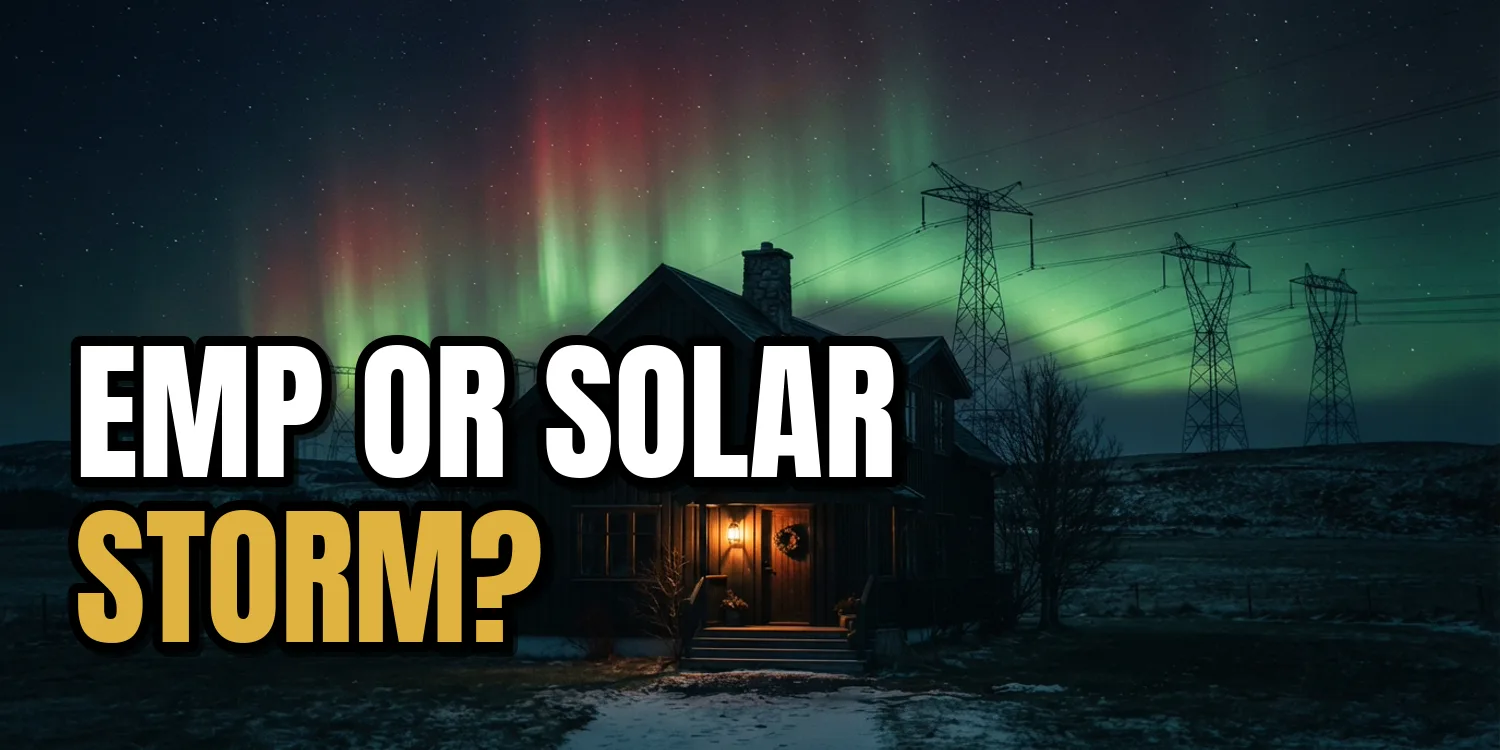
EMP vs solar storm: what each would do to your house
A solar storm wrecks grid transformers but spares an unplugged phone or car. A nuclear EMP can hit the grid and your home electronics at once. How to prepare for each.
EMP, solar storms, long blackouts, economic collapse and unrest: what each one breaks, and how fast.
A solar storm wrecks grid transformers but spares an unplugged phone or car. A nuclear EMP can hit the grid and your home electronics at once. How to prepare for each.
Other sections
 Grid-down living
 Stockpiling
 Home defense and security
 Bug-out and evacuation
 Communications
 Medical when help is delayed
 Family emergency plans
Most preparedness writing starts with the scary headline. We start with the chain of failures behind it. A high-altitude EMP, a severe solar storm, a cyberattack on a utility and an ice storm that drops transmission lines are very different events, but inside a house they arrive as the same short list: no power, then no water pressure, no fuel pumps, no card payments, no refills at the pharmacy and, after a few days, nervous neighbors.
That is why this section sorts every threat by what it takes away and for how long. A three-day outage after a storm and a months-long regional failure call for the same first steps. They differ in how deep the stockpile goes and how seriously you take security.
The federal Cybersecurity and Infrastructure Security Agency treats a high-altitude EMP as the case of most concern because it could disable large sections of the national grid at once (CISA on electromagnetic pulse). The USGS warns that strong geomagnetic storms can push currents into the grid that damage or destroy large transformers (USGS on space weather). People often treat the two as one event. Our guide to what an EMP and a solar storm would each do to your house sorts out which one can reach your electronics and your car. Neither agency publishes a household EMP checklist, so our articles say clearly which advice is official and which is reasoning from it.
Heat waves, ice storms, hurricanes, wildfire shutoffs and grid emergencies all end in the same dark house. These are the events most families will actually face.
Bank holidays, runaway prices and fuel shortages, and what a household can do with cash, a deep pantry and skills when money stops working the way it used to.
What happens to a neighborhood when services stop, how to read the warning signs early, and when staying put stops being the safe choice.
The long-tail events that close stores, schools and roads for weeks at a time.
Pick the two scenarios most likely where you live and the one that scares you most, and read those first. Then go to stockpiling and the family plan, because the same supplies and the same written plan cover nearly everything here.