Threats and scenarios
EMP vs solar storm
A severe solar storm is a grid problem: it can burn out the big transformers that feed your street, and it leaves an unplugged phone, radio or car alone. A high-altitude nuclear EMP can do the same damage to the grid and, in the same instant, reach the electronics inside your house and garage, with no warning at all.
You have read that a solar flare could "fry everything" and that an EMP would stop every car on the road. Both claims get repeated on forums as if the two events were one, and that confusion sends money to the wrong preps: Faraday cans for a threat that cannot reach the gadgets inside them, or no plan at all for the outage both events cause.
The short version for your house: both end in a long blackout, so that is what you prepare for first. Only the nuclear case adds damage to electronics you own, and only space weather gives you hours to get ready.
Plan for the months-long outage both would cause
Why the two get mixed up
The mix-up starts with a phrase. Writers and even some engineers call a big geomagnetic storm a "solar EMP," because one slow part of a nuclear pulse behaves much like it. Jerry Emanuelson, an electrical engineer who maintains one of the longest-running EMP reference pages, puts the correction plainly: at ground level, "solar EMP" is not known to produce the two fast components of a nuclear pulse, and the phrase "has caused a huge amount of confusion in the general public" (Futurescience, E1, E2 and E3).
So the two events share one mechanism and differ on the one that matters most to a homeowner. That shared mechanism attacks long power lines. The mechanism only a nuclear burst has attacks small electronics.
What a solar storm does: currents in long lines
The event preppers mean by "solar flare" is usually a coronal mass ejection, or CME. NOAA's Space Weather Prediction Center describes it as a cloud of plasma and magnetic field thrown off the sun, often alongside a flare, travelling anywhere from under 250 to nearly 3,000 kilometers per second (NOAA SWPC, coronal mass ejections). When one hits Earth's magnetic field with the right orientation, it sets off a geomagnetic storm.
That storm makes the ground itself carry slow electric currents, and anything long and metal picks them up: transmission lines, pipelines, undersea cables. The USGS describes what that did on the morning of March 13, 1989: a storm seized Québec's power system, tripped relays, damaged high-voltage transformers and left a province twice the size of Texas in the dark (USGS, preparing the nation for intense space weather).
The worst case is a grid that stays down. The same USGS article cites a National Academy of Sciences report that a rare superstorm could cause continent-wide loss of electricity, with damage persisting for months and costs above $1 trillion. Large transformers are custom-built and slow to replace, which is why the outage would run long.
Your kitchen circuits, by comparison, are short. The storm does not induce damaging current in a phone on the counter or a radio in a drawer, and Emanuelson notes there is "no known mechanism by which a solar storm would destroy an automobile," apart from cutting off its fuel supply (Futurescience, EMP effects on vehicles).
What a nuclear EMP does: three pulses
CISA, the federal agency that leads EMP planning for critical infrastructure, says an EMP can come from a high-altitude nuclear detonation, specialized conventional munitions or non-nuclear directed-energy devices. It treats the high-altitude nuclear version, HEMP, as the one of most concern because it "may damage or disable large sections of the national electric grid and other critical infrastructure control systems" (CISA, electromagnetic pulse).
A HEMP arrives as three overlapping pulses, defined by the International Electrotechnical Commission:
- E1, the fast one. It rises to its peak in about 5 nanoseconds and can reach roughly 50,000 volts per meter near the ground. It induces very high voltages in any conductor, which is how it damages computers and communications gear, and it moves too fast for ordinary lightning protectors to catch.
- E2, the middle one. It resembles lightning and on its own would be the easiest to guard against. The EMP Commission's worry is timing: it lands a fraction of a second after E1 may have knocked out the surge protection meant to stop it.
- E3, the slow one. It lasts tens to hundreds of seconds and pushes currents into long lines the same way a geomagnetic storm does, with the same threat to power transformers.
Those three descriptions come from Emanuelson's summary of the IEC definitions and the EMP Commission's 2004 executive report, linked above. E3 is the overlap with space weather. E1 is the part with no counterpart in nature.
Inside your house: your electronics
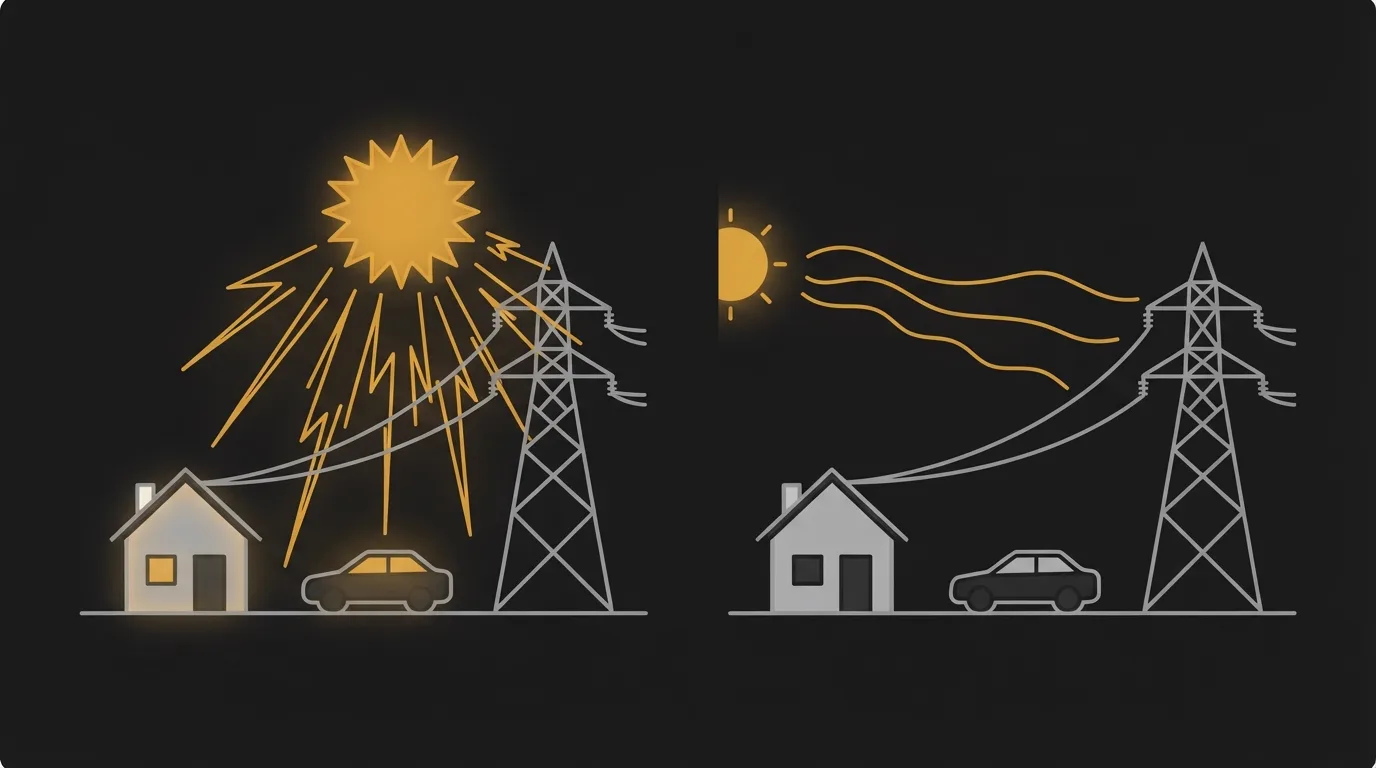
After a space weather event, the gear in your house should work the next morning. The lights are out because the grid is, and a battery radio, a flashlight, a laptop and a charged phone all still function. What fails around them is everything that needs the network: cell towers on backup power that runs dry, card readers, gas pumps, the water utility's pumps.
After a nuclear EMP, the outcome inside the house is uncertain, and honest sources say so. House wiring, cable runs and antennas act as collectors for the E1 pulse, and Emanuelson warns that wiring inside a garage "will simply act as an EMP antenna" and re-radiate the pulse indoors. Gear plugged into the wall or wired to an outside antenna is more exposed than gear sitting loose in a drawer. Which household devices would fail, and how many, nobody has tested at scale.
One more thing to know: CISA's EMP material is written for utilities and infrastructure operators. There is no official household EMP checklist, so any home advice, including this page, is reasoning from that guidance and from the engineering above.
Your car: parked is safer, and fuel is the real limit
For space weather the answer is short. A car has no long lines to collect current, so it keeps running until the tank is empty.
For a nuclear EMP, the best public data is the EMP Commission's vehicle testing, quoted at length on the Futurescience vehicles page. The Commission exposed 37 cars, model years 1986 to 2002, to simulated pulses up to the simulator's limit, close to the E1 peak described above. Cars that were switched off showed no effects afterward. Among running cars, three engines stalled at roughly 60 percent of that limit or more and needed a restart, one dashboard needed repair, and 25 showed nuisance faults such as blinking lights. Of 18 trucks, one could not be restarted and was towed.
Two caveats keep that from being a clean bill of health. The newest car tested was a 2002 model, and later cars carry far more microprocessors running at lower voltages. Second, the Commission stopped testing each vehicle at its first fault, because the vehicles were borrowed and had to go back in good shape. The fair reading is that a parked car probably starts, a moving car may stall, and highways could jam with crashes as traffic lights fail at the same moment.
Emanuelson's practical point applies to both events: whatever the car does, getting fuel afterward would be extremely hard, because pumps, payment systems and refineries all need power. If you own an older vehicle, his advice is to keep spare ignition parts and fuses for it, since it is easier to repair, though not immune.
Warning time: a day or two for one, nothing for the other
Space weather comes with a forecast. NOAA watches CMEs leave the sun with coronagraphs on the SOHO and STEREO spacecraft, and the fastest Earth-directed ones arrive in 15 to 18 hours, while slower ones take several days. When the shock front reaches the DSCOVR satellite, upstream of Earth, forecasters get a final 15 to 60 minutes of warning. That is time a household can use.
- Fill water containers and the bathtub while the pumps still run.
- Top off vehicles and generator fuel, and pull some cash.
- Charge every battery bank, radio, phone and laptop.
- Unplug sensitive electronics and disconnect outside antenna leads, which costs nothing and limits surge damage if the grid trips badly.
- Refill prescriptions due in the next month.
A HEMP would come with no forecast. It would happen during an escalating war, and the first sign at home would be the lights going out and the phone going dead together. Every prep for that case has to be in place beforehand.
How likely each one is
NOAA rates geomagnetic storms on a five-step scale. At the top, G5 "Extreme," its own description for power systems reads: "some grid systems may experience complete collapse or blackouts. Transformers may experience damage." It puts the average frequency of G5 storms at four per 11-year solar cycle (NOAA space weather scales). Note the word "may" in that wording. Utilities in North America now work under two reliability standards for geomagnetic storms, one for operating procedures and one for assessing their systems, which the USGS article describes. The USGS also counts only a few major storms per century, and a superstorm of the kind the Academy studied is rarer still.
CISA calls extreme EMP a "low probability/high consequence" scenario. Its assessment is that an adversary with basic nuclear and missile capability could cause regional disruption, while continent-wide grid damage would take an advanced arsenal used during a wider war.
Space weather is also the one that touches radio users directly. NOAA notes that at G5, HF radio "may be impossible in many areas for one to two days" and satellite navigation can be degraded for days. If your family plan leans on ham radio, plan for local VHF and UHF contact during that window. Our guide to FRS, GMRS and ham radio covers which local service fits a family.
The prep they share: a long, local outage
Line the two scenarios up and the overlap is large. Both remove grid power over a wide area for longer than a normal storm outage, both shut down fuel and card payments, and both leave you waiting on repairs measured in weeks or months. A household that can run without the grid for a month is ready for most of either event.
That work is ordinary. Ready.gov's power outage guidance covers the basics: food safety once the fridge warms, running generators and camp stoves only outdoors and at least 20 feet from doors and windows, and a battery-backed carbon monoxide detector on every level (Ready.gov, power outages). Water storage, a deep pantry and enough prescription medicine to cover the gap matter more than any EMP-specific gear. The stockpiling section works through the amounts.
The prep only EMP needs: shielded spares
Protecting electronics from E1 means storing spares inside a closed conductive box, a Faraday container. Unplugging alone does not help much against a pulse that couples into any conductor, including a device's own circuit traces.
Preppers most often use a galvanized trash can, and its limits are worth knowing. Ken Jorgustin of Modern Survival Blog notes that a metal can with its lid on gives about 20 dB of attenuation, which "is not very good by itself," and that sealing the lid seam with conductive tape lifts it to around 40 dB. He adds that the container does not need to be grounded (Modern Survival Blog, what is in your Faraday cage). The fair objection is cost: whatever sits in the can is idle until the day it is needed, which may never come. Keep it to cheap, useful items.
- A handheld two-way radio and a small AM/FM/weather receiver.
- An old phone or tablet loaded with offline maps, manuals and your family documents.
- LED flashlights and a small solar charger for AA cells.
- For an older vehicle, the ignition parts and fuses that would get it running again.
None of that helps against a solar storm, which spares the same items sitting on a shelf.
What I would do with the next weekend and the next $100
I'd start with the outage, because it is the part of both scenarios I can be sure of. Water for two weeks, a pantry that does not need a fridge, a month of prescriptions and a safe way to cook and stay warm cover the solar case almost completely and carry most of the nuclear one.
Then I'd set up a free alert from NOAA's Space Weather Prediction Center and write the checklist above on a card, so a G4 or G5 watch turns into an hour of chores instead of a panic. Only after that would I buy a metal can and a roll of conductive tape, and put one radio, one old phone and a flashlight in it. That last step is cheap insurance against the rarer threat, and it is the only one of the three that is about EMP at all.
Frequently asked questions
Can a solar flare fry my phone or laptop?
Would my car still start after an EMP?
Do I need a Faraday cage for a solar storm?
How much warning would we get?
Which one is more likely?

Written by
Walt Brenner
Grid-down threats, home security and family plans
Walt Brenner is the pen name of the writer who covers grid-down threats, home security and family emergency plans for Dark Grid Prep. He writes from FEMA and Ready.gov guidance, utility and government reports, manufacturer manuals and long-running prepper forums, and he says plainly where those sources disagree. His beat is the household: what a family of four in a suburb or on a rural lot should have, know and do before the lights go out.
Last checked 2026-11-09
Comments
No comments yet. Questions and your own experience are welcome.
Thank you. Your comment will appear once it has been reviewed.