Communications
FRS vs GMRS vs ham radio
For most families the answer is GMRS: one inexpensive FCC license with no exam covers you and your relatives for ten years, and it lets you use stronger radios, better antennas and repeaters. Add ham radio later if someone in the house wants to talk beyond the county, and keep cheap FRS handhelds for short hops around the yard.
You want a way to reach your spouse at work and your kids at school when the cell network fails, and the radio aisle hands you three acronyms, two kinds of license and range claims of 30 miles or more. Most of the confusion comes from the fact that the cheap blister-pack radios, the ones labeled "FRS/GMRS," sit right at the line between the license-free service and the licensed one.
Here is how each service works, what it costs to use legally, how far it really reaches, and which one fits the household you actually have.
Write your radio channels into the family plan
Which service fits your household
- Everyone stays within a mile or so (one house, a neighbor, a campsite): FRS handhelds are enough, and nobody needs a license.
- Family spread across a town or a commute: GMRS, with a mobile radio in the car or a base radio at home, and a local repeater if one exists.
- You want news and contacts from outside the disaster area, or to join organized emergency nets: one person in the house gets a ham license.
The three are not rivals so much as layers. A typical household that takes comms seriously ends up with GMRS as its family network and one ham operator listening farther out.
FRS: no license, about a mile
The Family Radio Service is the walkie-talkie you buy at a sporting goods store. Anyone can use it, at any age, with no paperwork. Since the FCC's 2017 rewrite of its personal radio rules, FRS radios may run up to 2 watts on channels 1 to 7 and 15 to 22, and half a watt on channels 8 to 14 (summary of the Part 95 reform). The antenna is built into the radio and cannot be swapped for a better one.
That combination caps the range. A preparedness guide from Entropy Survival puts realistic FRS range at about 1 to 2 miles in favorable conditions, "and often much less in buildings, forests, or hilly terrain" (Entropy Survival, GMRS license guide). The 30-mile number on the package assumes two people on mountaintops with a clear line between them.
Where FRS earns its place: kids in the backyard, someone walking to a neighbor's house, two cars in a convoy that stay close, and a spare pair for a grandparent who will never apply for anything. A pair costs little and runs on AA cells in many models, which matters when charging is hard.
GMRS: one license covers the family
The General Mobile Radio Service uses many of the same channels at higher power. The license is the part people overestimate. There is no exam. You create an FCC registration number, file the application in the FCC's licensing system and pay the fee, which the Entropy guide lists as $35 for a ten-year license. Anyone 18 or older may apply.
One license covers more people than most buyers expect. Relatives of the licensee may operate under the same call sign, and the list runs well past spouse and children: parents, siblings, grandparents, grandchildren, aunts, uncles, nieces, nephews and in-laws. For a household with three drivers and two teenagers, that is a single filing.
What the license buys you:
- Up to 50 watts on the main channels, so a mobile radio in a truck or a base station at home can reach much farther than any handheld.
- Radios with removable antennas, which means a roof or mast antenna for the house and a magnetic-mount antenna for the car.
- Repeater channels. GMRS repeaters are radios on towers or hills, often run by local clubs, that receive your signal and rebroadcast it at height.
Entropy's guide gives rough ranges of 1 to 5 miles for handhelds, 5 to 15 miles for mobile radios and 25 miles or more through a repeater. Treat those as planning numbers from one retailer, since terrain changes everything.
The usual objection is that licensing puts your name in a public database. It does: FCC licenses are searchable by call sign. If that bothers you, weigh it against what you get, which is legal use of the radios that actually reach across town.
Ham radio: an exam buys the most reach
Amateur radio is a different kind of service. Every operator holds an individual license, there is no family umbrella, and you earn it by passing a test. The entry license, Technician, takes one exam of 35 questions on rules, operating practice and basic electronics (ARRL, getting licensed). The ARRL publishes every question that can appear, and exams are given in person and online by volunteer examiners. Licenses run ten years, and anyone may hold one regardless of age, apart from representatives of foreign governments.
A Technician gets every amateur frequency above 30 MHz plus slices of the shortwave bands (ARRL, Technician license). In practice that means the 2-meter and 70-centimeter bands for local and regional talk, often through club repeaters. Upgrading to General opens shortwave voice across the continent and beyond.
Why preppers bother with the exam:
- Ham repeaters are run by amateur clubs and emergency management groups and are generally free to use for any licensed amateur (Off Grid Web, grid-down comms).
- Shortwave can carry news from hundreds of miles away when every local source is down.
- The ARRL's Amateur Radio Emergency Service organizes volunteers who support served agencies in disasters, so a licensed operator has somewhere to plug in.
The cost is time. Someone has to study, take the exam and then practice enough to operate a radio with dozens of settings under stress. If nobody in your house will do that, a ham radio in a closet is a paperweight.
Why the box range is wrong
Signals on these bands travel roughly in a straight line. Two people standing on flat ground can see each other only a few miles before the curve of the earth, houses and trees get in the way, and the radio waves stop at about the same point. Power helps less than buyers think. Height helps most.
That is why the three services differ so much in practice. An FRS handheld is a small antenna held at shoulder height. A GMRS base station can put its antenna on a roof, and a GMRS or ham repeater puts one on a tower or ridge, where it can see a whole valley. Once your signal reaches the repeater, the repeater does the long-distance work.
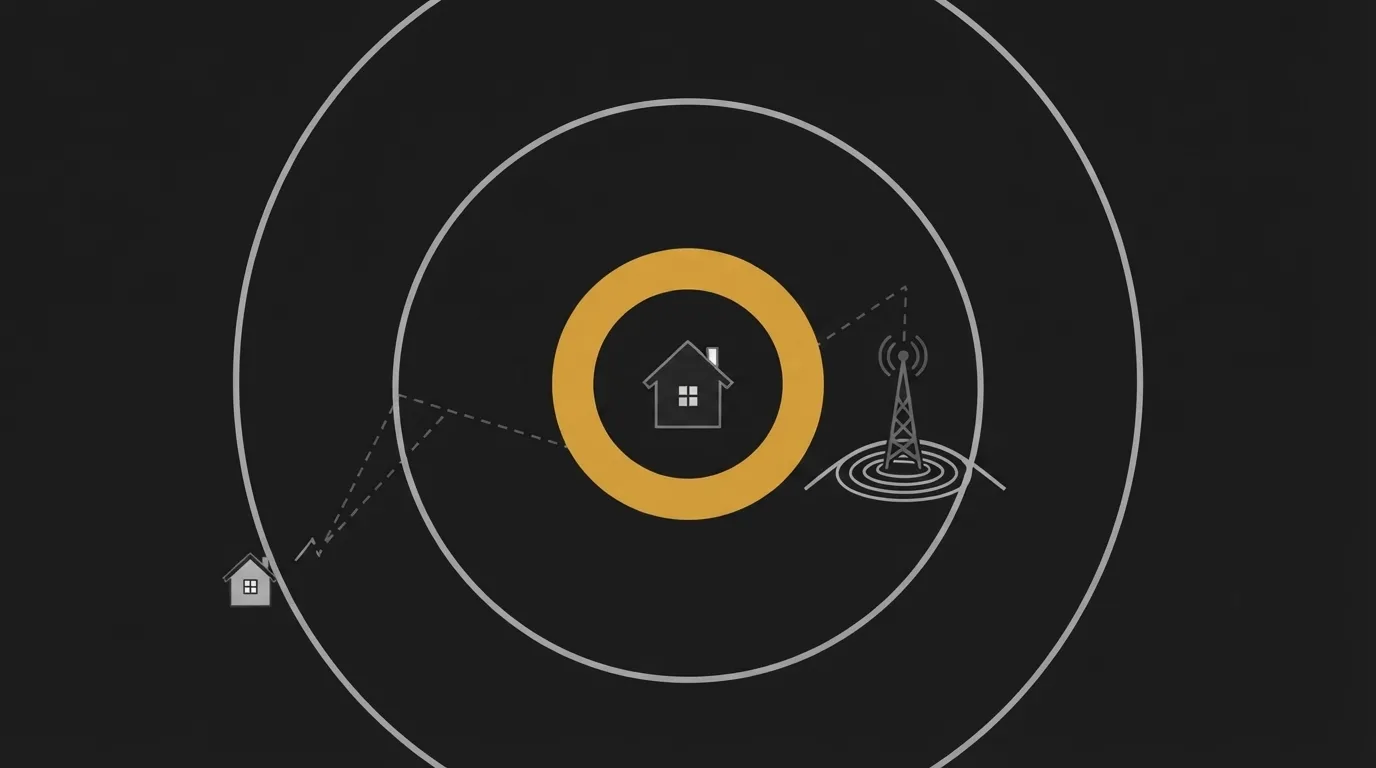
Before you buy anything, try this test with borrowed or cheap radios: one person drives the route between home and school or work, calling every half mile, and you note where the signal drops. That map tells you which service you need better than any spec sheet.
Repeaters when the grid is down
A repeater only helps while it has power. Some run on batteries and solar, others on a utility feed with a few hours of backup, and the owner may not say which. In a short storm outage most keep working. In a long one, you should assume some go silent.
So every plan needs a simplex channel, meaning radio to radio with no repeater in between, written down alongside the repeater. Your family should know: try the repeater first, and if there is no answer, switch to the simplex channel at the set check-in time. The same logic applies to ham operators, with one more wrinkle. NOAA warns that during an extreme geomagnetic storm, shortwave radio "may be impossible in many areas for one to two days," which is covered on our EMP vs solar storm page. Local VHF and UHF keep working through that.
The cheap-radio licensing trap
The radio most often sold to preppers is a low-cost Chinese dual-band handheld, the Baofeng UV-5R being the best known. It is an amateur radio, and a licensed ham may use it on the ham bands. In 2018 the FCC issued an enforcement advisory against marketing radios that can transmit outside licensed bands. The ham writer KB6NU explains that the advisory did not outlaw the hardware for licensed hams (KB6NU, did the FCC make Baofengs illegal). It is not certified for FRS or GMRS, so programming it onto those channels is not legal even with a GMRS license.
The other trap is the emergency rule. Forums often cite 47 CFR 97.403, which lets an amateur station use any means of radio communication when there is an immediate threat to life or property and normal communication is impossible (text of 97.403). Some read that as permission to buy a radio now and skip the license until the day it matters. The rule is written about amateur stations, and the practical problem is worse than the legal one: a person who has never keyed a radio, picked a repeater offset or found the right channel will not learn under stress.
Kids, older relatives and who carries what
Match the radio to the person. A young child does best with an FRS handheld set to one channel, with the channel knob taped, and a single rule: press, talk, let go. Teenagers can carry a GMRS handheld under a parent's license. An older relative who will not learn new gear might get a simple FRS radio and the job of listening at home.
The licensed operators, if any, take the radios with settings: the car mobile, the base station, the ham handheld. Write the channel plan on a card for every bag and every car, with the primary channel, the backup, the repeater if you have one and the check-in times. That card is the part of comms that fails most often, because people buy radios and never agree on how to use them.
The order I would buy in
I would get the GMRS license first, because it is cheap, takes no studying, and turns every radio in the house into something you can use legally at full strength. Then I would buy one mobile or base radio with a proper outdoor antenna, plus GMRS handhelds for each adult, and run the drive test above to find the weak spots.
FRS handhelds come next, as cheap spares and for the kids. Ham radio comes last and only if one person in the household is willing to study for it, because the license is the easy part and the practice is the real commitment. For a family whose members spend their days within one town, GMRS does the job. For a family that wants to hear what is happening in the next state, it is worth the exam.
Frequently asked questions
Can my 12-year-old use our GMRS radios?
Is a Baofeng legal without a license?
Do FRS and GMRS radios talk to each other?
How long does the ham exam take to study for?
Will these radios work after an EMP?

Written by
Walt Brenner
Grid-down threats, home security and family plans
Walt Brenner is the pen name of the writer who covers grid-down threats, home security and family emergency plans for Dark Grid Prep. He writes from FEMA and Ready.gov guidance, utility and government reports, manufacturer manuals and long-running prepper forums, and he says plainly where those sources disagree. His beat is the household: what a family of four in a suburb or on a rural lot should have, know and do before the lights go out.
Last checked 2026-11-09
Comments
No comments yet. Questions and your own experience are welcome.
Thank you. Your comment will appear once it has been reviewed.