Medical when help is delayed
Dental emergency when the dentist is closed
A closed dental office means the hospital for a serious infection or a jaw injury, and the dentist as soon as the practice can see you for the rest. At home, keep a knocked-out permanent tooth moist, rinse a toothache, and take a pain reliever from the bottle you already have.
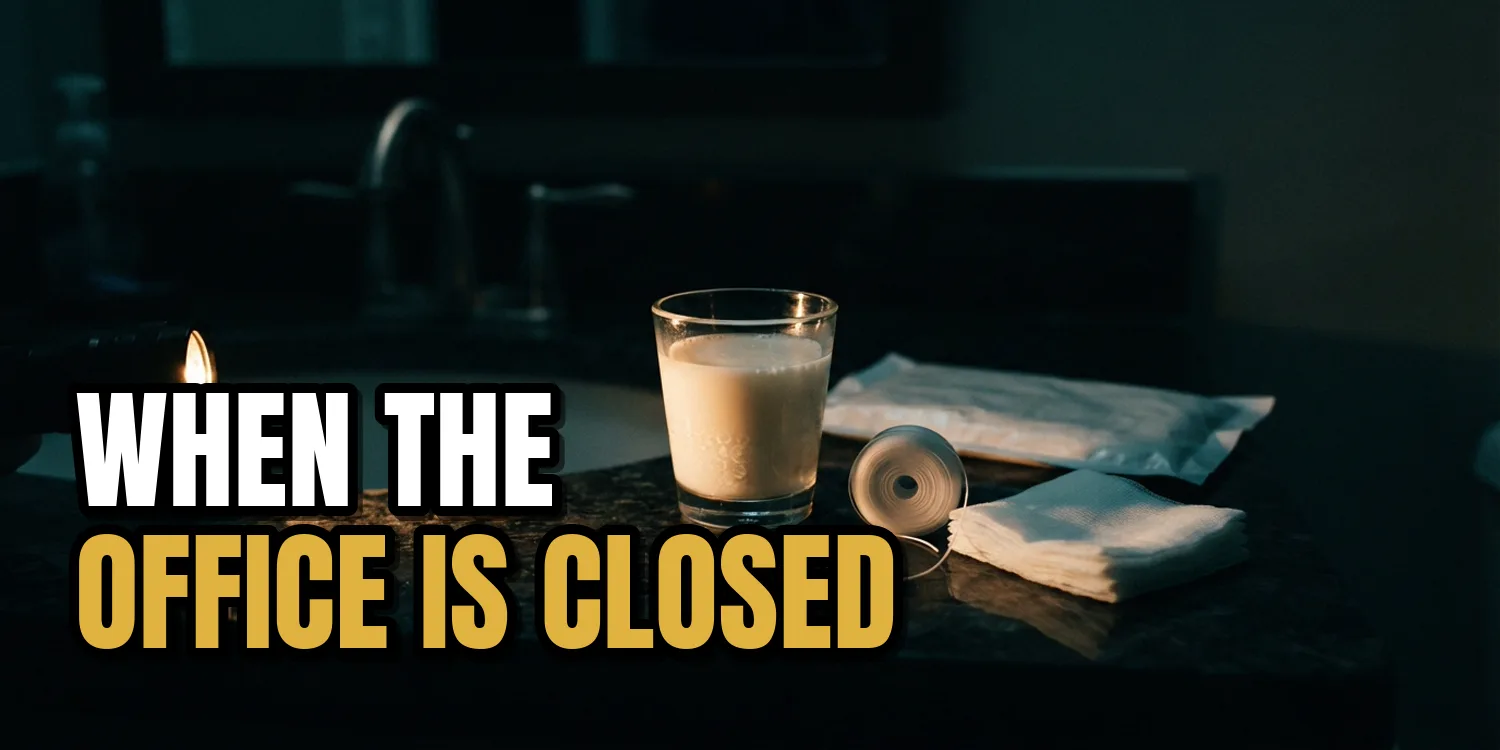
Saturday night, and the only voice at the dental office is the answering machine. Three days into a blackout, that phone may not ring at all, and the driveway may be the long part of the trip. The split between waiting for the office and leaving for a hospital does not move with the lights. What you lose when the grid is down is the chance to ask someone first.
What counts as a dental emergency after hours
The American Dental Association's MouthHealthy page on dental emergencies puts the first instruction in one place. See your dentist as soon as you can. If the accident happens when that office is not open, visit your local emergency room. A working phone still earns a call to the practice before you get in the car, because someone on call can sometimes see you before morning. The hospital is the door that page names when the practice cannot see you.
A holiday weekend and a dark week share that split. On the weekend you can still dial. In a wide outage the cell site may be quiet, and a rural road can make the hospital a long drive. Write the route on an ordinary afternoon, next to the other medical numbers in your family emergency plan. The signs that send you, and the one kind of damage that can wait, stay the same on both nights.
MedlinePlus, on a broken or knocked-out tooth, draws the wait line for a single case. A simple chip, or a broken tooth that is not causing discomfort, may not need an emergency visit. It should still be repaired. A sharp edge drags across the tongue every time you eat. If there is pain, fever, swelling, or a bite that no longer closes, do not wait for a regular appointment. Those signs should send you out the door, and waiting for Monday does not settle them.
Toothache relief at home
Start with the two moves that same Association page gives for an aching tooth. Rinse with warm water, then floss gently, in case a husk or a strand of meat is wedged at the gum. Food packed into a tight contact can hurt enough to send you looking for a drill, and the floss is the check before that conclusion.
If the rinse and the floss leave the pain where it was, and you cannot reach a dentist or a primary care clinician, MedlinePlus on toothache says you can use an over-the-counter pain medicine. Swallow it, and follow the label on the bottle already in the house.
Keep the tablet off the gum. MouthHealthy says aspirin placed on the aching tooth or the gums may burn the gum tissue. MedlinePlus on tooth abscesses says the same placement increases irritation and can cause mouth ulcers. The medicine belongs in the stomach, or it stays in the cabinet.
Seek care for a severe toothache, for pain that lasts longer than a day or two, for fever, for an earache, or for pain when you open your mouth wide. A sore evening after biting a pit can sit inside a short wait. Pain that is still climbing on the second morning is past it.
Look at the gum while you wait, because an ache can be an abscess. The signs MedlinePlus lists are continuous severe pain, fever, gum swelling that may look like a pimple, a swollen jaw, and swollen glands in the neck. A swollen area of the upper or lower jaw is the one that page calls a very serious symptom. Untreated abscesses may get worse and can lead to life-threatening complications, including infection that spreads past the tooth. Warm water and a swallowed tablet cover the hours until a clinician sees you. The infection itself needs that clinician.
If swelling and fever make it hard to drink, fluid loss becomes its own problem during a hot week without power. The signs, and when oral fluids are enough, are on the page about dehydration and oral rehydration.
Knocked-out tooth: what to do
Look at which tooth is in your hand before you try to put it back. MedlinePlus says that in most cases only permanent teeth are replanted, and baby teeth are not replanted. A child's first tooth stays out of the socket. Get that child to a dentist, or to the hospital if the office is closed.
A permanent tooth is on a short clock. Nemours KidsHealth says permanent teeth are most likely to be saved when they are put back in the socket within 15 minutes. Find the tooth and hold it only by the crown, the chewing edge, so your fingers stay off the root.
If you can, seat the tooth back in the socket without touching the root. MouthHealthy gives that as the first try, and it says to keep the tooth moist the whole time. If it will not go back in, store it. MedlinePlus says to place it in a container and cover it with a small amount of cow's milk or saliva. You can also hold it under the tongue, or between the lip and the gum. The Association describes the same choices as the cheek, milk, or a tooth preservation product that carries the ADA Seal.
KidsHealth says not to store the tooth in tap water. MedlinePlus says not to brush the tooth, not to clean it with alcohol or peroxide, and not to let it dry out. That page also says not to scrape the root. The root is the surface the socket has to accept. A dry minute, or a scrub in the sink, works against the only reason you are carrying the tooth at all.
Then go. The American Academy of Family Physicians says to see a dentist or go to the emergency room right away, and to keep the tooth moist on the way. A hospital is the place for a serious infection and a jaw injury, and the staff can arrange a dentist afterward. Hospitals differ on whether they put the tooth back themselves, so the moist tooth and the fastest dental hands you can reach are the plan.
Blood from the socket that will not slow is a bleeding problem as well as a dental one. Our stop the bleed basics page walks through direct pressure, and what to do when pressure on the wound is not enough. A mouth that keeps pouring is a reason to head for the hospital even while you are still hoping a dentist will pick up.
A cracked, broken, or chipped tooth
A crack gets warm water and cold on the face. MouthHealthy says to rinse the mouth with warm water right away, to clean the area, then to put cold compresses on the face so the swelling stays down, and to see a dentist as soon as you can. That is the sequence. The cold is on the cheek and the jaw, outside the mouth.
A chip that does not hurt can wait for a booked visit. MedlinePlus says you may not need an emergency visit for a simple chip, or for a broken tooth that is not causing discomfort. Make the appointment anyway. The reason given there is the sharp edge, which keeps cutting the cheek until someone smooths it.
The night changes when the teeth stop meeting. If you cannot close the upper and lower teeth together, MedlinePlus says the jaw may be broken, and that needs medical help right away at a dentist's office or a hospital. Cold on the face still limits the swelling while you arrange the ride.
A fall, a ball, a steering wheel. The same face can carry a small chip and a jaw injury together. Check whether the teeth meet before you decide the evening is only a chip. If they meet and nothing hurts, the chip can wait for office hours. If they do not meet, you are past the chip and into the ride.
A lost filling, a lost crown, and a temporary filling
A temporary filling is the material a dentist places to close a tooth for a short time. A temporary crown is the cap that sits on the prepared tooth while the permanent crown is made. After that crown work, MedlinePlus on dental crowns says to contact the dentist if you lose the temporary crown, if swelling gets worse, if the bite feels wrong, or if tooth pain is not relieved by a swallowed pain medicine.
A filling that drops out on a Saturday is the errand a lot of households are actually facing. The list I can cite is written for the temporary crown. I would still call about a lost filling, and I would use three of those signs to decide whether the call can wait for morning: pain a swallowed medicine does not ease, swelling that is increasing, and a bite that feels wrong. If the tooth is only tender, I would call when the office opens and leave the hole until that visit.
If the practice is closed and one of those three signs is already there, use the hospital door the Association names for a dental emergency after hours. I would keep a lost crown to show the dentist, and I would leave it off the tooth until that visit.
A dental first aid kit for the first aid box
Two additions come straight off the Association's emergency page. Floss belongs in a first aid kit, in case something is caught between teeth. A tooth preservation product that carries the ADA Seal is a useful thing to have if a tooth is lost when you did not expect it. The Seal is the mark that page tells you to look for.
Both items go in the household first aid box, the middle layer of the home trauma kit checklist. The bleeding pouch by the door stays the small kit you grab for a severe bleed. Floss and a preservation product live with the bandages, where you will actually find them while you are holding a tooth.
Cow's milk is one of the liquids named for that tooth, a small amount in a container. A shelf-stable carton in the same box means you still have milk when the refrigerator has warmed up, and you only need the small amount that covers the tooth. The instant cold compress already on the Red Cross list for that box is what goes on the face for a crack or a jaw you think is broken. Gloves, gauze, and a notebook already sit in the kit and in the resupply bin. The notebook is where the time, and what you did, gets written for the person who takes over.
The pain reliever is the bottle the household already uses, stored with the other medicines. A reserve of prescriptions is a different job, with its own rules, and it is covered in the emergency medication stockpile. The dental box holds the floss, the milk, the Seal product if you buy one, and the cold pack you meant to replace last winter.
When to go to the emergency room
Three pictures should end the time at the bathroom sink.
The jaw. If you think it is broken, put cold compresses on the face to control the swelling, then go to a dentist or a hospital emergency department immediately. That pairing is MouthHealthy. Teeth that will not close together are the MedlinePlus sign that the jaw may be broken. Another hour of checking the bite from the couch does not change the sign.
The abscess picture is the one already listed: continuous severe pain, fever, a gum swelling that can look like a pimple, a swollen jaw, swollen glands in the neck. The swollen jaw is the symptom marked very serious, and an abscess left alone can spread. That is the limit on everything in the cabinet. The kit can hold a tooth and take the edge off pain. A clinician has to see the abscess.
Bleeding that keeps coming. Heavy bleeding from the mouth uses the same first actions as any severe bleed, and the hospital is the destination when a dentist is not available to take it.
The Association's line still covers the night the office is shut, and that trip is to the hospital. The painless chip can wait for a booked visit. Fever, swelling moving through the face, and a jaw that will not close are the drive.
Pick the hospital, and the road to it, on a week when the phones work. The trauma kit page already treats that route as part of being ready, because the supplies only buy the time to arrive. In a blackout the drive may be slower, while fever, a swollen jaw, or a bite that no longer closes still sends you to the hospital.
My take
I would use a calm month to take care of the tooth that already hurts. A cleaning, a filling that has been waiting, a permanent crown that was supposed to replace a temporary one. The box is for the night that plan fails: floss, a sealed carton of milk, a preservation product with the ADA Seal, and the cold pack that should already be in the first aid box. I would write the dental office number and the hospital route on the same card as the other medical numbers, and I would put that card where the floss is.
The limit I would keep in view is infection. An abscess is beyond anything on that shelf. A swollen jaw or a fever means a clinician the same night, including when the drive is inconvenient and the grid is down. You handle the first hour, then a dentist or a hospital takes over. More of that planning sits in the medical section.
Sources
Frequently asked questions
Can an emergency room put a knocked-out tooth back?
Can I carry the tooth in milk?
Does aspirin on the gum help a toothache?
What should I add for teeth?

Written by
Walt Brenner
Grid-down threats, home security and family plans
Walt Brenner is the pen name of the writer who covers grid-down threats, home security and family emergency plans for Dark Grid Prep. He draws on FEMA and Ready.gov guidance, utility and government reports, manufacturer manuals and long-running prepper forums, and he says plainly where those sources disagree. His beat is the household: what a family of four in a suburb or on a rural lot should have, know and do before the lights go out.
Last checked 2026-11-26
Comments
No comments yet. Questions and your own experience are welcome.
Thank you. Your comment will appear once it has been reviewed.