Family emergency plan
How to write a family emergency plan
A family emergency plan that survives a phone outage is a single written page that answers, before anything happens, what each person does, where everyone goes and who decides, so nobody has to call anyone to find out. Write it around the two or three threats most likely where you live, give every person a wallet card, and practice it twice a year.
Most family plans quietly assume a working phone. Mom will text the kids, Dad will call the school, everyone will check the group chat. That assumption fails in exactly the disasters a plan is written for. Two days after Hurricane Maria, the FCC reported that 95.2 percent of the cell sites in Puerto Rico were out of service, and relatives on the mainland spent days dialing numbers that never rang (NPR via Connecticut Public). Some of the messages that did get through went by radio station.
Ready.gov opens its planning page with the same warning: "Your family may not be together if a disaster strikes," so you need to know how you will reconnect if separated (Ready.gov, make a plan). This guide is how to write that plan so each person can act on it alone, with a dead phone, from wherever they happen to be.
Start with the emergencies you are most likely to face
A plan for everything is a plan for nothing in particular. The Red Cross asks families to work through the emergencies most likely where they live, and to sort them into two kinds: the ones you ride out at home, such as a winter storm, and the ones that send you out the door, such as a hurricane (American Red Cross, make a plan). Ready.gov points to FEMA's National Risk Index for a county-level look at which natural hazards rate highest where you are.
For most American households the short list is a long power outage, a severe storm of whatever kind the region gets, a house fire and one regional threat: wildfire in the West, flooding along rivers and coasts, tornadoes across the middle of the country. Add whatever this site's readers tend to worry about on top of that. Our threats section covers grid failure, EMP and civil unrest, but the plan for those turns out to look very much like the plan for a two-week blackout, which is good news. One well-written plan covers most of them.
Next to each threat, write one line: stay or go, and what would change that. For a winter storm the line might say to stay home and leave only if the house drops below 45°F while the roads are still open. For wildfire it might say to go on the first evacuation warning without waiting for the order. Settling the trigger at the kitchen table saves an argument on the day. Our guide to bugging in or bugging out walks through how to set those triggers.
Decide who does what in the first hour
The Red Cross puts it simply: identify responsibilities for each member of the household and how you will work together. In practice the first hour of an emergency is a handful of jobs, and each one needs a name beside it, plus a backup name for when that person is at work or out of town.
- Collecting the children from school or daycare, and who is allowed to sign them out.
- Checking on a parent or neighbor who lives alone.
- Shutting off gas, water or power if the situation calls for it.
- Grabbing the medicine, the documents pouch and the go-bags.
- Loading the pets and their food.
- Listening to the radio and deciding, against the sheet, whether to stay or leave.
The last job matters most. Somebody has the final word, and the plan says who. In a family of two adults that is usually whoever is home. If both are home, pick one in advance, so the hour is not spent debating.
Write default rules for when nobody can call
This is the part most plans leave out, and it is the reason a plan works without phones. A default rule tells each person what to do when they cannot reach anyone, so silence becomes an instruction instead of a reason to panic. Good defaults are short and impossible to misread:
- If the power goes out and you are at work, come home before dark unless the roads are closed.
- If you cannot reach anyone within two hours, go to the neighborhood meeting place and wait there until the time on your card.
- Kids stay at school until a named adult arrives. Nobody else picks them up.
- If the house is empty when you arrive, look for the note in the kitchen drawer before going anywhere.
That note is worth its own line in the plan. Ready.gov's evacuation advice includes leaving "a note telling others when you left and where you are going" (Ready.gov, evacuation). Agree on where it goes, inside the house where your own people will look and a passerby will not, and keep a pencil and pad there.
Pick one out-of-area contact as well, a relative in another state who collects check-ins and passes them on. The Red Cross notes that long-distance calls and texts can get through when local lines are overloaded. The details of that layer, the message format and the radio channels, are in our family communication plan, and the master plan simply points to it.
Set meeting places in three rings
The Red Cross asks for two meeting places: one right outside the home for a sudden emergency such as a fire, and one outside the neighborhood in case you cannot get home. I'd add a third, out of town, because the emergencies this site plans for often close whole neighborhoods.
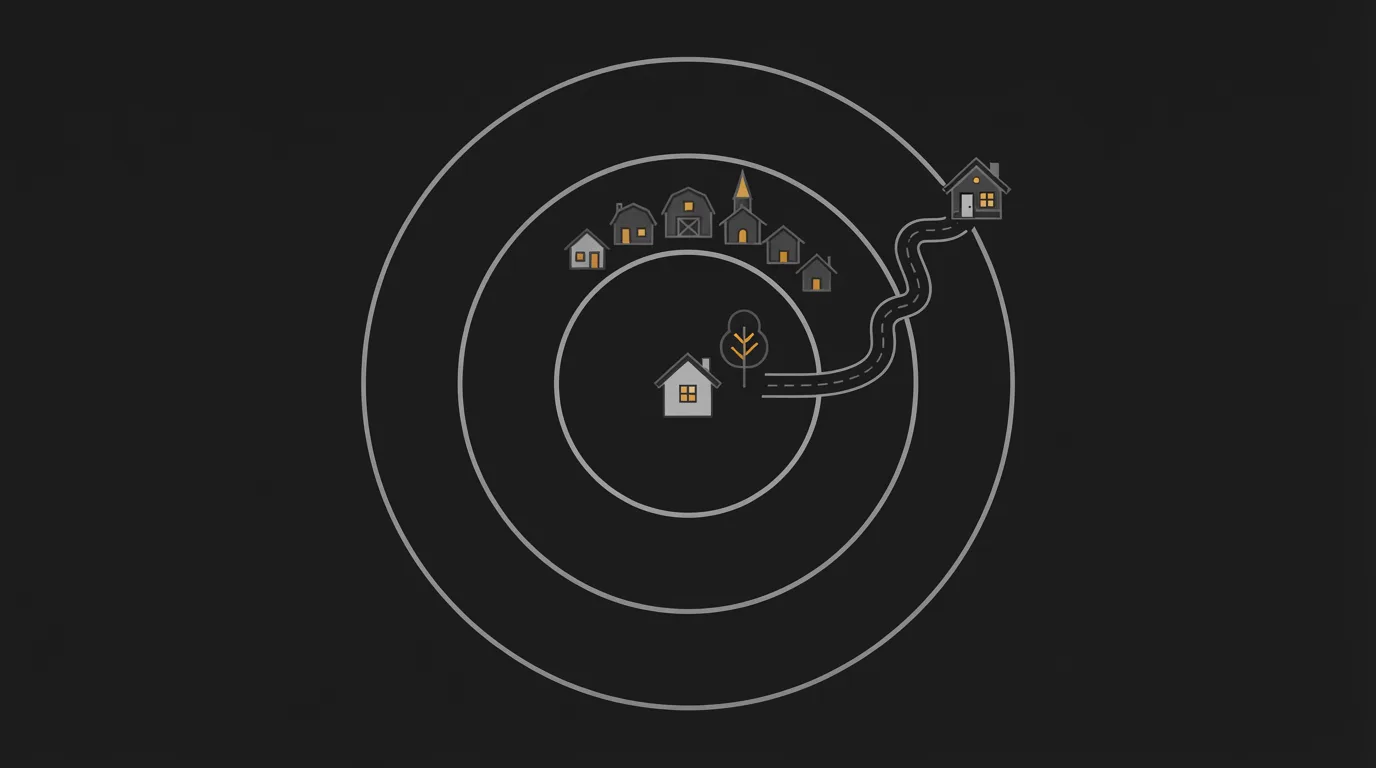
The first ring is a fixed object a child can find in the dark: the mailbox, a particular tree, the neighbor's driveway. The second is a place everyone already knows, open to the public and reachable on foot from school and work, like a library, a church parking lot or a relative's house across town. The third is a home you could actually stay in, a friend or relative an hour or two away. Ready.gov suggests picking destinations in different directions, so a fire or flood that closes one road does not close every option.
For each place, write the address, the route on foot and by car, and how long to wait before moving on to the next ring. A meeting place with no time attached tends to turn into a family member waiting there all night.
Plan for whoever is away from home
The plan has to work at 2 p.m. on a Tuesday, when the household is spread across a school, two workplaces and a commute. Call the school and daycare and read their own emergency plans: where they move children, how they release them and which adults are on file. The Red Cross reminds families to make sure those places hold the contact numbers too.
Think about the people who are part of the household but not in it: a student away at college, a family member deployed with the military, a spouse who travels for work. The Red Cross suggests deciding how the plan changes when they are home and what they do when they are not. A college student usually needs one instruction more than any other: stay put, follow the campus plan and check in with your relay person when a line opens.
The adult with the longest commute needs a way home on foot. Our get-home bag checklist covers what goes in the car or under the desk, and the route belongs on the paper map in that bag.
Write down the needs that are easy to forget
Ready.gov's list of household needs to plan around is a good prompt: different ages, dietary needs, medical needs including prescriptions and equipment, disabilities, languages spoken, pets or service animals, and school-aged children. Go down it and write a line for each that applies.
Medicine is the one that turns an inconvenience into an emergency. List every prescription, the dose, the pharmacy and the prescribing doctor on the back of the master sheet. Our guide to an emergency medication supply covers how to build a reserve, and anyone on a powered device such as an oxygen concentrator needs a written line on how long its battery lasts and where to take them if it runs down.
Pets need a destination. Ready.gov notes that most public shelters accept only service animals, so the out-of-town ring should be a place that will take the dog, or the plan should name a pet-friendly motel along the route. If a parent lives alone, their part of the plan has enough moving parts to deserve its own page, and our plan for aging parents who live alone covers the check-in schedule and the point at which someone goes to get them.
Say who shuts off the utilities, and how
Ready.gov asks that every household member know how to shut off the gas, the main water valve and the electricity. In practice that means a written line for each, with where the shutoff is and what tool it takes.
Gas comes first, because leaks start fires after disasters. If you smell gas or hear hissing, open a window, get everyone out, turn off the outside main if you can and call the gas company from a neighbor's home. Ready.gov is blunt about the rest: once the gas is off, "only a qualified professional can turn it back on" (Ready.gov, safety skills). Show everyone the valve and the wrench, but do not close it as a drill.
For water, find the main valve where the line enters the house, tag it and make sure it closes fully. Shutting it also traps the water in the water heater and toilet tanks, which is a store worth keeping if the city supply is contaminated. For electricity, Ready.gov's order is to switch off the individual circuits first and the main breaker last. Tape a photo of each shutoff, with an arrow, to the back of the plan.
Put the evacuation on paper
If the plan says to leave, the sheet should say where to, by which road and in what order. Ready.gov's rule for the car is a half tank of gas at all times, since gas stations may be closed and unable to pump during power outages. The Red Cross adds that maps belong on paper as well as on phones, with alternate routes marked in case roads are closed.
Write the departure sequence as a short list: go-bags, medicine and documents into the car, pets loaded, house locked, the note left, the relative out of state told if the phones work. Ready.gov also suggests checking on neighbors who may need a ride. Our go-bag checklist covers what goes in each bag, and the plan only needs to say where the bags are and who carries which.
The sheet itself: what goes on it and where copies live
Ready.gov has a fillable family plan form, and the Red Cross publishes a printable template and a wallet-size contact card. Either is a fine starting point. Whatever form you use, the master sheet should hold, on one page:
- Every household member with date of birth, phone, school or workplace and medical notes.
- The out-of-area contact and two local contacts, with numbers written out in full.
- Your top threats, each marked stay or go with its trigger.
- The first-hour jobs with a name and a backup beside each.
- The default rules for when nobody can call.
- Three meeting places with addresses and wait times.
- Utility shutoffs with their locations.
- Where the go-bags, documents, cash and medicine are kept.
- The radio station or NOAA weather channel you will listen to.
Then cut it down to a wallet card for each person: the out-of-area contact, the three meeting places and the two or three defaults that apply to them. The Red Cross wants every person to carry contact numbers in writing as well as on their phone. Very few adults can recite a relative's number from memory, and a child's card is the only copy the school will see.
Our printable family emergency plan and wallet card builder lays all of this out for you: fill in the form once and it prints the one-page sheet and a fold-over card for each person, without saving anything you type.
Keep the full sheet on the inside of a kitchen cabinet door, in every go-bag, in the glovebox and in the documents pouch. A copy stored in the cloud is a useful extra if the house is lost, provided nobody mistakes it for the original.
Practice it, then fix what breaks
A plan nobody has walked through is a set of guesses. The Red Cross suggests practicing evacuation twice a year: grab the kit as you would for real and drive the route. Walk the children to the first and second meeting places. Have each person read their card aloud and say what they would do if the house were empty when they came home.
The bigger test is a planned weekend with the power off, which shows which parts of the plan quietly depend on electricity. Our grid-down drill lays out how to run one safely and how to turn what goes wrong into a short list of fixes. Reread the sheet after every drill, and rewrite it after any move, new school, new job or change in medicine.
Where I'd start this weekend
I'd start with the default rules, ahead of the threat list and the meeting places, because they are the part that makes the plan work with dead phones and the part most families skip. Set aside one hour at the kitchen table with everyone old enough to follow it and write those first, then the first-hour jobs. Then walk outside and pick the first meeting place together, and choose the second on the drive to school on Monday.
I'd print the cards that same day and put one in every wallet and backpack. The third meeting place, the utility photos and the evacuation routes can wait a week. A rough plan on paper that every person can act on beats a perfect one still sitting in a browser tab.
Frequently asked questions
How long should a family emergency plan be?
Is a phone note or an app enough?
What if we cannot agree on whether to stay or leave?
How often should the plan be updated?

Written by
Walt Brenner
Grid-down threats, home security and family plans
Walt Brenner is the pen name of the writer who covers grid-down threats, home security and family emergency plans for Dark Grid Prep. He draws on FEMA and Ready.gov guidance, utility and government reports, manufacturer manuals and long-running prepper forums, and he says plainly where those sources disagree. His beat is the household: what a family of four in a suburb or on a rural lot should have, know and do before the lights go out.
Last checked 2026-11-13
Comments
No comments yet. Questions and your own experience are welcome.
Thank you. Your comment will appear once it has been reviewed.