Communications
How to write a family comms plan
A family communication plan is one sheet of paper that tells every person in the house how to reach the others and where to go when they cannot: an out-of-area contact to text, a short status message, a radio channel and a time to try it, and a place to meet. Fill it in at the kitchen table, give everyone a wallet copy, and run it twice a year.

Most families assume they will just call each other. On an ordinary day that works. Right after a tornado, an ice storm or a regional blackout, everyone in the area tries the same thing at the same minute, the network clogs, and the phone that was supposed to hold the family together shows "call failed" over and over. A few hours later the towers that run on backup batteries begin to drop off. Our guide to whether cell phones work if the grid goes down shows how long that takes and why a text often arrives when a call will not.
The plan below covers both stages: the first hour, when the network is jammed, and the days after, when it may be gone. It follows the federal template and adds the layers preppers use when the outage runs long.
What goes on the page
Ready.gov's family emergency communication form is the cleanest starting point, and it asks for less than people expect. Its sections are:
- Household: the home phone and street address.
- Each family member: name, mobile number, any other number or social media account, email, and important medical notes.
- Schools, childcare, caregivers and workplaces: address, emergency or hotline number, website, and their emergency or pick-up plan.
- Emergency contacts, with mobile, home number, email and address.
- Meeting places, each with instructions.
- Medical: poison control, doctor, pediatrician, allergies and prescriptions, insurance, assistive devices with serial numbers, and the vet.
That covers the phone era. What the form leaves to you is the part that matters when phones stop working: the order in which you try each method, the times you will listen, and what each person does if nobody answers. The rest of this guide fills those gaps.
Pick an out-of-area contact
The most useful name on the sheet belongs to someone who lives far enough away to be outside whatever hit you. The Illinois Emergency Management Agency puts the reason plainly: "it often is easier to call outside your immediate area," and family members can call that contact "to provide location and coordinate reunification plans" (Ready Illinois, Text First, Talk Second).
Think of this person as a switchboard. You text them, your spouse texts them, the college kid two states over texts them, and they pass along what each of you said. Nobody in the disaster zone has to reach anybody else in it.
Pick someone who keeps a phone charged, answers unknown numbers when they know there is trouble, and will write things down. Ask them, out loud, to take the job. Then name a second one in a different region, because a hurricane or a winter storm can cover several states at once.
Text first, and agree on the words
Texts get through when calls do not. Ready.gov's tech page explains why: networks get overwhelmed in emergencies, and "text messages require less bandwidth, which means they are able to be transmitted more reliably" when everyone is on their phone at once (Ready.gov, Get Tech Ready). A text also waits in the queue and goes out by itself when a gap opens, while a failed call is simply lost.
Agree on a fixed message so nobody wastes battery composing one. I would use three parts in a set order: status, location, next move. A message like "OK, at work, going to Spot 2 by 6 pm" tells the reader, or the out-of-area contact passing it along, everything in one line.
A few rules worth writing on the sheet:
- Keep any call short and stick to what matters. Illinois also asks callers who cannot get through to wait ten seconds before redialing, so the network has room to recover.
- Set up a family group chat now, while it costs nothing. Ready.gov suggests one for exactly this.
- For 911, call. Text-to-911 is not offered by every dispatch center, so find out from your county whether yours takes it before you rely on it.
- Put the out-of-area contact in every phone under a name that sorts to the top, and on paper, because a dead phone keeps its contacts to itself.
When the phones go quiet
A grid-down plan needs more than one way to talk, written in the order you will try them. Preppers borrow a military habit called PACE: primary, alternate, contingency, emergency. The method sets an order of precedence, and "agreed upon triggers inform parties when to move to another form" (PACE methodology, summarized from a U.S. Army Infantry article). The triggers are the part most families skip.
For a household it can look like this:
- Primary: cell texts and the group chat.
- Alternate: texts or email through the out-of-area contact, a landline if you still have one, and the internet over any working Wi-Fi. A satellite dish on a battery can keep that Wi-Fi up after cable and cell fail, and our guide to whether Starlink works if the grid goes down gives the battery it needs.
- Contingency: two-way radio on a named channel at set times.
- Emergency: go to the meeting place.
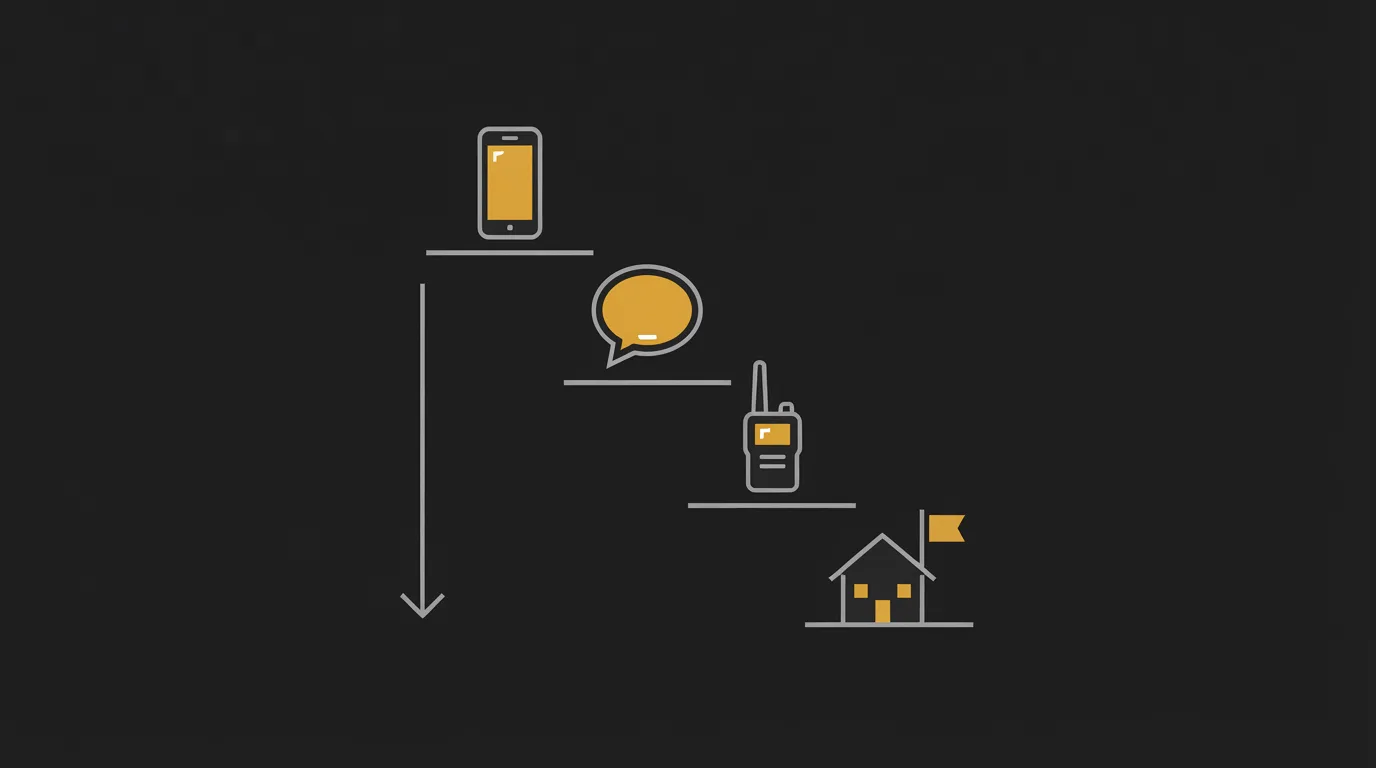
Write each trigger as a sentence a twelve-year-old could follow. "If your text has not gone through in 30 minutes, turn on the radio at the next check-in." "If nobody answers on the radio at two check-ins in a row, go to Spot 1." Without those lines, every person decides alone when to give up on the phone, and the family ends up on four different layers at once.
The radio layer depends on which service you use. FRS handhelds need no license and cover short distances, while GMRS needs one inexpensive FCC license for the family and reaches farther. Our comparison of FRS, GMRS and ham radio covers the license and realistic range of each. Whatever you choose, the plan names the channel, the backup channel, and the privacy code if you use one.
Check-in windows
A radio left on all day runs its batteries down, so a separated family switches theirs on only at agreed times. One prepper who trained with a radio group describes the same structure on a small scale: everyone had to know how to get comms back up "or where we would meet if comms check windows were not met" (Weik Fitness, Creating a PACE Plan).
My suggestion for a household: listen for ten minutes at the top of every hour on the first day while people are still getting home, then drop to three windows a day, at 8 a.m., noon and 6 p.m. Pick times that do not depend on a working phone clock. A cheap wristwatch in each bag solves that.
Use the same windows to listen for news. Ready.gov puts a battery or hand-crank radio and a NOAA Weather Radio in its basic kit, and the person at home can tune them between check-ins and pass what they hear to whoever calls in. Our guide to the NOAA weather radio covers how to program one for your county so it sounds the alarm by itself.
Meeting places and the no-show rule
The Ready.gov form leaves room for several meeting places with instructions, and the instructions are where plans succeed or fail. Name three:
- Spot 1, right outside the house: the mailbox or a neighbor's driveway, for a fire or a gas leak.
- Spot 2, in the neighborhood: a church, a library or a friend's house that everyone can walk to.
- Spot 3, out of town: a relative's home or a place you would evacuate to. Our guide to bugging in or bugging out covers how to decide when leaving makes sense.
Then add the no-show rule. How long does someone wait at Spot 2 before moving on, and what do they leave behind to say they were there? I would write two hours and a note in a sealed bag taped somewhere you all know, with the time, who was there and where they went next. A roll of tape and a zip bag in every go-bag cost almost nothing.
Kids at school, adults at work
The form asks for each school's and workplace's emergency plan, and that line deserves a phone call this month. Ask whether the school holds children until an authorized adult signs them out, and whether it would move students to a separate reunification site. Find out which adults are on your child's pick-up list and add a neighbor or grandparent who is usually close by.
Adults need a written answer to a harder question: do you go to the school or go home? If one parent works ten minutes from the school and the other works an hour away, write down who goes where so the near parent does not assume the far one is coming.
For a teenager who drives, the plan should say whether they pick up siblings or come straight home. For a parent who lives alone, the check-in network in our guide to an emergency plan for elderly parents plugs into this same sheet, with their contact list and medical notes on the back.
Paper copies and where they live
A plan on a phone dies with the battery. Print it, and make a card-sized version for every wallet, backpack and glove box with four things on it: the out-of-area contact's number, the text format, the radio channel with check-in times, and the three meeting places. Laminate the cards or keep them in a zip bag. Our printable plan and wallet card builder puts the channels, check-in times and meeting places on each card for you and prints them ready to cut.
The full sheet goes on the fridge or inside a kitchen cabinet door, in each go-bag, and in the document folder with your IDs and insurance. Ready.gov's tech page also recommends scanning important documents into a password-protected drive or the cloud, which gives you a second copy if the house is lost. Our go-bag checklist shows where the document pouch fits in the pack.
Keep phones charged when weather is coming and switch them to low power mode once the grid drops. A car can charge a phone in an outage, but only with the vehicle outdoors and away from the house, never in an attached garage. Our carbon monoxide guide covers why.
Run the plan twice a year
A plan nobody has tried hides its mistakes. Pick a Saturday and test it without warning the out-of-area contact more than a day ahead:
- Everyone sends the status text to the contact from wherever they are, and the contact replies with what they heard.
- Everyone turns on a radio at the noon window, and each person checks in on the primary channel, then the backup.
- One person walks to Spot 2 and leaves a note. Another finds it.
Write down every failure. The common ones are a radio with dead batteries, a child who cannot find the channel, a contact who did not pick up an unknown number, and a meeting place that turns out to be locked on weekends. Fix each one on the sheet that afternoon, then reprint the cards.
Twice a year is a good rhythm, timed with daylight saving changes when many people already swap smoke alarm batteries. Review it any time a job, a school or a phone number changes.
Where I would start
If you do one thing this week, call the person you want as your out-of-area contact and ask them to take the job. Then fill in the federal form, print it, and write the PACE order and the check-in times on the back by hand. That one evening covers the first jammed hour, when a family without a plan has no idea where everyone is.
Radios come after the paper. A pair of FRS handhelds and an agreed channel are enough to start, and you can move to GMRS once you know how far your family is usually spread. The written plan is what makes any of that gear useful, so keep it with the rest of your family emergency plan and build outward from there. Our guide to writing the whole family plan covers the parts this sheet leaves out: the first-hour jobs, the default rules for when nobody can call, the utility shutoffs and the evacuation order.
Frequently asked questions
Who makes a good out-of-area contact?
Should young children carry the plan?
Is a group chat enough?
How often should the plan change?

Written by
Walt Brenner
Grid-down threats, home security and family plans
Walt Brenner is the pen name of the writer who covers grid-down threats, home security and family emergency plans for Dark Grid Prep. He draws on FEMA and Ready.gov guidance, utility and government reports, manufacturer manuals and long-running prepper forums, and he says plainly where those sources disagree. His beat is the household: what a family of four in a suburb or on a rural lot should have, know and do before the lights go out.
Last checked 2026-11-10
Comments
No comments yet. Questions and your own experience are welcome.
Thank you. Your comment will appear once it has been reviewed.