Communications
If the grid goes down, will cell phones work?
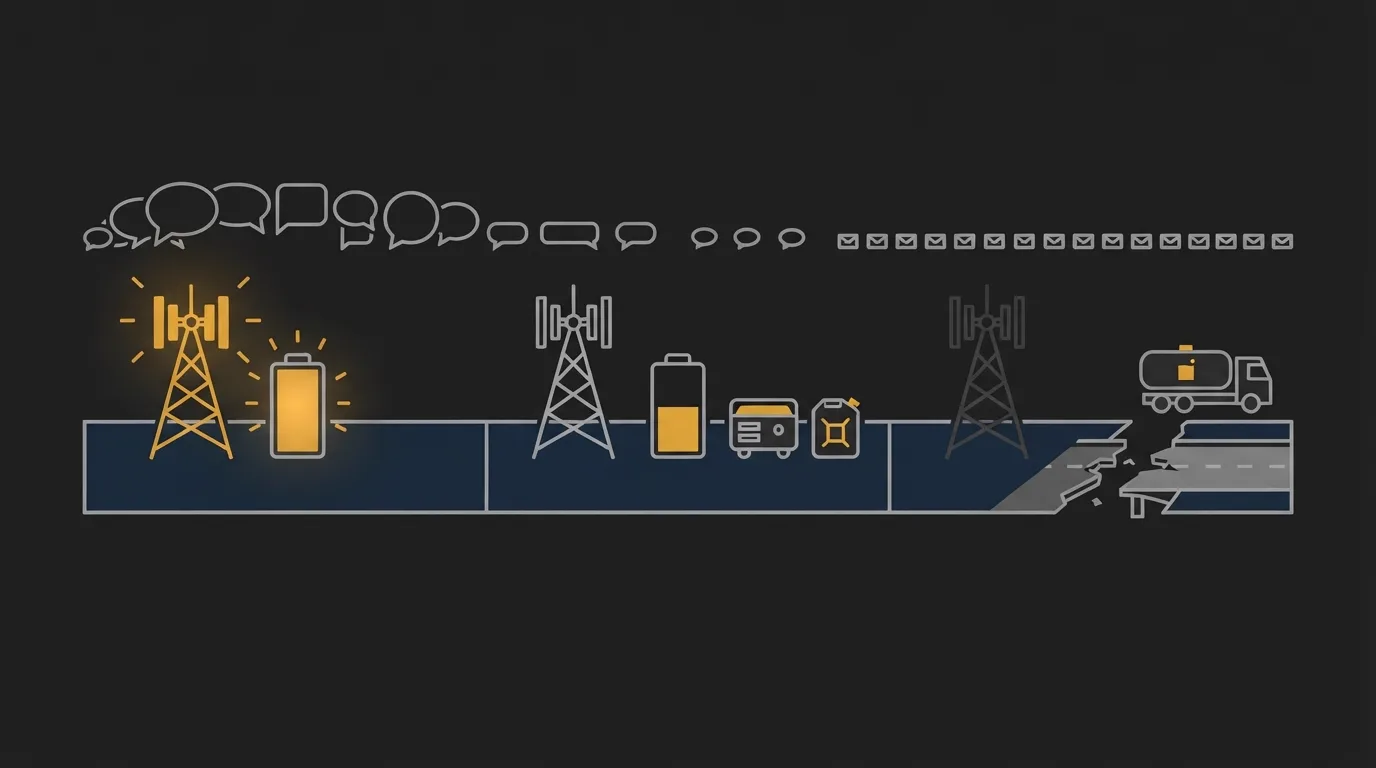
For the first few hours, mostly yes. Cell towers switch to batteries that typically last two to four hours, and towers with a generator keep running for days if fuel keeps arriving, so service thins out rather than stopping at once. Texts get through longer than calls, and in a long, wide outage the network fades out with the fuel supply.
Your phone itself does not care about the grid. It runs on its own battery, and a charged phone stays on for a day or more. The question is whether there is anything left for it to talk to. A cell call or text has to reach a tower, travel over fiber or microwave links to a switching center, and come back out through another tower near the person you are calling. Every one of those pieces needs electricity, and each one has its own backup, or none.
This guide covers how long towers really last without power, what the big hurricanes showed, why a text gets through when a call will not, how to keep your phone charged for a week, where Wi-Fi calling and satellite texting fit, and what the family plan should fall back on when the bars go to zero.
Do cell towers work without power?
For a while. A cell site turns utility power into direct current for its radios and keeps a bank of batteries charged on the side. When the utility feed drops, the batteries take over with no gap, which is why your phone usually keeps its signal for the first part of a blackout and many people never notice anything changed.
How long that bank lasts is the question everyone asks, and the answer is shorter than most expect. Inside Towers, which reports on the tower industry, puts it plainly: "Typical cell site battery reserve times are two to four hours" (Inside Towers, Wireless Carriers' Power Predicament). The exact figure depends on how much equipment the site carries and how old its batteries are. Some sites also have a standby diesel generator, supplied by the carrier or the tower company, which can run the site for several days before it needs fuel.
No federal rule says how much backup a tower must have. After Hurricane Katrina knocked out about 1,000 cell sites in 2005, the FCC ordered a minimum of eight hours of battery backup at cell sites and 24 hours at switching centers. The carriers fought it, and the courts sided with them, so each carrier still decides its own reserves. The same Inside Towers piece concludes that carrier thinking on backup power "has changed little since Katrina or Sandy."
So in practice your neighborhood has a mix: some towers that go quiet in an afternoon, some that hum along on a generator, and a network that gets thinner as the hours pass. Carriers fill holes with portable sites on trucks and trailers, and they move generators to the towers that matter most. That works well in a storm that hits one region while the rest of the country sends crews and fuel.
What Maria, Laura and Helene showed
The FCC tracks cell site outages during big disasters, and the numbers from recent hurricanes are the best evidence a household has for planning.
Hurricane Maria in 2017 is the worst case on record for a whole island. Two days after landfall, FCC data showed 1,707 of Puerto Rico's 1,789 cell sites down, about 95%, and 47 of its 78 municipalities had every site out (Converge Digest, citing FCC data). The island's grid had collapsed with them, and there was no neighboring grid to lean on.
Hurricane Laura in 2020 shows the battery problem in isolation. In Louisiana, more than 200 of the state's 4,650 cell towers went off the air because they ran out of power, either because the batteries drained, the generator ran dry, or both, before the utility could restore the line.
Hurricane Helene in 2024 set the record for the mainland. At the peak, 4,562 cell sites were out across five states. In the affected counties of North Carolina, 74.31% of sites were offline, while Florida, where the storm came ashore, lost only 2.58% of its sites (Wireless Estimator, citing FCC figures). The difference was the mountains: flooding cut fiber lines, and "fuel resupply has been delayed, as many small bridges have been destroyed or washed away." A generator is only as good as the road to it.
Two lessons come out of those numbers. Service fails in patches, so one family member may have a signal while another across town has none. And the outages that last are the ones where fuel and repair crews cannot get through, which is exactly the situation a long grid-down event creates everywhere at once.
In a long, wide grid failure
A storm outage is a local problem with outside help. The scenario this site plans for is different: a blackout that covers a large region for weeks, from a solar storm, a cyberattack or a cascading failure. We lay out how likely that is in our briefing on whether the power grid is going to shut down.
In that case, think of the cell network as a fuel problem. The first night, battery-only towers go quiet. Over the next days, generator sites last as long as their tanks, and refueling depends on diesel deliveries competing with hospitals, water plants and everyone else. The switching centers and fiber links behind the towers need power too. A phone with full bars can still fail to connect if the link behind the tower is down.
An EMP is a separate case, because it can damage electronics as well as cut power. Our guide to EMP versus a solar flare covers what each one does to equipment, and a spare handheld radio stored in a Faraday container is the backup for that one event.
Will texts go through in a power outage?
Usually better than calls, and for longer. A voice call holds a channel open for every second it lasts, while a text is a tiny packet that the network can slip in between other traffic and hold until there is room. When a tower is overloaded or running on its last battery, a call fails outright and a text waits in line and arrives late.
That is why carriers and the FCC repeat the same advice in every hurricane season. One version, from CNN's guide to phones in a storm: "Unless it's for 911, try to text instead of making a phone call. It takes less battery power and is less likely to cause network congestion" (CNN via WCPO, cell phone tips during hurricanes). Congestion is its own danger even when every tower has power. When ice stranded drivers around Atlanta in January 2014, towers were overloaded by the sheer number of people calling home.
Some habits help a message get through:
- Send plain SMS when data is weak. Messaging apps need a data connection, and data is the first thing to crawl on a crowded tower. Know how to send a regular text on your phone.
- Write the whole thing in one message. "All 4 OK at home, staying put, next check 6 pm" beats five short texts and one missed reply.
- Send it to the out-of-area contact. A relative in another state is on a network that is not under strain, and every family member can text that one person instead of trying each other.
- Leave calls for emergencies. A call to 911 should go through on any carrier's tower your phone can reach, so keep calls for that and keep the lines free for others who need them.
Keeping phones charged for a week
If the network holds up, a dead phone is the more likely problem. Ready.gov lists a phone with a backup battery in its basic kit (Ready.gov, build a kit), and a week-long outage takes more than one backup battery.
- Power banks, charged and rotated. One mid-size bank per person covers several full phone charges. Top them up every few months, since they slowly lose charge on a shelf. Our phone charging calculator works out how many days the banks you own will last.
- The car. A car charger turns a full tank into days of phone charging. Run the engine only outdoors with the garage door open wide or the car in the driveway, never in a closed garage, as our carbon monoxide guide explains.
- A power station and a small solar panel. A portable battery station charges phones dozens of times, and a panel refills it on clear days. Our solar generator runtime calculator shows how long one lasts with the other loads in the house.
- A crank or solar radio with a USB port. Slow, but it works with nothing else, and it brings in the news while it charges.
Then make each charge last. Turn on low power mode, dim the screen, close apps that refresh in the background, and switch on airplane mode when there is no signal. A phone that keeps searching for a tower that is not there drains its battery fast. Turn it back on at set check-in times, send and receive, and switch it off again.
Wi-Fi calling, satellite texts and the home phone
Wi-Fi calling lets your phone place calls and texts over your home internet instead of a tower. That is only as good as the internet connection. Cable and fiber run through powered boxes in the neighborhood, which usually go dark with the grid even if your router is on a battery. Satellite internet skips the street equipment. Our guide to whether Starlink works if the grid goes down covers what the dish draws and how to power it, and why Wi-Fi calling should be switched on, with your home address entered for 911, before you need it.
Satellite texting from the phone is the newest fallback. Apple says that with an iPhone 14 or later, "if you call or text emergency services but can't connect because you're off the grid," the phone tries to connect by satellite (Apple Support, Emergency SOS via satellite). You need to be outside with a clear view of the sky, Apple tells you to try a normal 911 call first, and the service is free for two years after activation. It can also notify your emergency contacts. Several Android phones and carriers now offer similar satellite messaging. It is a way to report an emergency or send a short message, slowly, and it will not carry a conversation. Our guide to satellite phones and satellite texting covers the Pixel version, the messengers that text family for days, and when a voice handset is worth its airtime.
The home phone deserves a second look. The Red Cross suggests keeping a phone that is not cordless, because a cordless base needs wall power. A traditional copper line is powered from the phone company's side, so a corded phone on it often keeps working. Most home phone service today runs over cable or fiber through a box in the house, and that box lasts only as long as its own battery.
What the family plan falls back on
A good plan assumes the phones will not work and treats every bar of signal as a bonus. Our walkthrough on how to write a family communication plan sets out the full order. For phones, it comes down to four lines on paper:
- Text first, to the relative outside the area, at fixed check-in times so batteries are not wasted waiting.
- Handheld radios next. FRS radios need no license and cover a neighborhood, and GMRS reaches across town. Our guide to FRS vs GMRS vs ham radio explains the ranges and licenses. Write the channel on every card.
- A battery radio for news. Phone alerts travel over the same towers, as our guide to emergency alerts in a power outage explains. A NOAA weather radio and an AM/FM set keep you informed when the phone cannot.
- Default rules for when nobody can reach anyone. Who picks up the kids, where you meet, how long you wait. These matter most, because they work with no signal at all.
Put the numbers on paper too. Few people remember a spouse's number, let alone a sister's. The Red Cross says "Everyone should carry emergency contact information in writing and saved on their cell phones." Our printable family plan and wallet cards have room for every number, the radio channel and the meeting places. Anyone who commutes should keep a car charger and a spare battery in a get-home bag.
My take: count on texts for a day, plan for no phones
From what the hurricane records show, I'd plan around three phases. In the first hours, phones mostly work, and the job is to send one clear text to your contact in another state and stay off voice calls. For the next few days, service comes and goes by neighborhood, so check in at set times and charge from the car or a battery pack. After that, in a regional failure with fuel running short, assume the phone is a flashlight, a camera and a notebook, and let the radios and the written plan carry the family.
If I had to spend money in one place first, I'd buy a power bank for every person in the house and a pair of FRS radios, and print a contact card for every wallet. That covers the hours when the phone still works and the days after it stops, for less than one new phone.
Frequently asked questions
How long does a cell tower battery last?
Can I still call 911 if my carrier is down?
Does airplane mode save battery in a blackout?
Will my home phone work when the power is out?

Written by
Walt Brenner
Grid-down threats, home security and family plans
Walt Brenner is the pen name of the writer who covers grid-down threats, home security and family emergency plans for Dark Grid Prep. He draws on FEMA and Ready.gov guidance, utility and government reports, manufacturer manuals and long-running prepper forums, and he says plainly where those sources disagree. His beat is the household: what a family of four in a suburb or on a rural lot should have, know and do before the lights go out.
Last checked 2026-11-14
Comments
No comments yet. Questions and your own experience are welcome.
Thank you. Your comment will appear once it has been reviewed.