Grid-down living
Solar generator runtime calculator
To find how long a solar generator runs something, take its usable watt-hours, knock off about 15 percent for the inverter, and divide by the watts the load draws. A 1,000 Wh unit keeps an average refrigerator going for roughly 11 hours. Enter your own battery, appliances and panels below to see runtime, recharge days and the size you would need.
A "solar generator" is a portable battery with an inverter and outlets built in, sold with folding panels to refill it. In a blackout the question is always the same: will it keep the fridge cold, the CPAP running and the lights on until the power comes back, and how fast will the sun put back what you used? That depends on four numbers you can read off labels and a map. Put them in and the calculator does the arithmetic, then shows every step under the result.
Work out your runtime and recharge
The result is an estimate for planning. Real draw changes with the room temperature, how often the fridge door opens and how clean the panels are, so treat the runtime as a ceiling and the recharge time as a floor. Anyone on oxygen or another life-sustaining device should read our blackout plan for CPAP and home oxygen before trusting a battery with it.
Size a gas generator for the same loads
How the calculator gets its numbers
Every runtime figure for a battery comes from one division: the energy you can take out of it, divided by the energy your loads use. The calculator splits that into four steps so you can see which assumption moves the answer most.
1. What your appliances use in a day
Daily use is watts times hours, added up across everything you plug in. The Department of Energy's appliance estimating method works the same way, and for a refrigerator, which cycles on and off, it says to divide the label's wattage by three to get a working average. A better source for a fridge is the yellow EnergyGuide label on the door or in the manual, which gives kilowatt-hours a year under a federal test. The example label in the Building America Solution Center shows 630 kWh a year, about 1.7 kWh a day (PNNL Building America Solution Center, EnergyGuide label). Divide that by 24 and you get the 70-watt average the calculator starts with.
For your own fridge, take the kWh figure on its label, multiply by 1,000 and divide by 8,760 hours in a year. A 450 kWh label is 51 watts on average, an 800 kWh label is 91. Older fridges and side-by-sides sit at the top of that spread. A summer kitchen at 85°F pushes the compressor harder than the test room did, so add a margin if the outage is a heat wave.
2. What the inverter keeps for itself
The battery stores direct current, and your fridge wants 120-volt alternating current. Turning one into the other costs energy, usually 10 to 15 percent on a modern portable station, which is why 85 percent is the default. USB and 12-volt outputs skip the inverter and lose less, so a phone or a CPAP on its DC cord gets more out of each watt-hour than the same device plugged into an AC socket.
The inverter also draws power just by being switched on, even with nothing plugged in. Manuals list it as idle or no-load consumption. It is small, but it runs every hour the AC side is on. If your manual gives a figure, enter it. The calculator assumes the inverter stays on as long as your longest-running appliance does. Turning the AC side off overnight when only USB devices need power saves that whole amount.
3. How much of the battery you can use
The capacity printed on the box is the cell capacity. The calculator lets you hold some back, 10 percent by default, so a dead battery never leaves you without a way to charge the phone or the radio. Raise it if your station's manual tells you to keep the battery above a certain level for long life, or if you want the reserve to cover a second night.
4. What the panels put back
Panels are rated in watts under full sun, about 1,000 watts of sunlight per square meter. A peak sun hour is one hour of sunlight at that strength, so a location with four of them delivers the same energy in a day as four hours of full midday sun. GreenLancer's state table, built on National Renewable Energy Laboratory data, puts Arizona at 7 to 8, Texas at 4.5 to 6, Illinois at 3 to 4 and Michigan, Ohio and Pennsylvania at 2.5 to 3.5. The same page gives Austin 2.73 in December against 6.77 in July (GreenLancer, peak sun hours by state).
No panel delivers its full rating for long. NREL's PVWatts calculator assumes 14 percent losses for a properly mounted rooftop system. A folding panel laid on a porch, hot in the sun, set at the wrong angle and wired through a long cable loses more, so the form assumes you get 70 percent of the rating. Daily harvest is panel watts times sun hours times that share, and the station's charge controller caps it: if the spec sheet says 200 watts of solar input, a 400-watt array still only puts 200 in.
How long a solar generator runs a refrigerator
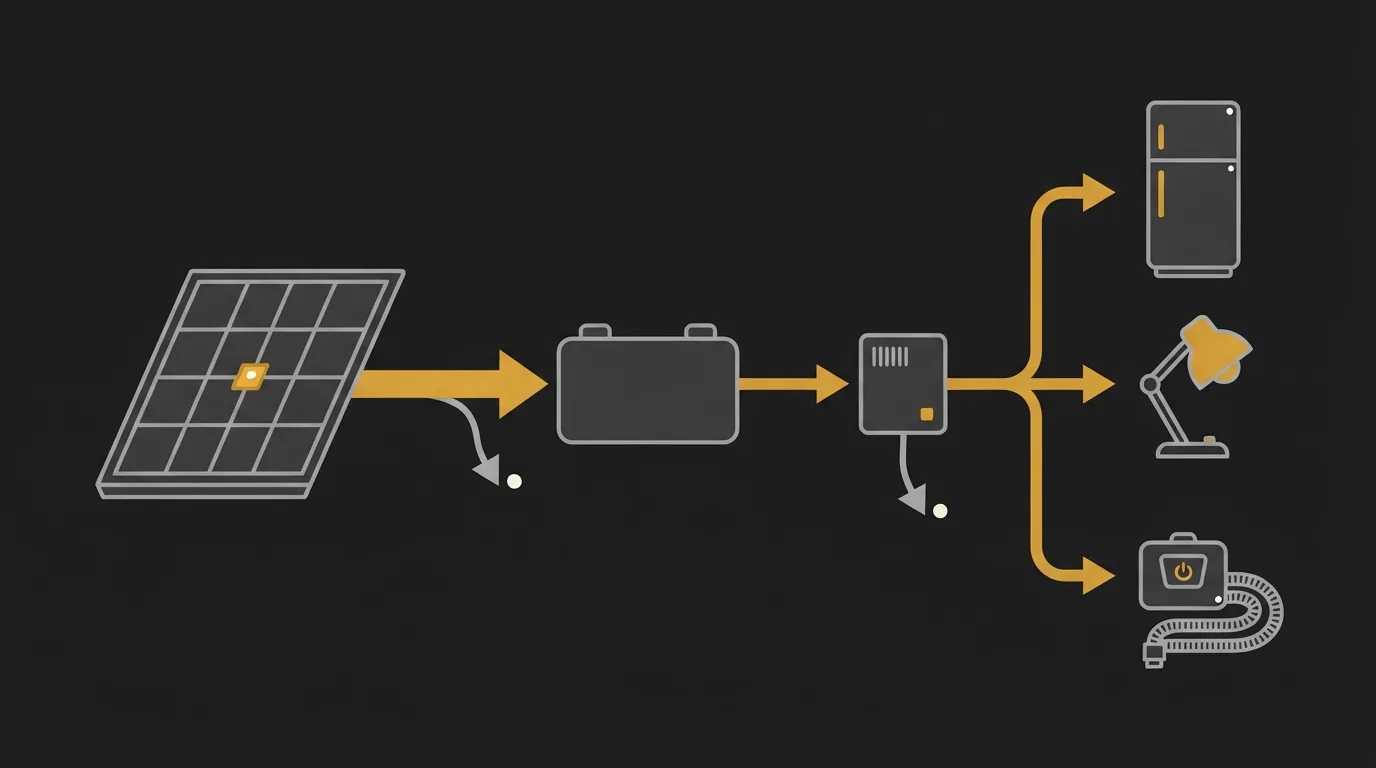
This is the question most people bring to a solar generator for a power outage, and the honest answer is "less than a day on most portable units." At a 70-watt average, a fridge uses about 1,680 Wh in 24 hours at the outlet, or roughly 1,980 Wh out of the battery once the inverter has taken its share. So:
- A 500 Wh station: about 5 hours, which is only a little longer than a closed fridge holds its cold on its own.
- A 1,000 Wh station: about 11 hours with the 10 percent reserve kept back.
- A 2,000 Wh station: about 22 hours.
- A 3,600 Wh station or an expansion battery: a little under two days.
Those figures change the plan. Ready.gov says a closed refrigerator keeps food cold for about four hours and a full freezer holds its temperature for about 48 (Ready.gov, power outages). A battery does not need to run the fridge nonstop to save the food. Run it for an hour or two at a time, keep the door shut in between, and a 1,000 Wh unit stretches over two or three days. A freezer stuffed with jugs of frozen water needs even less help.
What size solar generator do you need
Work it backwards. Take the daily use the calculator gives you, divide by the inverter efficiency, multiply by the number of sunless days you want to ride out, and divide by the share of the battery you are willing to empty. The calculator prints that figure as the battery you would need. It also prints the panel wattage that would put back a full day's use in a day, which tells you whether the sun can carry the load or only slow the drain.
Most households land in one of three places:
- Phones, radio, lights and a laptop: a few hundred watt-hours a day. A 500 Wh station holds a day or two of that, and a 100 to 200-watt panel keeps up on most fair days.
- Those, plus a CPAP every night: 400 to 700 Wh a day. A 1,000 Wh station gets you through one sunless night with room to spare, and a 200-watt array refills it on a fair day.
- Those, plus a full-size refrigerator around the clock: 2,000 to 2,500 Wh a day from the battery. That takes a 4,500 to 5,500 Wh battery to ride out two cloudy days, and 700 to 900 watts of solar to keep up in a four-sun-hour place. At that size, a small gas generator for a few hours a day is the cheaper way to keep the food cold, and the battery covers the quiet hours.
A worked example: the default household
The defaults describe a common bug-in setup: a 1,000 Wh station, an average refrigerator, two 10-watt LED bulbs for five evening hours and a CPAP with the humidifier off for eight hours a night. The panels are 200 watts in a four-sun-hour location.
- Daily use at the outlets: 1,680 Wh for the fridge, 100 for the bulbs and 320 for the CPAP, so 2,100 Wh.
- Out of the battery: 2,100 divided by 0.85 is about 2,471 Wh a day.
- Usable battery: 1,000 Wh minus the 10 percent reserve leaves 900 Wh.
- Runtime with no sun: 900 divided by 2,471 is 0.36 of a day, close to 9 hours.
- Solar harvest: 200 watts times 4 hours times 0.7 is 560 Wh a day, enough to refill the empty battery in about 1.6 sunny days.
- Runtime with the panels out: the sun covers 560 of the 2,471 Wh, so the battery drains about 1,911 Wh a day and lasts about 11 hours.
- To ride out two days with no sun: about 5,500 Wh of battery. To break even every day: an array of about 880 watts.
Drop the fridge from the list and the same station tells a different story. The bulbs and the CPAP use 420 Wh a day, about 494 out of the battery, so 900 usable watt-hours last nearly two days and the 560 Wh harvest more than covers each day's use. That one change, cooling the food some other way, is what turns a portable station from a few hours of backup into something that keeps going.
Clouds, snow and short winter days
The sun hours you type in matter more than any other number. Take the Austin figures above: the same 200-watt panel that harvests about 950 Wh on an average July day at 70 percent brings in about 380 Wh in December. Further north, on overcast weeks, the harvest can fall to a small fraction of that. Commenters on a Pacific Northwest family's backup plan warned that the region's winter clouds and rain leave "very little solar recharge capability" (The Cool Down, backup solar plan in the Pacific Northwest).
Three habits help. Set the panel at a steep angle facing south in winter, and move it through the day to follow the sun if you are home. Keep snow and dust off it, since a panel partly shaded can lose far more than the shaded share. And plan a second way to charge: most stations accept a car's 12-volt socket or a wall outlet fed by a gas generator, so an hour of engine time can refill what three grey days could not.
What a solar generator will not run
Runtime is only half the test. The inverter also has a continuous rating in watts and a short surge rating, and a load bigger than either trips it no matter how full the battery is. Check these before an outage, while you can still return the unit:
- Electric space heaters and hair dryers: a 1,500-watt heater would empty a 1,000 Wh station in about half an hour. Heat the people instead, as our guide to staying warm without power in winter explains.
- Well pumps and central air: most are 240-volt motors with a starting surge several times their running draw. Few portable stations offer 240 volts or that surge.
- Electric ranges, ovens and water heaters: thousands of watts each, on 240 volts. Cook outdoors on a camp stove.
- Microwaves, kettles and coffee makers: they will run on a station rated above their label wattage, but each minute uses 20 to 25 Wh. A few short bursts a day are fine, but a pot of coffee every morning eats a real share of the battery.
The upside of a battery is safety. It burns no fuel, so it can sit in the kitchen next to the fridge, while a gas generator has to stay outside at least 20 feet from doors and windows. Our carbon monoxide guide covers why that distance matters and why a battery is the only power source that belongs indoors.
Which loads I'd size it for
I'd size a solar generator for the loads that cannot wait: the CPAP or other medical device first, then phones, a radio, lights and the internet router. Those fit on a 1,000 Wh station with 200 watts of panels in most of the country, and that setup keeps working for weeks if the sun shows up at all. I'd skip buying a battery big enough to carry the refrigerator all day and all night. Running the fridge an hour at a time, eating the perishables first and freezing jugs of water in advance gets the food through the first days for a fraction of the money, and a small gas generator does the heavy lifting beyond that.
Before you buy anything, run the calculator with your own fridge label and your December sun hours. If the battery it says you need costs more than a generator plus the fuel to run it, that is your answer, and the long-term power outage guide shows how the two fit together over a week or more.
Frequently asked questions
Can I run a solar generator inside the house?
Will a solar generator run a well pump?
Should I keep it plugged in all the time?
Can I charge it from my car?

Written by
Walt Brenner
Grid-down threats, home security and family plans
Walt Brenner is the pen name of the writer who covers grid-down threats, home security and family emergency plans for Dark Grid Prep. He draws on FEMA and Ready.gov guidance, utility and government reports, manufacturer manuals and long-running prepper forums, and he says plainly where those sources disagree. His beat is the household: what a family of four in a suburb or on a rural lot should have, know and do before the lights go out.
Last checked 2026-11-14
Comments
No comments yet. Questions and your own experience are welcome.
Thank you. Your comment will appear once it has been reviewed.