Grid-down living
Sizing a generator for your house
A portable generator of about 4,500 running watts keeps a refrigerator, a freezer, a furnace blower, some lights and the phones going, and roughly 8,000 watts with a 240-volt outlet adds a well pump and most of a small home without central air. Running the whole house, central air included, takes a permanently installed standby unit in the 10 to 20 kilowatt range.

Those three sizes are where most households land, but your own number comes from a list of what you will run at the same time, added up from the labels on the appliances, plus enough headroom for the biggest motor in the house to start. Get that list right and you buy the smallest generator that does the job, which is also the one that burns the least fuel when the gas stations are dark.
Plan the whole outage with our survival guide
Running watts and starting watts
Every portable generator is sold with two numbers on the box. The running (or rated) figure is what it can supply hour after hour. The starting figure, often called surge or peak, is the short burst it can deliver for a second or two while a motor spins up. The running figure is the one you size on. The starting figure only has to cover the moment the largest motor kicks on.
Lazar Rozenblat, whose independent generator sizing guide has been online since 2007, splits a house's demand the same way: continuous watts, peak power, and the surge current a motor draws at startup (smps.us, home generator sizing). He also warns against sizing from the generic wattage charts most calculators use, because two refrigerators of the same size can differ by a factor of two. The label on your own appliance beats any chart.
Start with the labels
The American Red Cross, writing with technical advice from the CDC, the NFPA and the Consumer Product Safety Commission, gives the method in four steps (Red Cross, generator safety):
- Add up the power ratings of the appliances and devices you want to use. The rating is on a label on the back or side.
- Add the wattage of every bulb you plan to light.
- Divide the total watts by the voltage to get amps.
- Pick a generator that produces more than that, because some machines draw up to three times their running power when they start, and others lose efficiency over time.
Some labels give amps instead of watts. Multiply amps by volts to convert: a label reading 5 amps at 120 volts means about 600 watts. Most household devices run on 120 volts. Anything with the big three-or-four-prong plug or its own double breaker, such as an electric dryer, a range or most deep-well pumps, usually needs 240.
Do this walk with a notepad before the season, while the lights still work. Ready.gov's first instruction for power outages is the same inventory: list what in the house relies on electricity and plan backup power for it, medical devices first (Ready.gov, power outages).
The motor surge that trips generators
Lights, phone chargers and a TV draw what they say and nothing more. Motors are different. A refrigerator compressor, a chest freezer, the furnace blower, a sump pump and a well pump each pull a burst of current every time they start, and in a cold house they start over and over all day.
The well pump is the one that surprises rural households. A pump installer in Oakville explains that a 1-horsepower submersible pump uses about 1,000 watts once it is running but needs a generator of 3,000 to 4,000 watts just to get started, and that most well pumps run on 240 volts (Oakville Pump, generators for well pumps). A family that sized for the fridge and lights alone finds out the first time someone flushes a toilet. What to do when that flush has no water behind it is in our emergency toilet guide.
You can shrink the surge problem with habit. Start the largest motor first, with nothing else on, and add the smaller loads after it is running. The Red Cross also says to stagger operating times when needed so the generator does not overload. A freezer that has held its cold for six hours can wait while the well pump refills the pressure tank. If the pump will not start once power is back, our guide to restarting a well pump after an outage walks through the breaker, the pressure switch and priming.
Three sizes that cover most houses
Rozenblat's rules of thumb line up with what most households actually need. I've grouped them by the kind of outage plan each one supports.
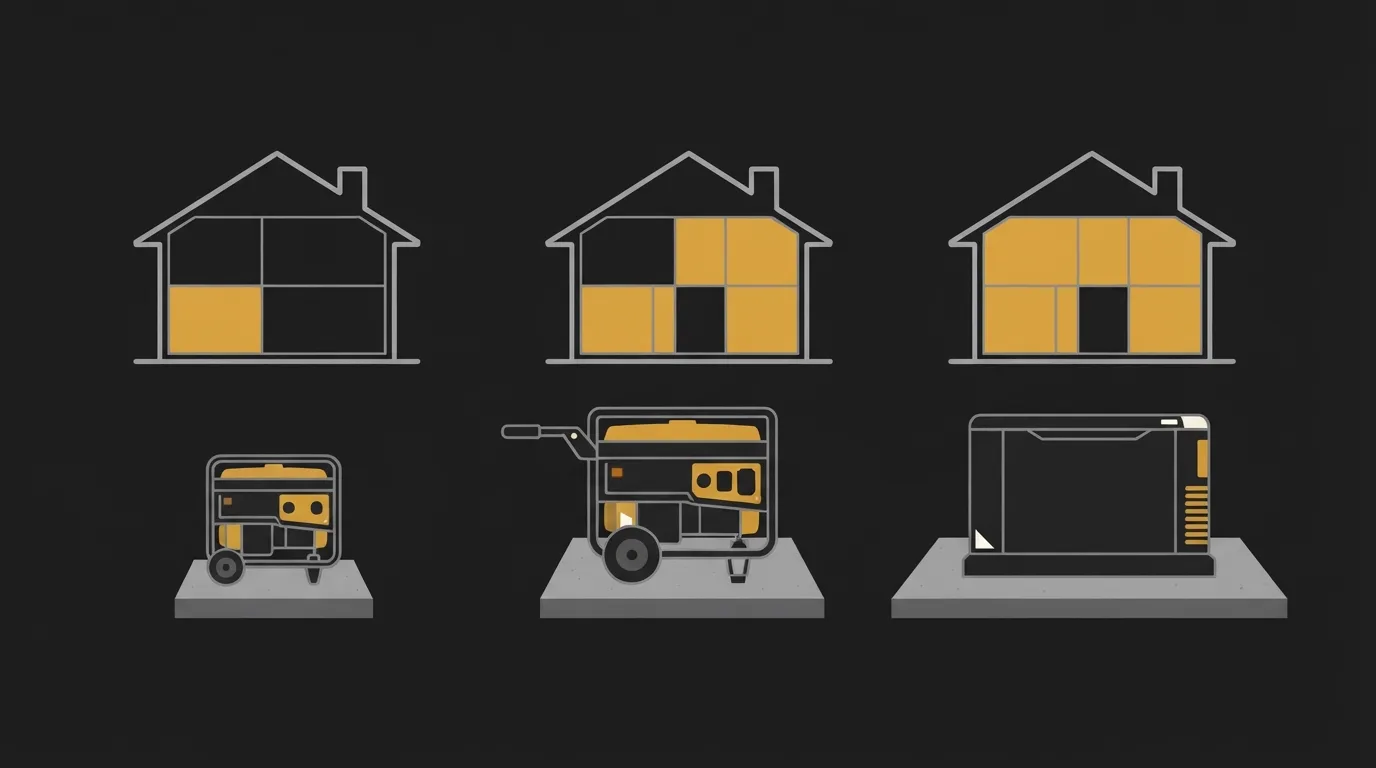
- About 4,500 watts, 120 volts. Enough for two or three essential loads at once: the refrigerator, a small furnace blower or a window air conditioner, plus lights and chargers. This is the bug-in kit for a suburban house with municipal water.
- About 8,000 watts with a 120/240-volt outlet. Runs most items in a small home without central air, and the 240-volt outlet is what lets it start a submersible pump wired into the panel. This is where most rural households on a well should start looking.
- 10 to 20 kilowatts, permanently installed. A whole house with central air. Rozenblat puts a typical single-family home with up to a 5-ton air conditioner at 15 to 18 kW. These run on natural gas or propane, sit outside on a pad, and need a licensed installer.
Those numbers assume you are not running everything at once, and nobody should during a blackout. Nameplate ratings are a worst case written for safety testing. Rozenblat notes they can sit up to 50 percent above what the appliance actually draws, and that compressors cycle on and off instead of running together. Size for the loads that overlap in real life, then add a 10 to 20 percent margin so the breaker on the generator is not tripping at the edge.
A worked example
Here is how the arithmetic goes for a made-up house: a family of four on city water in a cold state, gas furnace, no central air. Their own labels, read on a Saturday, give these running figures:
- Refrigerator, 700 watts
- Chest freezer, 500 watts
- Furnace blower and controls, 600 watts
- Six LED bulbs at 10 watts each, 60 watts
- Phones, a laptop and the internet router, 150 watts
- A 1,500-watt electric kettle or microwave, used in short bursts
The steady loads come to about 2,000 watts. The kettle or microwave pushes the peak toward 3,500 when it runs. If the fridge compressor happens to start at that same moment, it needs roughly two to three times its running draw for a second. A generator rated around 4,500 running watts covers that house with room to spare, and it does it at a fraction of the fuel a whole-house unit would burn. Swap the furnace for an electric space heater and the picture changes fast: a heater on high takes 1,500 watts by itself, which is why our guide to safe indoor heaters treats electric heat as something to run in short sessions.
Change one fact, a private well instead of city water, and this family moves up a tier. The pump alone wants a 240-volt outlet and a 3,000 to 4,000-watt start, so the 8,000-watt class becomes the honest answer.
Why the two 120-volt legs matter
Most American homes get 120/240-volt service, which arrives as two separate 120-volt lines. A generator with a 240-volt outlet has two 120-volt outputs as well, and Rozenblat points out that each one can supply only half of the generator's rated power. An 8,000-watt unit gives you about 4,000 watts per side.
That matters once the generator feeds the house wiring. If the refrigerator, the freezer and the furnace all sit on circuits from the same side of the panel, that side overloads while the other carries almost nothing. Ask the electrician who installs the switch to spread your critical circuits across both legs. It costs nothing at install time and can save you from buying a bigger machine.
Getting the power into the house
There are two safe ways. The simple one is extension cords: plug the appliances into the generator directly, or use heavy-duty outdoor cords rated at least as high as the total load on them, with all three prongs intact. The Red Cross is specific about that rating, and an undersized cord turns into a heater of its own.
The other is a transfer switch (or a breaker interlock on the main panel) installed by an electrician to the National Electrical Code. A transfer switch disconnects the house from the utility line before the generator connects, which is the only thing that keeps your generator from energizing the street (Wikipedia, transfer switch). Plugging a generator into a wall outlet, called backfeeding, can electrocute a lineman working down the road, and the Red Cross names it as a risk to your neighbors and your own household too.
Wherever the cords or the switch lead, the generator itself stays outdoors, at least 20 feet from windows, doors and attached garages. Our carbon monoxide guide for blackouts covers placement, alarms and what to do when one sounds.
Fuel decides how big is too big
A generator larger than your loads still burns fuel to stay running, and fuel is the thing that runs out. Rozenblat recalls that many Florida gas stations ran dry before Hurricane Irma made landfall, and that after Winter Storm Uri in February 2021, stations in the affected areas stayed closed until their own power came back (smps.us, home generator guide). A portable gasoline unit at full load can need refilling several times a day. Our generator fuel calculator shows how many gallons or propane tanks your size and schedule would take, and whether your garage may legally hold them.
That is the case for sizing small and running in blocks: a few hours in the morning to pull the freezer back down and pump water, a few in the evening for cooking and charging, and quiet in between. It is also the case for propane. A propane tank does not go stale the way stored gasoline does, and many portables now run on both fuels.
Standby units on natural gas solve the refill problem but bring their own limits. A typical residential gas meter is rated around 250 cubic feet per hour, which may not feed a large unit at full output, and the engine still needs an oil change every 50 to 100 hours of running. During a two-week outage, that means at least one oil change on a unit running around the clock.
Inverter or conventional
Inverter generators are the smaller, quieter units that slow the engine down when the load is light. They save fuel at partial load and produce a cleaner waveform, which suits computers, routers and anything with sensitive electronics (Wikipedia, engine-generator). Conventional open-frame units give more watts per dollar and are what you usually find at 8,000 watts and up. If you are still deciding between a portable, an inverter, a standby unit or a battery station, our guide to choosing a home generator goes through each type and how it connects to the house.
For a grid-down household, noise counts too. A running generator on a dark street tells everyone who has power, and the outage guide's section on staying low-profile applies directly. A quieter inverter unit, run in short blocks, draws less attention than a loud open-frame machine running all night. A battery station makes no noise at all and can carry the CPAP, the lights and the router between those blocks. Our solar generator runtime calculator shows how long one lasts on your loads and how many panels it takes to refill.
What I would buy
For a suburban house with a gas furnace and the town's water, I'd buy a dual-fuel portable around 4,500 running watts, two heavy-duty cords rated for the load, and a battery carbon monoxide alarm for every level before the generator ever comes out of the box. I'd keep propane on hand instead of a shed full of aging gasoline.
On a well, I'd skip the small units entirely and go straight to the 8,000-watt class with a 240-volt outlet, then pay an electrician for an inlet box and an interlock or transfer switch with the pump circuit on it. Water is the reason that household owns a generator in the first place, and our two-week water guide shows how fast a family runs through what is stored.
I'd only look at a whole-house standby if someone in the home depends on powered medical equipment or cannot tolerate heat or cold, and the house has a natural gas line or a large propane tank to feed it. For everyone else, the money spent on the bigger unit buys more resilience as stored water, fuel and a warm room.
Frequently asked questions
Will a 2,000-watt inverter generator run a refrigerator?
Can a portable generator run central air?
Is a bigger generator always safer to buy?
Do I need an electrician?

Written by
Walt Brenner
Grid-down threats, home security and family plans
Walt Brenner is the pen name of the writer who covers grid-down threats, home security and family emergency plans for Dark Grid Prep. He draws on FEMA and Ready.gov guidance, utility and government reports, manufacturer manuals and long-running prepper forums, and he says plainly where those sources disagree. His beat is the household: what a family of four in a suburb or on a rural lot should have, know and do before the lights go out.
Last checked 2026-11-11
Comments
No comments yet. Questions and your own experience are welcome.
Thank you. Your comment will appear once it has been reviewed.