Grid-down living
Emergency toilet when water stops
When city pressure, a well pump, or a broken winter main stops the water, the toilet tank does not refill and the flush is the first routine to fail. Use a pour-flush only after the sewer is confirmed working, and switch to two buckets, storing the waste until officials give a disposal instruction, whenever the main may be broken or the outage may last.
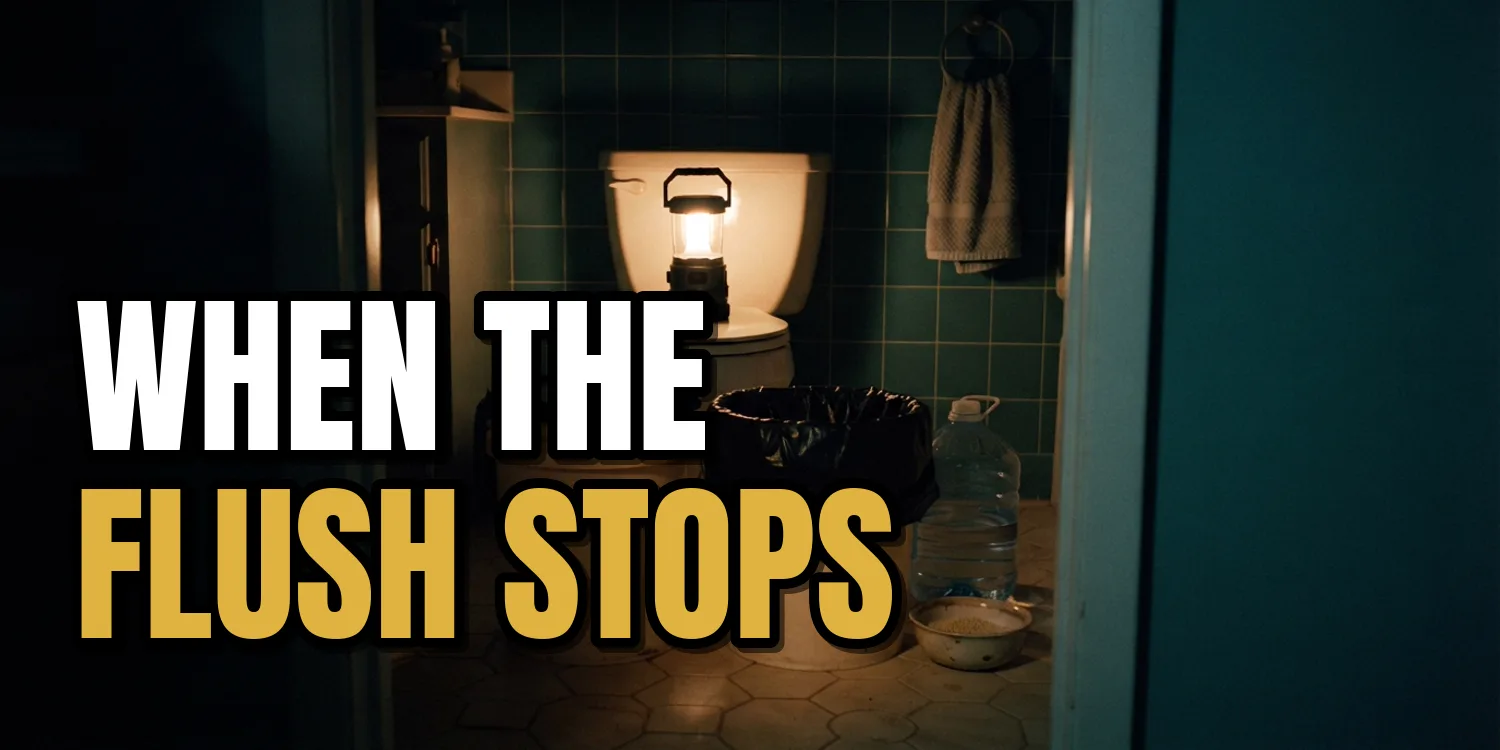
The tank on the toilet holds one flush. After that, with the well pump off or the city pressure gone, the handle has nothing behind it. Ready.gov's outage page says a blackout can take out water service, along with phones and transportation, and the bathroom shows it before almost anything else in the house does.
What you do next depends on the pipes under the street. Wash water poured in the bowl can empty it when the bowl still drains and the sewer path is confirmed working. A broken street main, sewage coming back up, or an official order to stop means you quit that fixture and move to two separate buckets. The same small kit covers both. It belongs in the house before the season turns.
Add moist towelettes, garbage bags, plastic ties and cover material for the solids bucket to the water you already keep. Then set the buckets up once during a grid-down drill, so the first night is not the night you are reading steps by lantern. The day-two waste lines on the power outage checklist are the short form of that job.
What follows is drawn from Ready.gov, the CDC's archived emergency sanitation guidance, Utah Emergency Management, Oregon State University Extension, Greywater Action and the Regional Disaster Preparedness Organization.
What breaks first when the water stops
Three ordinary failures take the pressure away. Each one shows up at the toilet, and they do not all leave you with a sewer you can still trust.
City water drops when the pumps stop. Ready.gov names water alongside communications and transportation as services a blackout can interrupt. At the sink you get a sputter, then air. Once someone uses the water left in the tank, the toilet does not fill again.
A house on a well goes dry the moment its pump has no electricity. The septic tank can be in good shape. Nothing is pushing water to the fixture. The startup load of that pump, and a generator that can carry it, are worked out on the generator sizing page and the home generator guide. Until the pump actually runs, the bathroom is a room without water service.
Winter can take the water even when the walls are still standing. Burst pipes and water systems that lost pressure were part of the February 2021 Texas freeze, which the winter storm page walks through from the household side. In the bathroom the result matches the other two failures. The tank stays empty, and the sewer beyond the house may be a bad place to send anything.
Time changes the plan as much as the cause does. A city blackout of a few hours, with no report of damaged mains, can sometimes be bridged with a careful pour. A strong earthquake is the other end of the scale. The Regional Disaster Preparedness Organization says families may have to live without running water and working toilets for weeks or months, which is why it publishes an emergency toilet project at all. That longer stretch needs a toilet that never meets the sewer.
Drinking and washing totals for two weeks already have a home on the water storage guide. The stockpile calculator turns a household and a number of days into gallons, fuel and batteries. None of that math is repeated here. The rest of this page is the toilet.
Sanitation supplies in a power outage
Ready.gov's basic kit is the sanitation list, and a lot of it is ordinary. The kit page names moist towelettes, garbage bags and plastic ties for personal sanitation. Next to them, the water page sets a floor of one gallon per person per day for several days, for drinking and sanitation together, and adds that hot weather can double what a person needs to drink. Treat that gallon as one shared supply. Drinking, washing and any water you pour into a toilet all come out of it.
Towelettes stand in for a sink when you are between real washes, on hands and on faces. Bags and ties are how you seal the bucket that holds feces, so the waste can sit, contained, until officials say where it goes. Buy more bags than a camping weekend suggests. A bucket in daily use makes waste every day, and the earthquake timeline above is counted in weeks.
The hardware beside the bags is simple. Two buckets with lids are what Utah Emergency Management describes as a clean way to keep liquid waste and solid waste apart. A cover of carbon material goes on the solids after each use. How much, and the order of a day, are in the two-bucket section below. The buckets have to be stable, closeable and clearly marked so nobody confuses them in the dark.
The washing setup is part of the same kit. Utah's hygiene guidance says to place it right beside the emergency toilet, with soap, clean water, paper towels and hand sanitizer. A jug left in the kitchen gets skipped on the third trip.
The first-hour job that protects your reserve is on the family plan, under who shuts off the utilities. Ready.gov's safety-skills page says gravity can drain the water heater and the toilet tanks unless you trap that water by shutting the main house valve. Find the valve, tag it, and make sure it closes, on a calm day. What you trap is only what those tanks held at that moment. Our page on natural gas during an outage covers whether the heater still lights once the power is out. A closed valve saves a reserve. Spending that reserve on flushes is how a short outage becomes a water problem by the second morning.
Can you still use the bathroom toilet?
Keep using the bathroom toilet only when both of these are true. The bowl still empties as it did last week, and you have a real reason to believe the pipes past your house are intact. Utah tells households to stop using drains: do not flush toilets or pour anything down them until you know the sewer lines are fixed. Waste pushed into a broken line comes back as a backup, usually through the lowest tub, shower or floor drain.
Oregon State University Extension covers the case that looks safest and shows up most often after a big disaster. Avoid the toilets even if your home's sewer lines are undamaged. Pipes under the house can be sound while the mains in the street are broken. A septic system may still be usable if it is not leaking and not backing up. That exception is a narrow one, and it is the household's job to look.
Set the outage you are in against those two instructions.
For a short blackout in town, with the mains undisturbed and nobody from the utility telling you to hold the toilets, a test pour tells you where you stand. If a modest amount leaves the bowl promptly, a bucket flush can carry the household for those hours. If the water rises and stays, the test is over and the fixture is retired.
After an earthquake, a flood, or a freeze that has already split mains, start from the other assumption. The street line is the hazard until the utility or the local health department says otherwise. The weeks without working toilets, the stretch the Regional Disaster Preparedness Organization describes, belong in this column. Filling a broken main with a family's waste is how the lowest bathroom in the house floods with sewage.
Septic households can check the exception before they trust the flush. Look for wet ground over the tank and the laterals, for smell in the house, and for any fixture that gurgles and returns what you sent. Quiet, dry ground supports the condition Oregon State allows. A gurgle or a smell in the house ends it.
An electric pump ends it too, the moment the power fails. Some septic systems and some sewer connections move waste with a grinder pump or a pump that lifts it up to the street. Those pumps sit idle without electricity. Until that pump has power, the buckets are the toilet. A generator can put a pump back to work where the pipes themselves are whole. It leaves a sheared street main exactly as it found it. Choosing and sizing the machine is the job of the generator pages linked above. The toilet decision stays here either way.
How to flush a toilet without water
When the sewer path is confirmed, the tank can stay out of the job. Greywater Action describes the flush as one motion. Lift the lid and dump greywater straight into the bowl. The pour creates a siphon, and the bowl empties. Greywater here means wash water, such as water from a shower or a bath. Water you are still treating as drinking water stays in the drinking jugs.
Have the main valve closed before you pour, the way the supplies section describes, so the tank and the water heater are not emptying themselves through a fill valve that will never see pressure again. The siphon starts in the bowl. That is where the water goes.
Watch that pour and believe what the bowl does. A bowl that empties cleanly can be used again while you still have a reason to trust the sewer, and while the stored water can spare it. A bowl that fills, pauses, or sends the water back is finished. Utah's page allows no second pour. Nothing further goes down the drains until the lines are known to be fixed. Close the lid, tell the house the fixture is off limits, and move everyone to the buckets.
A pour that works is still water you no longer have. Sanitation was already inside the gallon-a-day figure above, so a flush draws on the same store as the water you drink. Bath water feels spare when the tub is full at the start of an outage. A day later it may be the water you wanted for washing people. The long-term outage guide holds the week-one arithmetic, including how quickly a household's store is committed. Keep the bowl flush for the short, confirmed window. Move to buckets as soon as the jugs start to look like the rest of the week's drinking water.
Pour enough to get the siphon started, then watch the bowl. Another pour into a bowl that stayed full leaves you with a worse mess and less water. Heating wash water, and which flames may burn indoors, is a separate question on the cooking without power page. Where the family sleeps and spends the day is on the page about staying warm without power. A toilet routine that only works in a cold, closed-off bathroom will be dropped by the second night, so the buckets belong in the room people are actually using.
A two-bucket toilet, day to day
Once the fixture is retired, use two buckets. Utah calls separate buckets for liquid and solid waste a clean and safe way to handle it. Oregon State calls that split no-mix. Urine stays in one bucket and feces stay in the other. Pee carries volume and odor, and it is generally sterile. The pathogens sit in the feces. Keeping urine in its own bucket means that larger volume is not sealed into the bags with the solids, and those bags stay the smaller, covered portion you actually store.
The liquid bucket fills first. That is the volume argument for giving it a bucket of its own. It stays lidded, and it stays off open ground, until your health department says where liquid waste goes. Utah's line is that waste is never left on open ground, and a bucket tipped behind the garage fails it the same way a bag in the yard does.
After every solid use, cover the feces. Utah's measure is about two cups of kitty litter. Oregon State describes that cover as carbon material, and the reason is practical. It cuts odor and makes the waste less attractive to flies. Keep the litter with the buckets. A bag in a hall closet does no good at midnight.
Lids go back on both buckets as soon as you are done. An open pail in the living room is the failure the lids are there to prevent, and it is also how flies find the bucket Oregon State is trying to make uninteresting.
Set the soap and the jug close enough to use without leaving the buckets. The wash kit packed for that spot is the one from the supplies list. Each visit follows the same order. Liquid goes in its own bucket. Feces go in the other. The cover goes on the feces. The lids go on. Hands get washed before anyone touches a cup, a spoon or a child's face.
In cold weather, put that loop in the room you are already heating. The warmth guide is how you pick and seal that room. A careful setup in a bathroom you have closed off to save heat becomes a corner nobody walks to, and then the waste ends up somewhere worse. The warm room is the location that will still be in use on night three.
What to do with human waste in an emergency
You are storing waste until a person with authority tells you the next step. The CDC's archived emergency sanitation page says that preventing open defecation and containing waste are critical to reducing the spread of disease in a disaster. The same page describes a packet latrine: single-use biodegradable bags for sanitation at the point of use, typically set inside reusable buckets, and later buried or properly disposed of. The bag lining the feces bucket is that idea in household form.
Burial, in that CDC sentence, is something officials may direct. It is not a depth and a distance to copy onto a suburban lot from a national page. Local health departments decide whether burial is allowed at all. Until an instruction arrives, from the health department or over the emergency broadcast, the sealed bag stays stored.
Oregon State is plain about storage. Human waste does not go into the normal garbage. It has to be specially treated, and it should not ride to a landfill mixed with the rest of the household trash. Plan to hold the sealed bags until the sanitary system is back, or until officials give a disposal direction. Some counties later run a special collection. Others never do. Wait for an instruction that names the method before any bag goes to the curb, including on a day when the ordinary truck still shows up.
A lidded can, closed, and kept apart from drinking water and food, is the container that matches the containment the CDC page is describing. Size it for the long stretch already named above, not for a single missed collection. The extra bags from the supplies list are for the same reason. A can that fills on day three, with no legal place to empty it, puts the household back in the open-pail problem the lids were bought to avoid.
Diapers, periods and illness with the plumbing down
A used diaper is feces in a wrapper. It follows the solids, into a tied bag, stored with the other human waste, and it stays out of the kitchen trash. The garbage rule in the section above is the whole argument. A diaper pail set out for ordinary collection puts that waste on a truck Oregon State says should not take it.
Menstrual products take a tied bag and the same wait. They are a different kind of waste, and a bathroom that can no longer wash itself is a poor place to leave them loose. Seal them, keep them with the contained waste, and let the official instruction cover them too. Mark the bags if more than one person handles the can, so a change at night is not a search through every sack.
Illness raises the volume and puts waste on more hands. Vomiting and diarrhea have to land somewhere the buckets can hold, with the lids returned at once. Wash at the station after the toilet and after each diaper change. Use the soap and jug already sitting there, then dry off. That wash is what keeps containment from stopping at the pail. The disease concern on the CDC page is about waste moving through a household, and hands are the usual route.
Someone who cannot cross the house needs the setup moved to them. The plan for elderly parents already covers mobility, medicines and who looks in on whom. For sanitation, the buckets and the washing jug live in the room that person is using. Lids stay on, so waste crosses the hall only inside a closed bucket. A baby at one end of the house and a grandparent at the other may mean a second bucket for feces. The extra bucket saves that walk every hour.
What I'd set up before the next freeze
I'd start with the two buckets and the litter, and I'd leave the bathroom fixture alone until I knew the sewer was sound. February is a poor time to be assembling a toilet by feel, so the kit sits in a closet in November: two lidded buckets, garbage bags, ties, towelettes, soap, towels, sanitizer and litter for the cover. I'd mark the buckets in thick marker, one for liquid and one for solid, so a tired person can tell them apart without a conference.
I'd keep a pour-flush for a short outage only, and only with a reason to trust the sewer. That reason is the utility saying the mains are sound, or a septic tank that is quiet, with dry ground over it. I'd leave the bowl alone after an earthquake, and again whenever the first pour sat there. Once an outage runs past the water you can spare, I'd use only the buckets. That pour spends water you may want to drink the next day, so I would keep it for a few hours and move to the buckets for the rest of the week.
The job for tonight is smaller than restocking the whole house. Put the supplies with the water. During the next grid-down drill, set both buckets out, drop a cover on the feces bucket, and wash your hands from the jug the way you would if you had just used it. The power outage checklist already lists this work on day two. Doing it once while the lights are on is the practice. The drill page is where that evening is sketched if you want the rest of the house, not only the bathroom, in the same pass.
Frequently asked questions
How do you flush a toilet when the tank will not refill?
What goes in each bucket of a two-bucket toilet?
Can bagged human waste go out with the weekly trash?

Written by
Walt Brenner
Grid-down threats, home security and family plans
Walt Brenner is the pen name of the writer who covers grid-down threats, home security and family emergency plans for Dark Grid Prep. He draws on FEMA and Ready.gov guidance, utility and government reports, manufacturer manuals and long-running prepper forums, and he says plainly where those sources disagree. His beat is the household: what a family of four in a suburb or on a rural lot should have, know and do before the lights go out.
Last checked 2026-11-20
Comments
No comments yet. Questions and your own experience are welcome.
Thank you. Your comment will appear once it has been reviewed.