Grid-down living
If the grid goes down, will natural gas still work?
Yes, in most blackouts the gas keeps flowing, because most pipeline compressors burn gas and the meter at your house needs no power. What stops are the appliances that need a plug, so a furnace goes cold while a match-lit burner and a standing-pilot water heater keep working.
Plenty of families keep a gas line partly as insurance against the next outage, and the search for this question jumped this fall alongside the rumor of a 90-day grid shutdown. The honest answer has two halves. The gas system is sturdier than the power grid and usually keeps delivering. Whether your house can use that gas depends on the appliances at the end of the pipe, and most of the ones sold in the last twenty years need a plug. This guide sorts out both halves, then covers how long the supply holds and what happens in a collapse that lasts months.
If the power goes out, will natural gas still flow?
For an ordinary storm outage, yes. Gas moves from the wells through high-pressure transmission lines, gets pushed along by compressor stations every so often, and is stepped down to low pressure by regulators before it reaches the street and your meter. None of that last stretch needs power at your end. A team at Carnegie Mellon notes that the national pipeline network "has generally been much more reliable than the electric power system" and that it used to run mainly on gas (Carnegie Mellon via EurekAlert).
So when the lights go out on your block and the pipeline upstream is still full, the gas at your stove does not notice. The meter on the wall has no plug, and the pressure that reaches it was set miles away.
How long will natural gas last in a blackout?
No utility or federal agency publishes a number of days, so anyone who quotes one is guessing. What the record does show is a pattern. A local outage of hours or a few days almost never touches gas service. A wide outage in deep cold is when it falters, and the cause is usually the weather hitting the wells before the missing electricity hits the pipes.
The weak point is the compressor station. Pipelines need a push every so often to keep gas moving across long distances, and the Carnegie Mellon team counted nearly 1,500 compressor stations, about 10% of them driven by electric motors. Those sites usually carry backup power for their controls and lighting, but the authors write that electric compressors "are usually too large for practical on-site backup," so a power cut to the station stops them. They flag California, the Midwest, the Gulf Coast and the East as the regions with the most electric compressor capacity. A single station knocked out can starve gas power plants downstream, which deepens the electric outage that stopped the station in the first place.
Between the wells and your house, the pipes themselves hold a cushion. Operators call it line pack: gas squeezed into the pipelines under pressure, which they draw down when supply falls short. The cushion is sized for swings in daily demand, so a shortage that runs for days uses it up. In Winter Storm Elliott in December 2022, the pipeline trade group INGAA describes operators using line pack and storage "to try to cover shortfalls," then restricting deliveries when both ran low, because further draw would push pressure so low that "the pipeline system is at risk of collapse" (INGAA on the FERC/NERC Elliott report). That storm lasted six days.
When a home does lose gas, it rarely happens all at once. The first sign is weak flames and a furnace that will not stay lit, as the Texas cases below show.
For a family, the practical reading is this. Expect gas to last through an ordinary storm outage, plan for it to weaken in a multi-day cold snap that covers several states, and do not count on it at all past a few weeks of a wide grid failure. Treat any gas appliance that works without power as a bonus on top of a plan that does not need it.
What the Texas freeze showed about gas and power
February 2021 is the clearest real case of the two systems failing together. Federal regulators found that the primary cause of the Texas blackouts was frozen equipment at power plants, and the secondary cause was "frozen equipment and failures at natural gas wellheads and processing facilities, which led to a breakdown of the gas supply chain" (Fox Weather on the FERC/NERC report). At the worst point, 4.5 million Texans were without power, and more than 200 people died because of the storm. The full FERC/NERC report also lists power cuts to gas production and processing sites among the causes, which is the loop the Carnegie Mellon team warns about: less power means less gas, and less gas means less power.
The supply numbers show how fast it went. Federal energy statisticians at the EIA found that Texas gas production fell by more than 10 billion cubic feet a day between February 8 and 17, "mostly a result of freeze-offs," when water in the wells and gathering lines froze and blocked the flow (EIA, February 2021 production decline). National output for the month dropped 7%, the largest monthly fall in the agency's records. The EIA adds that Texas wells are not winterized to the same extent as those in colder northern states, which is why the drop was so steep there. That is the documented answer to how long gas lasts in a blackout: in the worst case on record, supply started failing within days, and the cold did it before the lost electricity did.
Most Texas homes on gas kept some pressure through that week, but the gas side has failed households on its own since then. In a December 2022 cold snap, Atmos Energy customers around Austin reported "low or no gas pressure," and the city of Leander opened a warming center for people left without heat (KXAN). One resident told the station her house fell to 31 degrees. Another viewer described the pattern that matters here: the stove still lit, while the furnace would not run on the weak pressure. Atmos asked customers to turn thermostats down, skip the gas fireplace and lower water heater settings.
The lesson for a household is simple. Extreme cold is when gas demand peaks and when wells and lines are most likely to freeze, so the gas fails most often in the very weather you were counting on it for.
Which gas appliances work without electricity
Gas appliances split along one line: whether the flame is lit and kept lit by a small electric part, and whether a fan has to move air or exhaust. An outage leaves the gas valve open at the meter, so anything that can light itself without a spark and vent without a fan keeps going.
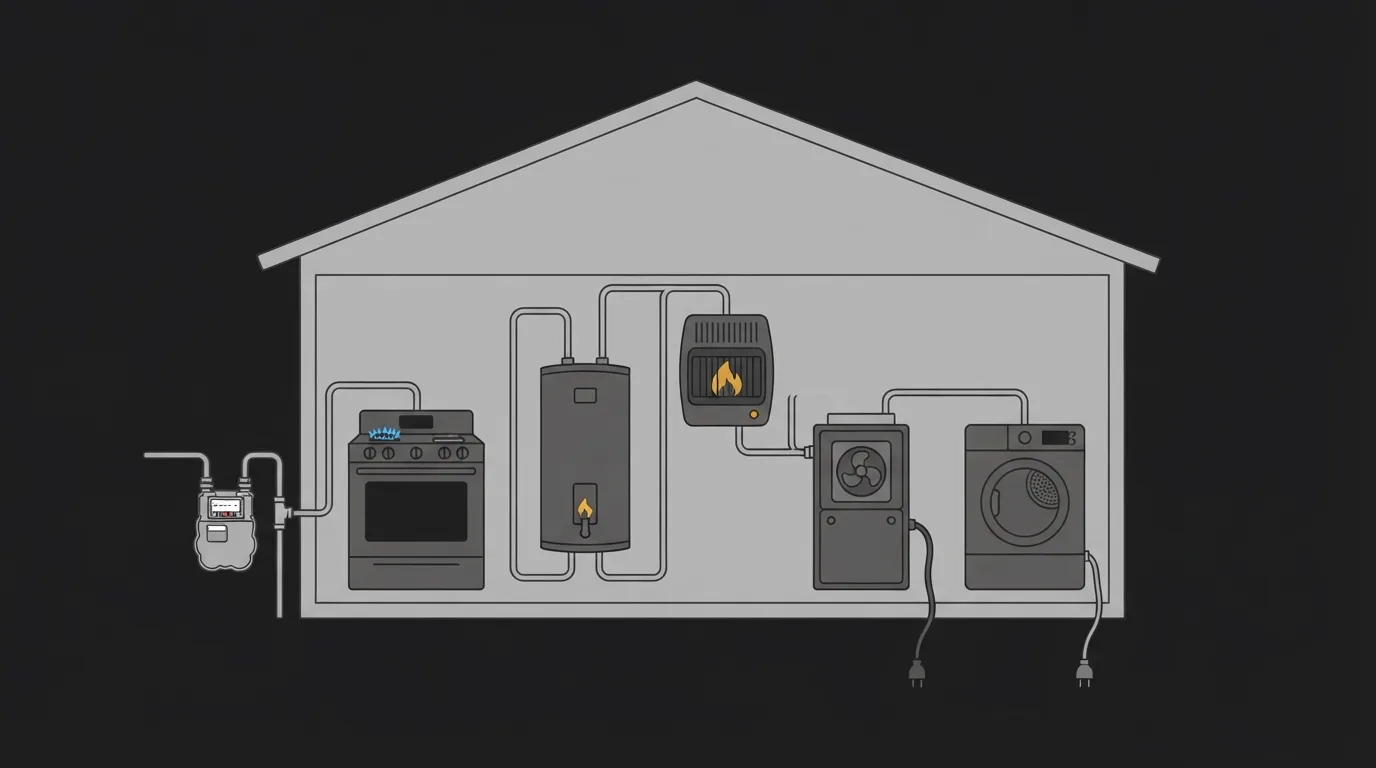
WestLight Energy, a California power agency, sorts household appliances this way (WestLight Energy, gas appliances during an outage):
- Usually still work: stovetop burners lit by hand, older tank water heaters with a pilot that burns all the time, gas wall furnaces, and most gas fireplaces.
- Usually stop: forced-air furnaces, gas ovens on most recent ranges, newer tank water heaters with electronic ignition, all tankless water heaters, and gas dryers, whose drum turns on an electric motor.
Your own model is what counts, so pull the manual for each appliance tonight and look for a section on power failures. Several makers put the manual-lighting steps right there.
Gas stove in a power outage: burners yes, oven no
Most gas cooktops with electric spark ignition can still be lit by hand. GE Appliances gives the method: hold a lit match next to the burner, then turn the knob to low (GE Appliances, lighting burners during a power failure). Light the match first so gas never builds up waiting for a flame, and use a long fireplace match or a utility lighter to keep your hand clear. Some high-end ranges have a safety interlock that cuts the gas to the burners when the power goes, so test yours on a normal day by flipping its breaker and trying a burner with a match.
The oven is the part that quits. GE says plainly that the oven "cannot be manually lit when there is a power outage," because its ignition system and gas valve need power. GE also warns that a burner blown out by a draft keeps sending gas until the knob is turned off, so never walk away from one.
A burner is for cooking. The range hood fan is off in a blackout, the burner's fumes stay in the kitchen, and Ready.gov says never to use a gas stove or oven to heat a home (Ready.gov, power outages). Cook, crack a window, then turn it off. For a house without gas, or when the burners will not light, our guide to cooking without power sorts the other stoves into indoor and outdoor ones.
Will my gas furnace work without power?
Almost certainly not, if it is the common kind that blows warm air through ducts. A forced-air gas furnace needs electricity for the blower that moves the air, and in most homes also for the igniter, the draft fan that pushes exhaust up the flue, and the control board that runs the sequence. WestLight puts it simply: most heating systems need electric fans and will not run with the power out. A furnace with an old standing pilot still needs its blower, so it stays off as well.
The exceptions are gravity and wall furnaces with no blower, some floor furnaces in older houses, and direct-vent wall heaters built to run without power. If you have one, find out from its manual whether it needs a battery or power for its controls.
The furnace blower and controls draw a small fraction of what the burner delivers in heat, which is why a modest generator can often keep a gas furnace running. Most furnaces are wired straight into a house circuit, though, so the safe route is a power inlet and transfer switch installed by an electrician, with the generator outdoors and well away from the house. Our guide to what size generator a house needs walks through reading the furnace label and adding up the loads.
Without a generator, the furnace is out of the plan for the duration. Shrinking the house to one sealed room is the next move, and our guide to staying warm without power in winter covers it step by step.
Gas water heater in a power outage
Here the age of the unit decides it. NW Natural, a gas utility in Oregon and Washington, says "most natural gas water heaters work without electricity" (NW Natural, natural gas in a power outage). That holds for the classic tank with a pilot: a small flame that burns day and night, a thermocouple that keeps the gas valve open while the flame is lit, and a flue that draws by heat alone.
Newer tanks are a different story. WestLight notes that many recent tank models use electronic ignition and stop without power, and that tankless gas heaters need electronic controls and stop as well. Units with a fan on top (power-vent models) also need power to push exhaust out.
A quick way to tell what you own:
- If you can see a flame through a small window near the base and the gas knob has a pilot setting, you have the old pilot design that works through an outage.
- A power cord or hardwired cable, a fan housing on top, or a digital display means it stops when the power does.
- A wall-hung box with no tank is tankless and always needs power.
A working water heater in a blackout gives you hot water for washing up, and the tank itself is a store of drinking water if the city supply fails. Our two-week water guide covers how much a household needs and where else to find it.
Gas fireplaces, wall heaters and logs
NW Natural says a gas fireplace "can work, even during a power outage," and many sealed, direct-vent fireplaces with a millivolt pilot do. Units with electronic ignition often take a battery backup for exactly this case, so put fresh batteries in yours before winter. A fan built into the surround will stop, which means the fireplace warms the room it sits in by radiant heat and little else. WestLight's caution applies: fireplaces are not a very effective source of heat for a whole house.
For one room in a blackout, that limited reach is fine. Seal off the room, close the doors around it, and let the fireplace work on a small space. A vent-free gas log set or wall heater releases its exhaust indoors the same way a stove burner does, so it is a different case. Our guide to safe indoor heaters for a power outage covers when an unvented heater can be used and when it cannot.
Carbon monoxide: the limit on everything above
Every gas flame makes some carbon monoxide, and a blackout takes away the fans that usually carry it out. A vented water heater or sealed fireplace sends its exhaust up a flue. A stovetop burner, an oven door left open and a vent-free heater put theirs into the room. Families trying to stay warm also close every door and window, which traps it.
Ready.gov's rules are short: carbon monoxide detectors with battery backup on every level of the home, and never a gas stove or oven to heat it. Snow can also block the outside vents of a high-efficiency furnace or water heater, so clear them after a storm. Our carbon monoxide guide covers the symptoms, where each fuel-burning appliance may run, and what to do when an alarm sounds.
If you smell gas, or the gas goes out
Natural gas carries an added odor that smells like rotten eggs. If you notice it, leave the house first and call 911 and the gas company's emergency line from outside, which is also what Atmos told its customers during the 2022 cold snap. Do not flip switches, start a car in an attached garage or use a phone inside.
Do not shut off the gas at the meter just because the power is out. Ready.gov's utility advice is that once the gas is off, only a professional should turn it back on (Ready.gov, safety skills). After a big storm, that wait can stretch into days while crews work through every house relighting pilots. Close the meter valve only for a leak, a fire or structural damage, and keep the right wrench beside it.
If your gas pressure drops or stops, turn every appliance to off or pilot. When it returns, a pilot that went out will not light itself, and a burner left on at the stove could leak. Relight pilots following the steps on the appliance label, or wait for the utility if you are unsure.
Would natural gas still work in an apocalypse?
The long-collapse version of this question, a grid down for months after an EMP, a solar storm or a cascade nobody can restart, has no real-world case to learn from. An MIT Lincoln Laboratory study for the Defense Department says so directly: weather outages have shown the gas system's resilience, "but no long-term, widespread electricity grid failures have occurred" (MIT Lincoln Laboratory, TR-1173).
The same study is the best guide to what would happen. It finds the gas system "reliable for short-term, limited-area disruptions," but warns that an outage covering everything from the wells to the customers, and lasting longer than the gas in storage, would void firm delivery contracts. Its conclusion is that gas-fired generators without a second fuel are unlikely to keep running "longer than weeks to a few months (depending on time of year)." That was written about military bases with priority contracts. A house at the end of a distribution line sits further back in that queue.
Several things wear down in a long collapse besides the compressors. Processing plants, the control systems that open and close valves remotely, and the crews who fix frozen wellheads and leaks all need power, fuel and people showing up to work. Our page on what happens if the power grid goes down follows what fails in the first hour, day, week and month. The gas may well keep coming for some time on momentum, and there is no way to know in advance how long your own line would last.
So a prepper planning for that case should treat the gas meter as a short-term asset. Use it while it works, and keep a fuel you hold yourself for the long run: propane in tanks you own, firewood for a wood stove, or both.
Planning for an outage that lasts weeks
For a two-day ice storm, a gas house with the right appliances is in good shape: hot meals, hot water and maybe a warm living room. For an outage of weeks, assume the gas could weaken at the same time the power is out, the way it did in Texas, and keep a second way to cook and stay warm that does not run through the meter. That might be a propane camp stove used outdoors, a supply of fuel for a heater that is rated for indoor use, and sleeping bags for everyone. The long-term power outage guide covers the rest of the house: food, water, light and sanitation.
If you are replacing an appliance anyway, ask the installer whether the model has a constant pilot, battery-backed ignition or a manual-lighting option. Ranges with burners you can light by match are common. Water heaters with a standing pilot are getting harder to find as makers move to electronic ignition, so a family that values outage use should ask early rather than take whatever is in stock.
My take: check the house before the first freeze
I'd start with the water heater, because it is the appliance most people guess wrong about, and I'd judge the whole house by one test: what can you cook and wash with when the breaker panel is dark? Spend one evening walking the house with a flashlight and a notepad. Look at the water heater for a pilot window or a power cord. Find the manual for the range and see whether it mentions lighting by match, then try it with the breaker off. Check whether the fireplace has a battery pack. Write the answers on the inside of a kitchen cabinet so whoever is home during an outage knows what still works.
Then add the three things gas cannot give you on its own: a box of long matches or a utility lighter kept beside the stove, a battery-powered carbon monoxide alarm for every floor, and a heating plan that does not depend on the furnace. A family that knows which flame still lights in the dark is far better off than one that finds out at midnight with a cold furnace.
Frequently asked questions
If the grid goes down, will natural gas still flow?
If the power goes out, will natural gas still work in my house?
How long will natural gas last in a blackout?
Would natural gas still work in an apocalypse?
Should I shut off my gas when the power goes out?
Can I run my gas furnace on a generator?
Is it safe to cook on a gas stove during a blackout?
How do I know if my water heater has a standing pilot?

Written by
Walt Brenner
Grid-down threats, home security and family plans
Walt Brenner is the pen name of the writer who covers grid-down threats, home security and family emergency plans for Dark Grid Prep. He draws on FEMA and Ready.gov guidance, utility and government reports, manufacturer manuals and long-running prepper forums, and he says plainly where those sources disagree. His beat is the household: what a family of four in a suburb or on a rural lot should have, know and do before the lights go out.
Last checked 2026-11-17
Comments
No comments yet. Questions and your own experience are welcome.
Thank you. Your comment will appear once it has been reviewed.