Grid-down living
Cooking without power
Indoors, cook only on the burners of a gas range lit by hand, a wood stove or fireplace with a working chimney, a butane stove whose label allows indoor use, or electric appliances on a battery or generator. Propane camp stoves, charcoal and gas grills, and the generator itself stay outside in open air, never in the garage or on a porch by a door.
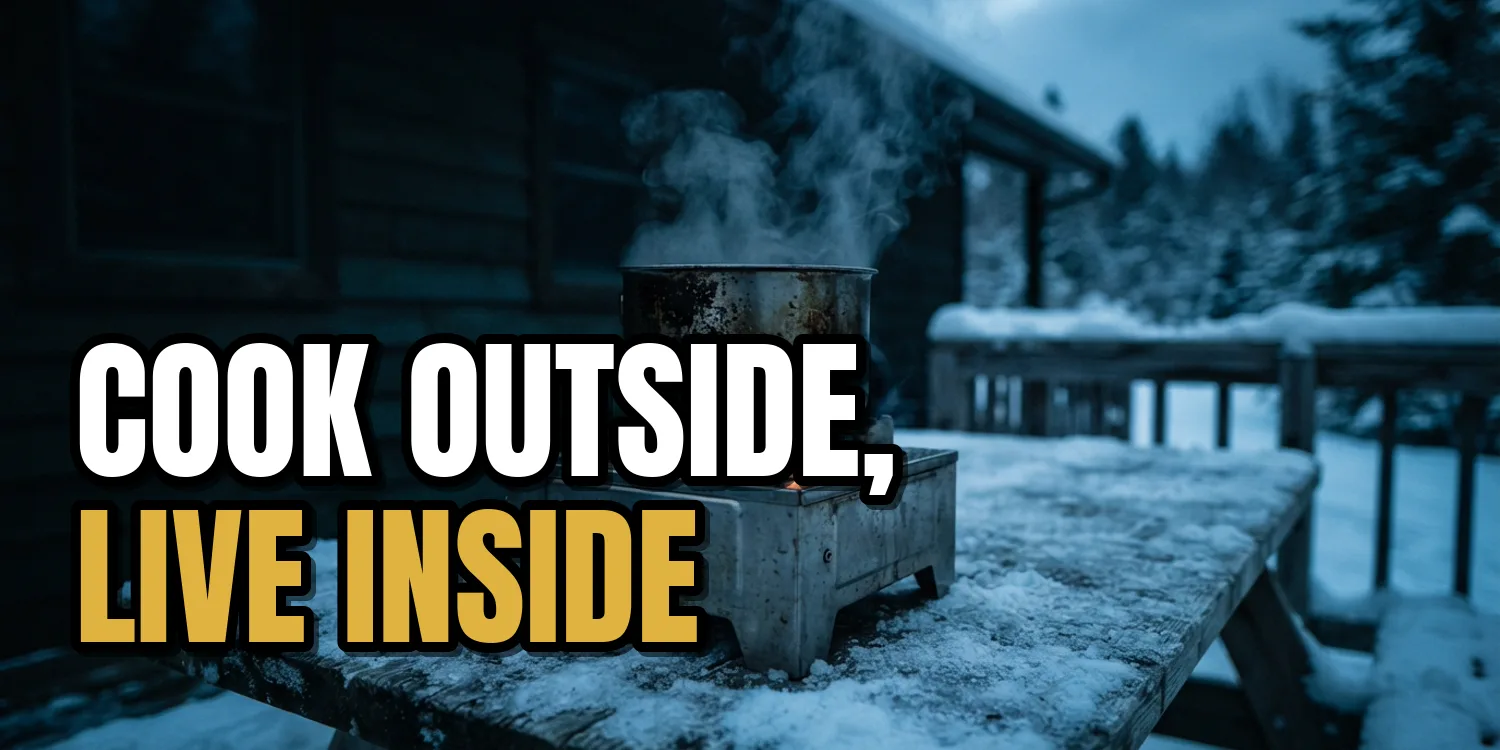
The first evening of a winter outage, someone in the house will want something hot. The kitchen is cold, the electric range is dead, and the camp stove from the summer trip is sitting in the garage. That stove is the reason this page exists, because the line between a warm dinner and a carbon monoxide call is mostly about where the flame burns.
Everything here comes from public sources a reader can check: the CDC, Ready.gov, the Department of Energy, and the power-failure instructions appliance makers publish for their ranges. We have not cooked on each stove ourselves. Where a rule depends on your own appliance, we say which part of its manual to check.
What is safe to cook with indoors
Five kinds of heat were built to run inside a house, and each comes with its own condition.
- The burners of a gas range. Natural gas usually keeps flowing in a blackout, and most cooktops with electric ignition can be lit with a match. The oven is a different story, covered below.
- A wood stove or a fireplace. Both vent through a chimney, which is what makes them indoor appliances. A flat-topped wood stove will hold a kettle or a cast-iron pan. An open fireplace can cook in a Dutch oven on coals, but only if the flue is open and the chimney was swept this season.
- A butane stove rated for indoor use. A small number of tabletop butane burners carry a CSA or ETL listing for indoor use. The rating is printed on the stove and in its manual. Without it, treat the stove as an outdoor one.
- Canned chafing fuel. The small cans of gel that keep buffet trays warm are made for use in dining rooms, with ventilation. They warm a can of soup slowly and boil water very slowly.
- Electric appliances on backup power. A microwave, kettle or coffee maker plugged into a battery station, or into a cord from a generator running outside, is the cleanest heat in a dark house.
Every flame on that list still burns oxygen and makes some carbon monoxide, so all of them assume a working battery CO alarm on the same floor. Our guide to carbon monoxide safety when the power is out covers where to put the alarms and what the first minute after one sounds should look like.
Can you use a camp stove indoors?
For the green propane stove most families own, the answer is no. The CDC's disaster guidance says to never use a charcoal grill, hibachi, lantern or portable camping stove inside a home, tent or camper, and it extends that to basements and garages (CDC, avoiding carbon monoxide poisoning). Read the warning label on yours. A propane camp stove without an indoor listing printed on it is an outdoor appliance.
The reason is simple once you see it. A camp stove is built to burn hard in moving air, and the open flame has no flue. In a closed kitchen in January, with the range hood fan off because the power is out, the exhaust has nowhere to go. A cracked window helps less than people expect, and a family that has been sealing doors against the cold has also sealed in the fumes.
Butane tabletop stoves are the exception people ask about. Modern Survival Blog, a long-running preparedness site, separates models that carry an indoor approval from generic camping units rated for outdoor use only, and its rules for the indoor-rated kind are strict (Modern Survival Blog on indoor butane stoves):
- Short cooking only, never as a heater.
- A ventilated room, never a sealed one.
- A stable, non-flammable surface away from curtains.
- Never left burning unattended.
- Turned fully off before the canister comes out.
- A carbon monoxide alarm in the home.
The same page notes that leaked butane is heavier than air and settles low, so spare canisters belong in a cool, ventilated shed or garage shelf, away from the stove and any heater. A dented or rusted canister goes in the trash, not on the stove.
Cooking on a gas stove when the power is out
If you cook on natural gas or propane at home, you probably have the best indoor option already. GE Appliances says the surface burners on its electric-ignition ranges can be lit with a match during a power outage: hold the lit match next to the burner, then turn the knob to low (GE Appliances, lighting burners during a power failure). Strike the match before you turn the knob, and use a long fireplace match or a utility lighter so your fingers stay clear.
GE adds a warning worth reading twice. A burner that blows out keeps sending gas until someone turns the knob to off, so a pot on a lit burner is never left alone in a drafty kitchen. The oven is off the table: GE says it cannot be lit by hand, because both its igniter and its gas valve need electricity. Some ranges also have a safety interlock that shuts the gas to every burner when the power drops, so try yours with a match on a normal day, with the range's breaker switched off.
Our answer to whether natural gas still works when the grid goes down covers the rest of the gas appliances in the house, from the furnace to the water heater. The one rule to bring back to the kitchen is that a burner is for cooking. Ready.gov says never to heat a home with a gas stove or oven (Ready.gov, power outages). Cook the meal, turn the burner off, and use the heaters in our guide to safe indoor heaters for a power outage for warmth.
What stays outside, and how far out
Anything that burns charcoal, propane from a bulk tank or camp cylinder, wood in the open, or gasoline does its cooking in the yard. That covers the charcoal kettle, the gas grill, the two-burner camp stove, a turkey fryer, a rocket stove, a fire pit and the generator that might run an electric hot plate.
Outside has a specific meaning in the official guidance. Ready.gov puts generators, camp stoves and charcoal grills outdoors and at least 20 feet from windows, doors and attached garages. The CDC adds that the garage is not outside, even with the big door rolled up, and that a grill near an open window can still push fumes into the house. Carbon monoxide has no smell, and charcoal burned indoors or in a garage is one of the leading causes of the poisonings the CDC counts after storms.
In practice, that rules out a few spots people reach for in bad weather:
- The attached garage, with the door open or shut.
- A screened porch or a covered patio against the back door.
- A sunroom, a mudroom or a basement walkout.
- Under the eaves next to a bedroom window.
Pick the spot before the storm. A patch of open yard or driveway with a folding table, clear of overhanging branches and away from the fuel cans, works for most houses. In snow, shovel a pad and set the stove on something level and dry. A wind screen of plywood or the side of a cooler helps the flame on a camp stove, but keep it on the windward side only, so the stove still has open air around it.
The generator gets its own spot, and the cook should not be standing in its exhaust. Our guide to choosing a home generator for a blackout covers how far it sits from the house and how it connects.
Cooking on battery or generator power
If you have backup electricity, the kitchen appliances you already own become the safest stove in the house, because they burn nothing indoors. The trade is in watts. The Department of Energy's appliance brief lists a microwave at 750 to 1,500 watts, a coffee maker at 900 to 1,200 and a toaster at 750 to 1,500, and notes that the figure on the nameplate is the most the appliance will draw (DOE appliance energy brief, Oregon State mirror).
High watts for a short time is the pattern to plan around. A 1,000-watt microwave run for five minutes uses about 83 watt-hours, a small slice of a mid-size battery station. The catch is the peak: the station's inverter has to handle the full draw at once, and many small ones cannot run a microwave at all. Read the station's continuous output rating and compare it to the appliance label before the outage.
On a portable generator, cooking is one more load on a machine that may already be running the fridge and the furnace fan. Turn something off while the microwave runs, or schedule meals for when the fridge has had its hour. Our generator sizing guide adds up the watts, and the solar generator runtime calculator shows how many days a battery lasts once cooking joins the list.
No-cook meals for a power outage
The easiest way to stay safe is to cook less. A household with a few days of food that needs no heat at all can skip the stove question for the whole first stretch of an outage, which is also when people are tired, distracted and most likely to make a mistake with fuel.
Order matters. Ready.gov says a closed refrigerator keeps food cold for about four hours and a full freezer holds its temperature for about 48. So the first meals come out of the fridge, the next ones out of the freezer as it thaws, and the pantry waits. When the power comes back, our power outage food safety checker sorts what survived.
For the pantry days, a few combinations need nothing but a can opener and a spoon:
- Tortillas with peanut butter and honey, or with canned chicken and a packet of mayonnaise.
- Canned tuna or salmon on crackers, with a can of fruit on the side.
- Ready-to-eat cereal or granola with shelf-stable milk from a carton.
- Rinsed canned beans with canned corn, salsa and tortilla chips.
- Trail mix, dried fruit and jerky for the middle of the day.
Our two-week emergency food list sets aside a three-day no-cook core for exactly this, and our page on MREs covers the military-style meals whose flameless heater warms food with a little water and no flame. That heater gives off hydrogen, so it still wants an open room.
Boiling water and planning fuel for it
In many outages the stove's biggest job is water. When a boil-water notice goes out, or a well's water is in doubt after flooding, the CDC says to bring water to a rolling boil for one minute, or three minutes above 6,500 feet, and notes that boiling does not remove chemicals (CDC, making water safe in an emergency). For how much water to store and the other ways to treat it, see our guide to storing water for a two-week outage.
Boiling eats fuel faster than warming food does, so it should be part of the fuel count. The most reliable numbers come from your own stove. Its manual lists the burn time of one canister or cylinder on high. Time how long your pot takes to boil a quart on a calm day, and you can work out how many boils one cylinder gives and how many cylinders a week of drinking water and meals takes.
How to cook during a power outage and make fuel last
Cooking on a single burner for a week is a different skill from cooking in a full kitchen. A few habits cut the fuel each meal takes:
- Keep a lid on every pot. An open pot loses much of its heat to the air.
- Cook one-pot meals: rice and canned chicken, pasta with a jar of sauce stirred in at the end, oatmeal with powdered milk.
- Use retained heat. Bring a pot of rice or beans to a boil, turn the flame off, and wrap the covered pot in towels or set it in a cooler for an hour to finish.
- Heat water once for the day and keep the extra in a vacuum bottle for coffee, cocoa and washing up.
- Thaw freezer food in the fridge before you cook it, so the stove is not doing the thawing.
- Use paper plates and one pan, because washing up takes water you may be hauling.
Fire and fumes while you cook
Cooking is still the most common way a house fire starts, and an outage makes the kitchen darker and the cook more rushed. Keep a headlamp on the cook rather than a candle on the counter, keep a lid within reach to smother a pan of burning oil, and never put water on grease. A multipurpose ABC extinguisher belongs by the kitchen exit. Our page on fire safety in a power outage covers which extinguisher to buy, where to mount it and when to leave instead.
Then watch the people. Headache, dizziness, nausea and sleepiness in several family members at once, especially after a meal was cooked, are the pattern the CDC warns about. Everyone goes outside into fresh air first, and the call to 911 comes from there.
What I'd set up before the next storm
I'd start by finding out whether my own range lights with a match: switch off its breaker on a quiet afternoon and try one burner. If it lights, the house already has its indoor stove, and the rest of the plan is a second CO alarm in the kitchen and a box of long matches in the drawer.
Then I'd pick the outdoor spot, put a folding table and a shovel by the back door, and keep the camp stove and its cylinders in the shed where nobody will be tempted to carry them into the kitchen on a cold night. If the house is all-electric and has no backup power, I'd lean harder on no-cook food and buy one butane stove with an indoor rating printed on it, with a few canisters stored outside. Three days of meals that need no heat at all covers the worst stretch, when nobody yet knows how long the outage will last.
Frequently asked questions
Can I use a propane camp stove in my kitchen if I open a window?
Can I cook on a charcoal grill in the garage with the door up?
Will my gas oven work during a power outage?
What can I eat if I have no way to cook at all?

Written by
Walt Brenner
Grid-down threats, home security and family plans
Walt Brenner is the pen name of the writer who covers grid-down threats, home security and family emergency plans for Dark Grid Prep. He draws on FEMA and Ready.gov guidance, utility and government reports, manufacturer manuals and long-running prepper forums, and he says plainly where those sources disagree. His beat is the household: what a family of four in a suburb or on a rural lot should have, know and do before the lights go out.
Last checked 2026-11-19
Comments
No comments yet. Questions and your own experience are welcome.
Thank you. Your comment will appear once it has been reviewed.