Grid-down living
Choosing a home generator
For most households a portable generator with a manual transfer switch is the best value for a blackout, an inverter model suits a smaller list of loads and a quiet street, and a standby unit is worth its price when someone in the house cannot go without power or nobody is home to start a machine. A solar battery station runs the small things indoors and silently, but it will not carry a well pump or a furnace through a cloudy week.
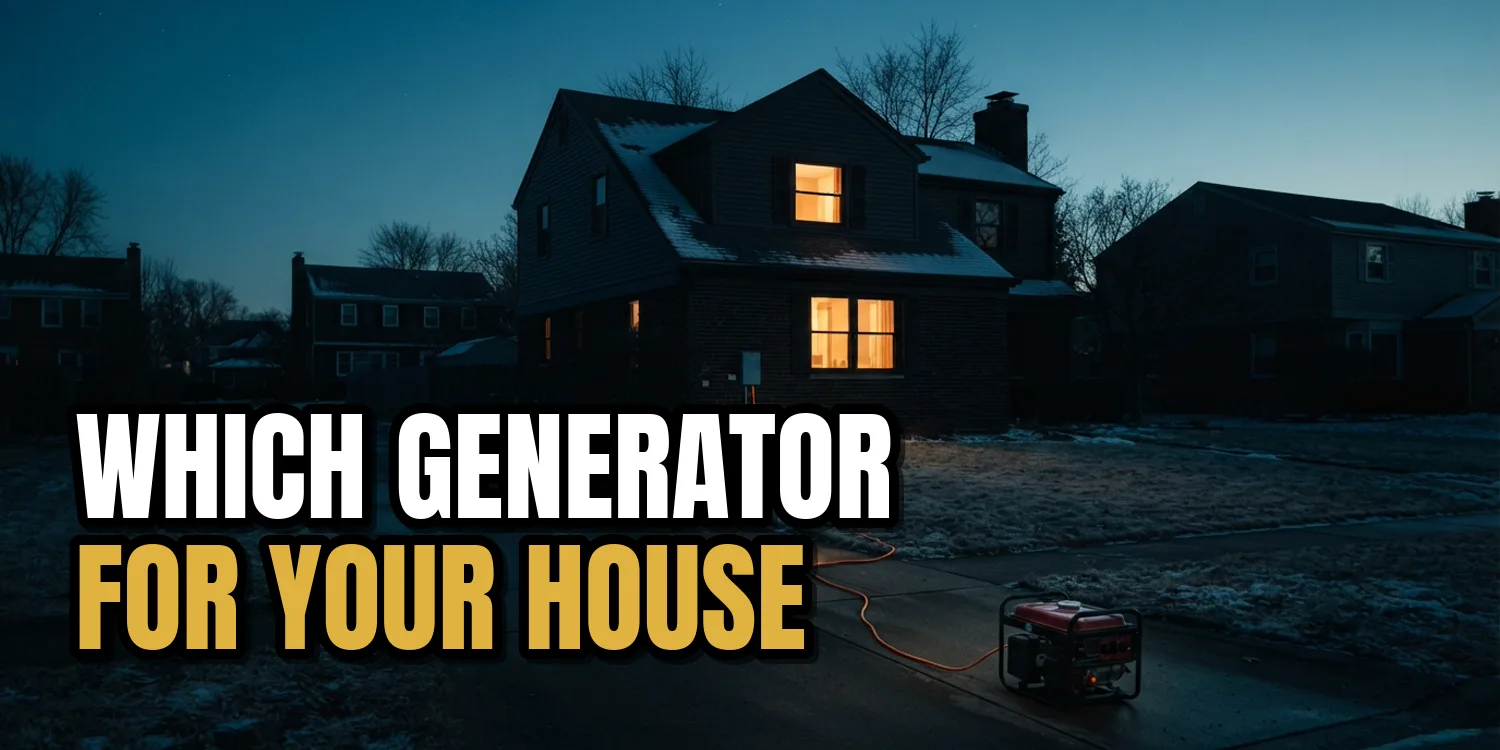
The choice comes down to four questions, in this order: what has to keep running, who will be home to start the machine, how it reaches the house wiring, and what fuel you can keep on hand. The watts come first, and we work them out on a page of their own: what size generator a house needs walks through the appliance labels and the motor surge. This page is about the kind of machine and how you live with it once the street goes dark.
Home generator for a power outage: the four kinds
Backup power for a house comes in four shapes. A conventional portable is an open steel frame around an engine and an alternator that turns at a fixed speed. An inverter portable sits in a closed case and changes its engine speed with the load. A standby generator lives on a concrete pad beside the house, runs on natural gas or propane, and switches on by itself. A battery power station, sold as a "solar generator", stores electricity and refills from panels, a wall outlet or the car.
The first three burn fuel and make carbon monoxide, so all three stay outdoors. The fourth burns nothing, which is why it is the only one that can sit beside the bed.
Portable generators: the most watts for the money
A conventional portable is what most hardware stores stock, from about 3,000 to well over 10,000 running watts. Large ones come with a 120/240-volt twist-lock outlet, which is the plug a transfer switch or an inlet box needs, and which is what lets a portable start a 240-volt well pump. For a rural house on a well that is often the deciding fact.
The price of that power is labor. A generator dealer's comparison of a 6.5 kW portable against a small standby unit lays out the routine: wheel it out once the rain stops, fill it, connect the cord to the house and start it, then shut it down every 5 to 10 hours to cool and refill. The same writer puts the fuel for about 32 hours at half load at roughly 25 gallons of gasoline, and notes that most portables are not meant to run in rain or bad weather (Norwall, standby vs portable). In an ice storm, that means someone in a coat at 2 a.m. with a gas can and a flashlight.
Open-frame units are also loud, and on a dark street a running engine tells every passerby which house has power. Our long-term outage guide covers keeping a low profile, and running the generator in short blocks helps with both fuel and attention.
Inverter generators for the home: quieter and easier on fuel
An inverter generator makes alternating current, turns it into direct current and then rebuilds a clean sine wave electronically. Because the output no longer depends on engine speed, the engine can slow down when little is plugged in. That is where the fuel saving comes from. Honda's published specifications for its EU2200i, an 1,800-watt rated unit, give 3.2 hours on its 0.95-gallon tank at full load and 8.1 hours at a quarter load (Honda, EU2200i specifications). A light overnight load stretches a small tank a long way.
The clean waveform matters for routers, laptops, the electronic boards in a modern furnace and anything with a charger. What holds them back is size: most inverter models run from about 2,000 to 4,000 watts, and many have no 240-volt outlet, so they keep the kitchen and the communications alive rather than the whole house. Two small inverters of the same model can often be paralleled with a kit to roughly double the output, a route some households take so that one can be carried and the other left at home.
One honest catch: manufacturers quote inverter runtimes at a quarter load and conventional runtimes at half load, as Champion's own fuel guide explains (Champion, fuel face-off). Two boxes that both promise "up to 10 hours" are not making the same promise.
Standby generator vs portable
A standby unit is wired to the house through an automatic transfer switch. When the utility voltage disappears, the switch senses it, the engine starts, and within seconds the house is on generator power without anyone touching anything. When the grid comes back, it switches back and the engine cools down and stops. It runs off the home's natural gas line or a large propane tank, so there are no cans to fill.
That automation is the real product. It matters most for three kinds of household: someone on home oxygen, a CPAP or another powered medical device; a house that sits empty for days, where frozen pipes or a dead sump pump do the damage; and older owners who should not be dragging a 200-pound machine across ice. For our readers in that first group, Ready.gov's power outage page puts planning for medical devices that run on electricity at the top of the list (Ready.gov, power outages), and our oxygen concentrator outage plan covers the rest of that plan.
The costs are the price of the unit, a licensed installation with permits, and upkeep. The engine runs a short automatic exercise cycle every week or so to prove it starts, and that burns fuel even in a month with no outage. Oil changes come due after a set number of running hours, which on a unit running around the clock arrives inside the first week of a long outage. Keep the oil and filter it takes on the shelf.
Hooked to the gas main, the machine is also only as good as the gas supply. Most outages leave gas flowing, but a long regional failure is a different case, and our page on whether natural gas keeps working when the grid goes down goes through what happened to supply in the 2021 Texas freeze. A propane tank on the property is the stored-fuel version of the same machine.
Solar generator vs gas generator for blackouts
A battery station with folding panels has two traits no engine can match. It is silent, and it makes no exhaust, so it can sit in the bedroom beside the CPAP or in the kitchen next to the fridge. It also starts in any cold without a choke, a pull cord or a can of fresh gas.
What it cannot do is make energy on demand. A station holds a fixed number of watt-hours, and a compressor, a furnace blower or a sump pump empties that store quickly. Refilling depends on sun, and the storms that knock out the grid often leave days of cloud behind them, which slows panel charging just when you need it. Our solar generator runtime calculator takes your battery size, your loads and your winter sun hours and shows how long a given station lasts and how many panels it takes to refill.
For most houses the two work best together. The battery carries the quiet loads overnight, and the gas or propane generator runs a few hours a day to cool the freezer, pump water and recharge the battery. That cuts engine hours, fuel and noise all at once.
Transfer switch vs extension cords
Every generator except a standby unit gives you a choice about how its power gets inside. Three of the routes are safe, and there is a fourth that nobody should ever use.
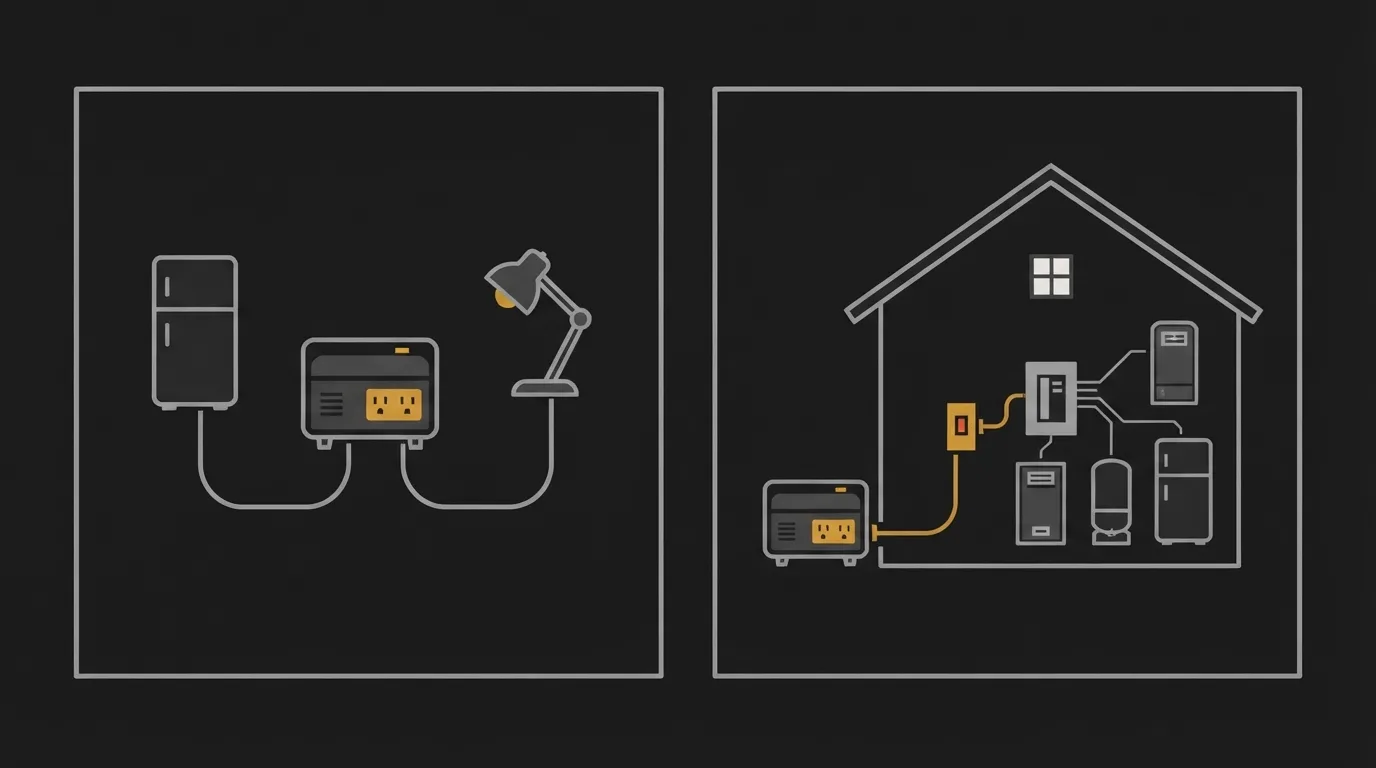
Extension cords are the cheapest start. Plug the refrigerator, a lamp and a phone charger straight into the generator with heavy-duty outdoor cords. The American Red Cross asks for cords rated at least as high as the combined load and in good shape, with all three prongs (Red Cross, safe generator use). The weakness is everything that has no plug. A furnace, a well pump and most sump pumps are wired into the panel, and a cord cannot reach them.
A manual transfer switch is a small sub-panel next to the main one. An electrician moves the circuits you choose into it (furnace, fridge, well pump, a few lights) and wires an inlet box on the outside wall. In an outage you run one cord from the generator to the inlet, flip the switch, and those circuits are live. A generator dealer's guide to the two panel options recommends the switch for most homeowners because it limits the generator to the chosen circuits and lets the electrician balance them across both 120-volt legs (Norwall, transfer switch vs interlock).
An interlock kit is a sliding plate on the main panel that lets either the main breaker or a generator breaker be on, never both. It is cheaper and lets you power any circuit in the house, which is also its trap. The same guide's example is a house where the well pump and the electric water heater kick on together and the whole place goes dark. With an interlock, you are the load manager, standing at the panel with a flashlight.
The route to refuse is backfeeding: a homemade cord with two male plugs pushed into a dryer or wall outlet. It can send power back up the utility line, where a lineworker expects it to be dead. The Red Cross warns that it puts utility workers, neighbors and your own household at risk, and electrical suppliers call it dangerous and illegal.
Gasoline, propane or natural gas
Fuel shapes the choice as much as the engine does. Gasoline is everywhere until the pumps lose power, and it goes stale in storage. Propane keeps for years in a tank, but Champion puts the output on propane at 5 to 10 percent below gasoline, and tank pressure drops in hard cold. Natural gas needs no storage at all and depends entirely on the pipeline. Dual-fuel portables, which run on gasoline or propane, let you keep propane as the long-term store and use gasoline when it is easy to get.
How much to keep depends on watts, load and hours a day. Our generator fuel calculator turns those into gallons or pounds and the cans or tanks they take, and shows the storage limits most fire codes set for a house and an attached garage.
Safety features that matter in the dark
Every engine generator makes carbon monoxide. Ready.gov's rule is to run it only outdoors, at least 20 feet from windows, doors and attached garages, and to keep battery-backed CO alarms on every level of the house. Our carbon monoxide guide for blackouts goes through placement, alarms and what to do when one sounds.
On a new portable, look for a CO shutoff. The voluntary ANSI/PGMA G300 standard, revised for units built from January 2025, requires a generator that claims to meet it to sample the air every second and shut down at 600 parts per million of CO, or at a 10-minute average of 400 (Norwall, G300-2023 summary). The sensor is a backstop for a mistake, and the 20-foot rule still applies.
Other features earn their keep on a cold night: electric start with a charged battery, a fuel gauge you can read with a headlamp, a fuel shutoff so the carburetor can be run dry before storage, and wheels that work on gravel and snow. A cover or tent made for running generators keeps snow and rain off without trapping exhaust. A tarp thrown over the frame does the opposite.
What I would pick for each kind of house
For a suburban house on city water with a gas furnace, I'd buy a dual-fuel portable in the 4,000 to 5,000-watt range with a 30-amp twist-lock outlet, and pay an electrician for an inlet box and a six-to-ten-circuit manual transfer switch. That gets the furnace blower, the fridge, the freezer and the router on real circuits without cords snaking through a cracked door. I'd add a battery station for the overnight hours so the engine can sleep.
On a well, I'd go straight to a larger portable with a 240-volt outlet and put the pump on the transfer switch, because water is why that household owns a generator at all.
I'd only spend standby money where the automatic start protects a person or the house itself: powered medical equipment, an owner who cannot handle a heavy machine in ice, or a place that sits empty in freezing weather. If budget is the limit and a quiet apartment-sized setup is all you need, a small inverter paired with a lithium power pack keeps the phone, the lights and the fridge going and fits in a closet.
Whatever you buy, start it once a month and run it under load, and do the first full connection on a clear Saturday afternoon. The night of the storm is a poor time to find out the inlet box needs a different plug.
Frequently asked questions
Can I run a generator in the garage with the door open?
Is an inverter generator big enough to run a house?
Do I need a permit for a standby generator?
Will a battery power station run a refrigerator?

Written by
Walt Brenner
Grid-down threats, home security and family plans
Walt Brenner is the pen name of the writer who covers grid-down threats, home security and family emergency plans for Dark Grid Prep. He draws on FEMA and Ready.gov guidance, utility and government reports, manufacturer manuals and long-running prepper forums, and he says plainly where those sources disagree. His beat is the household: what a family of four in a suburb or on a rural lot should have, know and do before the lights go out.
Last checked 2026-11-18
Comments
No comments yet. Questions and your own experience are welcome.
Thank you. Your comment will appear once it has been reviewed.