Medical when help is delayed
A blackout plan for CPAP and home oxygen
A home oxygen concentrator draws far more power than any battery a household can keep charged, so its plan rests on oxygen cylinders, a generator and a written point at which you leave for a place with power. A CPAP draws a fraction of that and can usually run several nights from a DC battery with the humidifier off. Both plans start with phone calls to the equipment supplier, the utility and the doctor, made before the storm.
When Texas lost power in February 2021, the state's final count of 246 deaths included people who lost the oxygen or dialysis equipment they relied on once the outage dragged on (NPR, via NHPR). For most households a blackout is a cold, dark inconvenience. For a household where someone breathes, sleeps or eats with the help of a machine, it starts a countdown, and the length of that countdown is set by decisions made months before.
This guide is written from the FDA's advice on medical devices in disasters, the American Lung Association's outage checklist for device users, the standard formula respiratory therapists use for oxygen cylinders, and the power math published by long-running preparedness writers. It does not replace the instructions that came with your equipment or a conversation with the clinician who prescribed it. It tells you which questions to ask them and how to turn the answers into a plan.
Start with a list and the watt-hours
Before anyone shops for a generator, write down every device in the house that plugs in and keeps someone well. The Survival Mom's guide to medical equipment in long outages suggests one line per device: who uses it, where its manual is, its running watts from the label, how many hours a day it runs, whether it has its own battery and how long that lasts, whether it takes DC power from a car or a 12-volt pack, and what happens if it stops (The Survival Mom). If the label gives amps instead of watts, multiply the amps by 120.
Then multiply watts by hours. That product, watt-hours per day, is the number every later decision hangs on. The same guide works two examples that show why oxygen and CPAP need such different plans:
- A home oxygen concentrator at 350 watts running around the clock uses about 8,400 watt-hours a day.
- A CPAP at about 55 watts for an eight-hour night uses roughly 440 watt-hours.
Its table puts typical home concentrators of three to five liters at 300 to 600 watts, portable concentrators at 50 to 150, and a CPAP without heat at 30 to 60 watts, rising toward 100 with a heated humidifier and tube. Your own machine's label beats any typical range, so use the number printed on it.
The four calls to make before storm season
Every official source on this subject starts on the phone. These calls cost nothing, and the answers decide how much equipment you need.
The equipment supplier
The company that delivered the concentrator or CPAP knows what it will tolerate. The FDA tells device users to read the instructions or call the distributor or manufacturer "to find out if your device can be used with batteries or a generator" (FDA). Ask how long any built-in battery runs at your settings, whether a spare battery can be supplied, and what the company does for its patients when an outage lasts days. Oxygen users should ask specifically for backup cylinders. The American Lung Association says suppliers "should provide stand-alone oxygen tanks that do not rely on electricity" (American Lung Association).
The prescriber
Ask the doctor what to do if the device has to stop for a while, and for nebulizer users, whether there is an alternative medicine or treatment to fall back on. The Lung Association suggests exactly that conversation for nebulizer and CPAP users whose outage outlasts their battery. Keep a printed copy of the prescription and the device settings with the plan.
The utility
Most electric companies keep a list of customers with medical equipment. Signing up "can give you priority notification of planned outages and may expedite power restoration," in the Lung Association's words, and some programs discount the bill. The programs we have read are careful to promise no restoration order, so the registry is a notice to the utility and nothing more. Our emergency plan for a parent who lives alone covers how those registries work.
The fire department
The FDA's power outage list opens with a step most people skip: "Notify your electric company and fire department to let them know you have a medical device that needs power." A fire department that already knows an oxygen user lives at an address can plan a welfare check or an evacuation instead of learning about it from a 911 call.
Oxygen: a plan built in layers
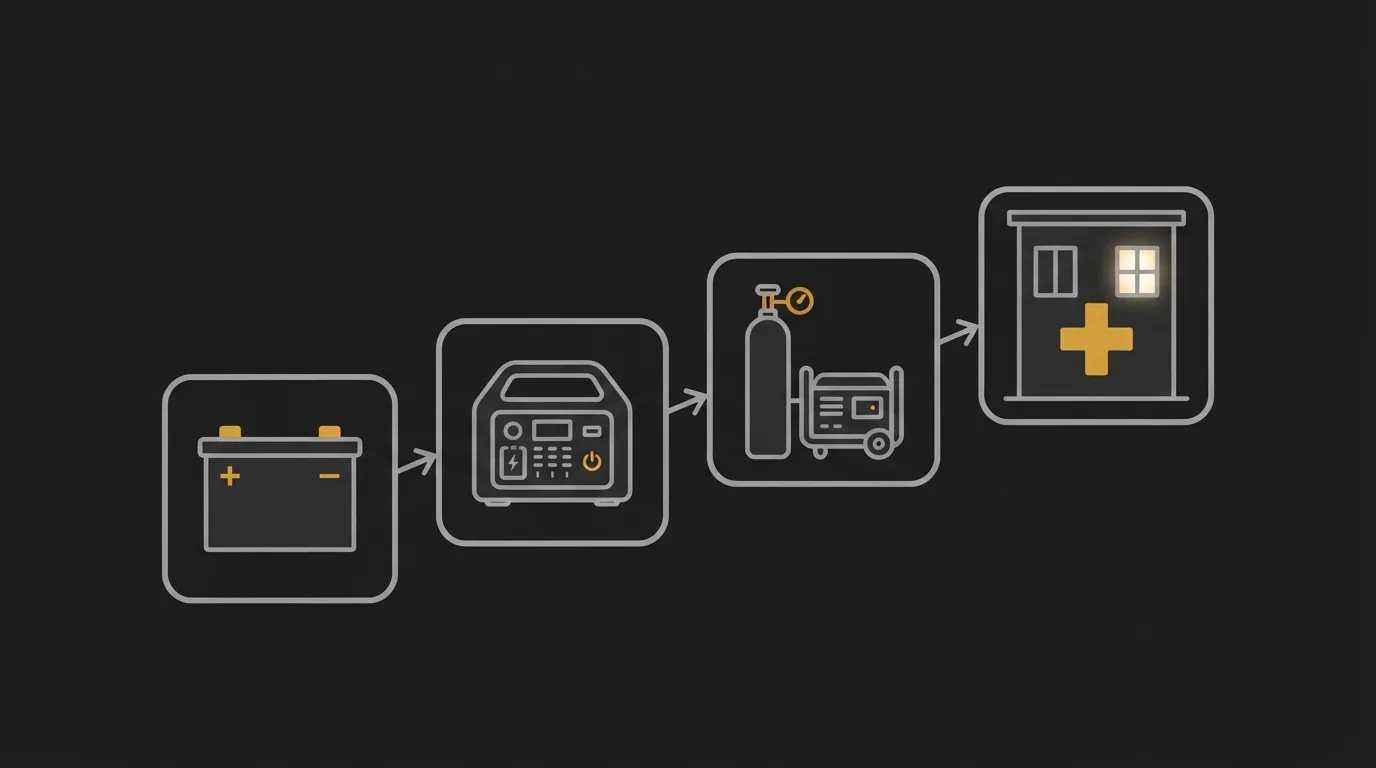
No single backup carries a home concentrator through a long outage, so the plan is a sequence. The Survival Mom lays it out by timeframe: a battery or small uninterruptible power supply for the first minutes, a power station as a short bridge, and a generator or large battery bank for day three and beyond, with oxygen cylinders under all of it as the fallback that needs no power.
Cylinders and how long they last
Respiratory therapists estimate cylinder time with one formula: minutes equal the gauge pressure times the cylinder factor, divided by the flow in liters per minute. The factor for the common E cylinder is 0.28, so a full E at 2,200 psi flowing at 2 liters a minute lasts about 308 minutes, a little over five hours (Respiratory Therapy Zone). Larger H cylinders carry a factor of 3.14 and last proportionally longer.
Run that formula for your own flow rate and the hours you want covered, and the cylinder count follows. Someone on 2 liters who wants a full 24 hours covered needs about five E cylinders, which surprises most families who keep one in the closet. Store them upright or secured so they cannot fall, away from heat, and ask the supplier how often to have them checked and refilled.
Portable concentrators
A portable concentrator draws a fraction of what a home unit does, which makes it the easier device to keep running. The Lung Association asks POC users to keep extra batteries and a car charger. Charging from a car works only outdoors with the engine in open air, never in a garage, and the fuel you burn is fuel you may need to evacuate.
Power stations and generators
A large battery power station is quiet and safe indoors, which makes it the right first layer when the lights go out at night. On a home concentrator it runs for hours, not nights: the Survival Mom calls a 2,000 watt-hour station "something to fill the gap, short term but not a three-day plan." Use those hours to switch to a cylinder, start the generator in daylight or move.
For outages measured in days, a generator does the heavy lifting. It runs outdoors only, at least 20 feet from doors, windows and vents, and the house needs working carbon monoxide alarms on every level. Our guides to sizing a generator for a house and carbon monoxide safety in an outage cover both in detail.
CPAP: the device that is easier to keep running
A CPAP is a low-draw machine used for a known number of hours, which puts a few nights within reach of a battery. Three habits stretch whatever battery you have.
First, run it on DC power where the maker allows. CPAP makers sell converters that take power straight from a 12-volt source. ResMed's for the AirSense 11, for example, accepts 12 or 24 volts from car sockets and standalone batteries (ResMed). Going DC to DC skips the loss of turning battery power into household current and back again inside the machine's own power supply.
Second, turn off the heated humidifier and heated tube during an outage. The Survival Mom's table shows heat nearly doubling a CPAP's draw. Keep distilled water on hand anyway, as the Lung Association advises, for when power returns or for a machine that tolerates the humidifier at low settings.
Third, keep two batteries if you can, one on the machine and one charging whenever the generator or a sunny day gives you spare power. At around 440 watt-hours a night, a 1,000 watt-hour station on DC covers two nights with room for phones.
Power the device will accept
Medical electronics can be fussy about what comes out of an outlet. The Survival Mom warns that a cheap conventional generator can make a CPAP noisy and throw error codes, and gives a short shopping rule: pure sine wave output on any inverter or power station, a surge rating above the device's startup draw, and enough watt-hours for the hours you need. For a generator, that points to an inverter model.
A small uninterruptible power supply between the wall and the device is a cheap fix for the first seconds. When the grid flickers, the machine keeps running instead of rebooting, and you get a few minutes to set up the next layer calmly. A UPS is a bridge for minutes and should never be counted as hours of backup.
Oxygen, flame and the lights you use
Blackouts bring out candles, oil lamps and camp stoves, and every one of them is a hazard near supplemental oxygen. The FDA asks oxygen users to use "battery powered flashlights or lanterns rather than gas lights or torches when oxygen is in use." Oxygen itself does not explode, but it feeds a fire and makes it burn hotter and faster, as Respiratory Therapy Zone explains.
In practice that means battery lanterns and headlamps in every room the oxygen user spends time in, no candles in the house at all while oxygen is running, and fuel-burning heaters kept well away from the tubing and the bed. Our article on indoor heaters for power outages and the guide to staying warm without power show how to heat one room safely.
Decide now when you leave
The hardest call in a long outage is the one families put off: when to stop waiting for the lights and go somewhere with power. Make it on paper while everyone is calm. The Survival Mom suggests a rule shaped like this: if the concentrator has less than eight hours of combined battery and cylinder time left and you cannot refuel or start the generator, you go to a named place.
That place should be decided in advance and written down with a backup. A relative's house on a different circuit, a hospital, or a shelter with a generator all work. The Lung Association notes that local shelters often have generators for charging devices, and that ventilator users whose battery runs short should relocate to a hospital or shelter. The FDA goes further for anyone whose device keeps them alive: seek emergency services immediately, and if possible ask your local public health authority for evacuation before severe weather arrives.
Keep the car's tank above half during storm season so that leaving is possible, and keep a go-bag for the device user with tubing, cannulas, filters, chargers, the manual and the prescription. Our emergency medication guide covers the medicine that goes with it.
When the power comes back
The outage is not over when the lights return. The FDA points out that many devices "reset to a default mode when power is interrupted," so read the settings on the screen and compare them with the printed copy before the user goes back on. Check that cords and batteries are dry, and do not plug in anything that got wet.
Then refill the layers in the order you will need them: recharge the device battery and the power station, call the supplier for cylinder refills, refuel the generator cans, and write down what ran low. Those notes are the best guide you will ever have to what the next plan needs.
Put it on one sheet
A plan that lives in one person's head fails the night that person is the one who is sick. Write a single page for each device with the model and serial number, the settings, the watt-hours per day, the battery and cylinder hours you have, the supplier's 24-hour number, the prescriber's number, the leave rule and the destination. Tape one copy near the machine and put one in the go-bag. Our printable family plan has room for the doctor and the meeting places, and the device sheet clips behind it.
Then try it. Our grid-down drill shows how to run a weekend with the main breaker off while the medical gear stays on its backups or keeps its normal power, which is the only way to find out that the DC cable is in the wrong drawer before it matters.
What I'd do first
For an oxygen user, I'd make the supplier call this week and ask for backup cylinders sized to a full day at the prescribed flow. Cylinders need no fuel and no charging, they work in any weather, and they are the layer most households are missing. The utility and fire department calls come next, then a generator plan for anything longer than a day.
For a CPAP user, I'd buy the maker's DC converter or battery first and practice a night on it with the humidifier off. That one purchase covers most outages. In both cases, I'd write the leave rule before buying anything else, because it is the decision that keeps a bad outage from becoming an emergency. The medical section has the rest of the household's kit, starting with the home trauma kit.
Frequently asked questions
Can a portable power station run a home oxygen concentrator overnight?
Will the utility restore my power first if I register as a medical customer?
Is it safe to sleep one night without my CPAP?
Where can I charge a device if my backup runs out?

Written by
Walt Brenner
Grid-down threats, home security and family plans
Walt Brenner is the pen name of the writer who covers grid-down threats, home security and family emergency plans for Dark Grid Prep. He draws on FEMA and Ready.gov guidance, utility and government reports, manufacturer manuals and long-running prepper forums, and he says plainly where those sources disagree. His beat is the household: what a family of four in a suburb or on a rural lot should have, know and do before the lights go out.
Last checked 2026-11-15
Comments
No comments yet. Questions and your own experience are welcome.
Thank you. Your comment will appear once it has been reviewed.