Grid-down living
Power outage checklist for families
In the first hour, hand out lights, close the fridge, catch water and get the news on a radio. Over the first day and week the list moves to food, phones, medicine, warmth and sanitation, and it ends with a short list for the moment the power returns.
This is the list to print and tape inside a kitchen cabinet. Each line is something one person can do and tick off, sorted by when it needs doing. The reasons behind each step, and what to do if the outage runs past a week, are in our longer guide to surviving a long power outage at home. Here the job is to get a family moving in the right order without a meeting at the kitchen table in the dark.
The sources are the ones a reader can check: the American Red Cross power outage safety page and Ready.gov's power outage guidance, plus what families who sat through week-long outages have written afterward about the things they forgot.
Split the first hour into four jobs
Most families lose the first half hour to everyone doing the same thing at once: three people hunting for the same flashlight while nobody fills the bathtub. Give each adult or older child one job before it ever happens, and write the names on the printed list.
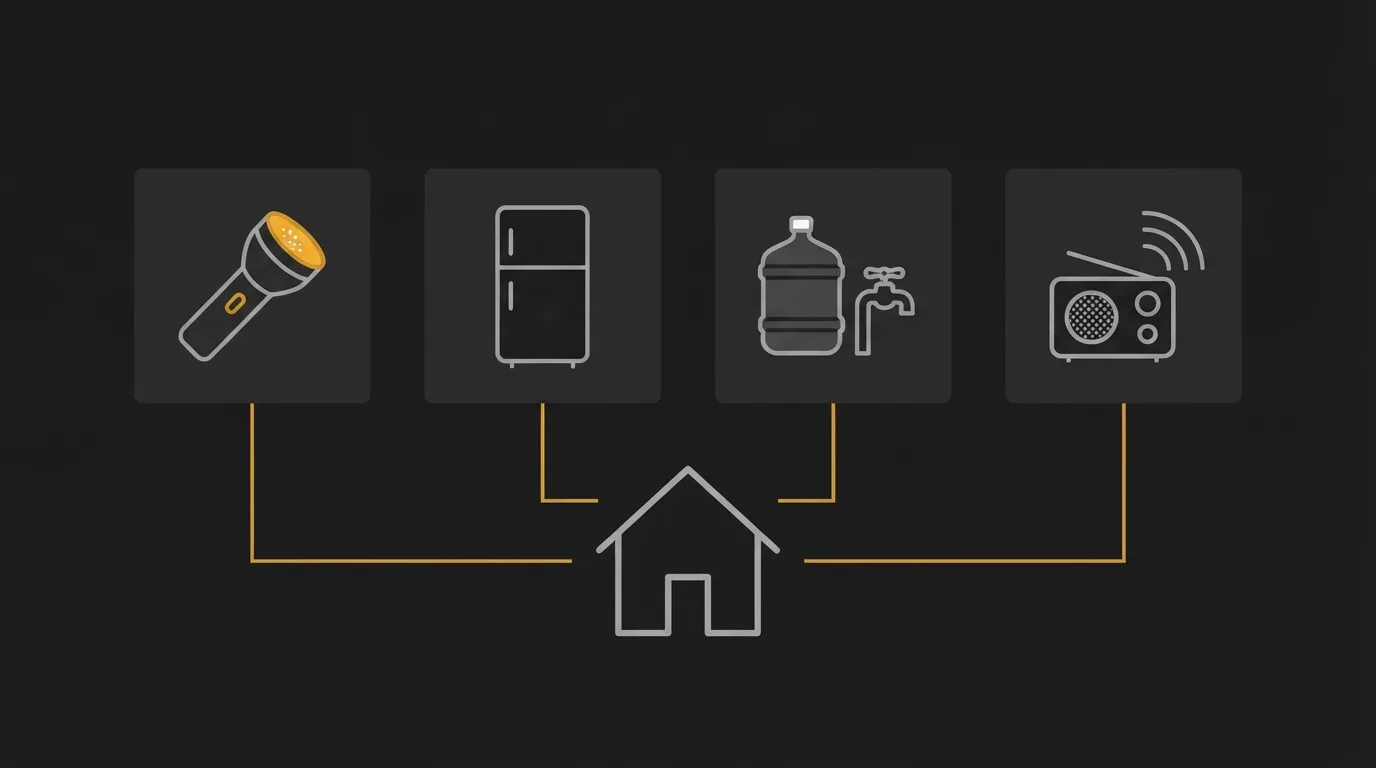
- Light. Gets a flashlight or headlamp to every person, puts the youngest child's light in their hand first, and keeps candles in the drawer.
- Cold food. Closes the refrigerator and freezer, tapes a "do not open" note across both, and drops a thermometer in each if there is not one already.
- Water. On city water, fills the bathtub and every clean pot while pressure lasts. On a well, counts the stored jugs, because the pump stopped with the power.
- News. Turns on the battery or crank radio, reports the outage to the utility once, and texts the family's out-of-area contact.
A family that has run this once in daylight does it in ten minutes at night. Our grid-down drill is the way to rehearse it without waiting for a storm.
The first hour: the tick list
Go through it top to bottom. The first two lines tell you whether you have an outage at all or just a tripped breaker.
- Look out the window. If the neighbors are dark, the fault is the utility's. If they are lit, check your own panel.
- Report the outage once by phone or the utility's app, then close the app to save the battery.
- Light for every person, and the candles stay put away. The Red Cross puts it in four words: "Use flashlights, not candles."
- Unplug televisions, computers and anything with a motor. Power often comes back with a surge. Leave one lamp switched on so you know when it returns.
- Fridge and freezer closed, notes on the doors.
- Water caught if you are on city water.
- Carbon monoxide alarms tested with the button. A hard-wired unit that stays silent has no backup battery. Our carbon monoxide guide explains why the next two days are when that matters most.
- Phones switched to low-power mode. One adult keeps a phone fully off as the reserve.
- The garage door released by its manual cord if a car needs to get out later. Find that red handle now, while you can still see it with a flashlight.
The first day: food, phones and the house
By the afternoon the question is how long this lasts. The radio and the utility's estimate are guesses, so plan as if the guess is wrong by a day.
Food
- Eat from the refrigerator first. The Red Cross gives an unopened refrigerator about four hours of cold.
- Keep the freezer shut. A full one holds its temperature for about 48 hours and a half-full one for about 24, by the same Red Cross figures, so a half-empty freezer is the one to watch.
- Move drinks and snacks into a cooler with ice so nobody opens the big doors for a juice box.
- Cook outside, at least 20 feet from windows and doors, on a grill or camp stove. A gas range can cook a meal. It never heats the room.
Phones and light
- Charge from a power bank, or from the car parked in open air. Never with the engine running in the garage.
- Ration screen time for the kids before the batteries ration it for you. Board games and a deck of cards last longer than a tablet.
- Put one lantern in the room the family is using and turn off every other light at bedtime.
The house
- Pick one room to live in and close the doors to the rest.
- In cold weather, move everyone's bedding into that room before dark. Our guide to staying warm without power covers sealing it and keeping pipes from freezing.
- In heat, the shaded side of the house is the room, and wet cloths and open windows at night do more than you would expect.
- If a generator runs, it sits in the spot you staked out ahead of time and feeds appliances through heavy-duty cords. Never through a wall outlet.
- Check on the neighbors who live alone, especially anyone older.
Days two to seven: water, waste and fuel
If the lights are still off on day two, the list turns from comfort to supply. This is when families who wrote about week-long outages say the small things caught up with them: trash piling up, diapers with nowhere to go, the toilet.
- Count the water every morning. Ready.gov's floor is a gallon per person per day for drinking and sanitation. Do not ration what people drink.
- Flush with a bucket of bathtub water poured into the bowl, and only when needed.
- Set up a lined-bucket toilet the day the stored water drops to a few days' worth, before it runs out. The steps, and the moment to stop flushing, are in our emergency toilet guide. Our two-week water guide has the amounts.
- Bag and tie trash, and keep it outside in a lidded can away from the door.
- Wash hands before every meal with a jug and a basin. A stomach bug in a house without running water goes through everyone.
- Count the fuel: gallons of gasoline, pounds of propane, sets of batteries. Run a generator in blocks to pull the freezer back down and charge batteries rather than all night.
- Check the freezer thermometer before opening it. The Red Cross and Ready.gov agree that food at 40°F or above gets thrown out.
- Keep a fixed radio time each day so the family hears the news together and nobody drains a phone looking for it.
- If the house is too cold or too hot to hold, go. Communities often open warming or cooling centers with charging stations, and the Red Cross lists a home that is too hot or too cold as a reason to evacuate.
Past day seven, this list has done its work and the questions change: fuel resupply, how visible your lit house is on a dark street, and whether the cause is a storm or something much larger. Those are in the week two and beyond section of our long outage guide.
Kids, pets and anyone who needs power to stay well
A generic outage list assumes a household of healthy adults. Most households are not that, and these are the lines that get forgotten.
Children
Give each child their own light and the one job they can do: a five-year-old can carry the notes to the fridge, a twelve-year-old can run the radio. Keep the bedtime and meal times the house already has. Younger kids find a dark house frightening for the first night, so a small glow light in the shared room is worth its batteries. Pack diapers, formula and wipes for a week, since a store run is the one errand you may not be able to make. The Red Cross has free kids' material on outages at its youth preparedness page, which helps before the event more than during it.
Pets
Pets need water from the same supply as everyone else, so count them in the gallon math. An aquarium pump or a heat lamp for a reptile is a power need like any other, and a battery air pump for a fish tank is a small thing to own in advance. Most public shelters take only service animals, which is why a pet changes the stay-or-go decision.
Medicine and devices
- Insulin and other refrigerated medicine go into the cooler with ice on the first day, and a call to the pharmacist or doctor settles whether a dose that got warm is still usable.
- Refill prescriptions before a forecast storm. Pharmacies close in outages too, and running out of medication is one of the gaps people most often report afterward.
- Anyone on home oxygen, a CPAP or another powered device needs a written plan with the supplier and the utility. Our CPAP and home oxygen blackout plan walks through it.
- Older relatives who live alone get a phone call on day one and a visit on day two. Our guide to an emergency plan for elderly parents covers what to set up with them in advance.
When the power comes back
The lamp you left switched on will tell you. Resist plugging everything in at once.
- Wait a few minutes before turning on the big loads, then bring back the refrigerator, freezer and furnace first and the electronics last.
- Leave any tripped breaker off until an electrician has looked at it, which is the Red Cross advice.
- If you shut off the gas, a qualified professional turns it back on. Do not relight it yourself.
- Stay at least 35 feet from any downed line and anything touching it, and call 911 about it.
- Do not use anything that sat in floodwater until an electrician has checked it.
- Go through the food with the thermometer. Anything that sat at 40°F or warmer, especially meat and dairy, goes in the trash.
- Reset clocks, thermostats and any medical device. Settings often return to factory values after a power loss.
- Shut the generator down, let it cool, and store the fuel away from the house.
- Write down what ran out, what broke and what nobody could find, and put it on the shopping list while it is fresh.
What has to be in the house before any of this works
Every line above assumes a few things are already on a shelf. The short version: a light per person and spare batteries, a battery or crank radio with NOAA alerts (our weather radio guide covers which features matter), a carbon monoxide alarm with battery backup on every level, two weeks of water and shelf-stable food the family already eats, a cooler and a thermometer, cash in small bills, a car with at least half a tank, and paper copies of phone numbers. The Red Cross recommends two weeks of food and water and a non-cordless home phone where you still have a landline. A written family emergency plan is where the job names from the first section belong.
A generator is the last purchase on that list. If you are weighing one, our page on what size generator a house needs works out the wattage from your own appliance labels.
How I would use this list
I'd start with the four first-hour jobs and skip buying anything until they have names on them. Print the list tonight, write a name next to each of the four first-hour jobs, and tape it inside the cabinet nearest the flashlights. Then I'd spend one evening with the main breaker off and the list in hand. One family who went a week without power summed it up on a forum as "A drill reveals stuff a spreadsheet never will," and that matches what drills tend to show: the garage door nobody can open, the half-empty freezer, the kid who has never been in a fully dark house.
If I could only fix one thing before the next storm, it would be the water job. Light and news are easy to improvise. A bathtub that never got filled is the mistake you cannot undo once the pressure drops.
Frequently asked questions
What is the first thing to do when the power goes out?
How long can I leave the freezer shut before food is at risk?
Should I flip the breakers back on myself after an outage?
Do I need to tell the utility I have no power?

Written by
Walt Brenner
Grid-down threats, home security and family plans
Walt Brenner is the pen name of the writer who covers grid-down threats, home security and family emergency plans for Dark Grid Prep. He draws on FEMA and Ready.gov guidance, utility and government reports, manufacturer manuals and long-running prepper forums, and he says plainly where those sources disagree. His beat is the household: what a family of four in a suburb or on a rural lot should have, know and do before the lights go out.
Last checked 2026-11-14
Comments
No comments yet. Questions and your own experience are welcome.
Thank you. Your comment will appear once it has been reviewed.