Grid-down living
Phone charging calculator
To find how many times a power bank charges a phone, multiply its mAh by 3.7 and divide by 1,000 to get watt-hours, keep about 70 percent for what is lost on the way in, and divide by the phone battery's watt-hours. A 10,000 mAh bank fills a 4,000 mAh phone about 1.7 times. Enter your own banks and phones below for charges per phone and the days your household stays reachable.
In a long outage the phone is the flashlight, the radio, the map, the family check-in and the only way to call 911. Most households own two or three power banks and have no idea how many days those buy. The number on the box makes them look bigger than they are, because it counts charge at the battery cell's voltage and ignores the heat lost getting it into the phone. Put in what you own and the calculator turns it into full charges, days of use per person and the extra capacity you would need to reach your goal.
Work out your charges and days
The result is an estimate for planning. Old banks hold less than their label, cold rooms slow charging, and a phone hunting for a dead tower burns through its battery far faster than one in airplane mode. Treat the days as a ceiling and keep a second way to charge. If the house also runs a CPAP, lights or a fridge off a battery station, the station's share for phones is whatever is left after those.
See what a power station runs besides phones
How the calculator gets its numbers
A power bank and a phone battery are both lithium cells, so the arithmetic is short. What makes the answer smaller than people expect is two conversions in the middle, and the calculator shows each one so you can see where the energy goes.
1. Turn mAh into watt-hours
Milliamp-hours measure charge, and charge only becomes energy once you multiply it by voltage. Anker's support page gives the formula: watt-hours equal mAh divided by 1,000, times the cell's nominal voltage, which for most lithium-ion power banks is 3.7 volts. A 20,000 mAh bank therefore stores 74 Wh at the cell level (Anker, why the rated capacity of power banks is lower than expected). The calculator uses 3.7 volts for every mAh figure you enter, the phone's battery as well as the banks. If your bank's label also prints watt-hours, enter that instead and pick Wh in the unit box.
Phones are rated in mAh the same way. Apple does not print battery size on its spec pages, but filings with Brazil's telecom regulator put the iPhone 16 at 3,561 mAh and the 16 Pro Max at 4,685 (MacRumors, iPhone 16 battery capacities). Samsung lists 3,900 mAh for the Galaxy S25 and 4,855 for the S25 Ultra (GSMArena, Galaxy S25 battery sizes). Search your model's name with "battery mAh" to find yours. The 4,000 mAh default sits in the middle of that spread, about 14.8 Wh.
2. What the power bank loses
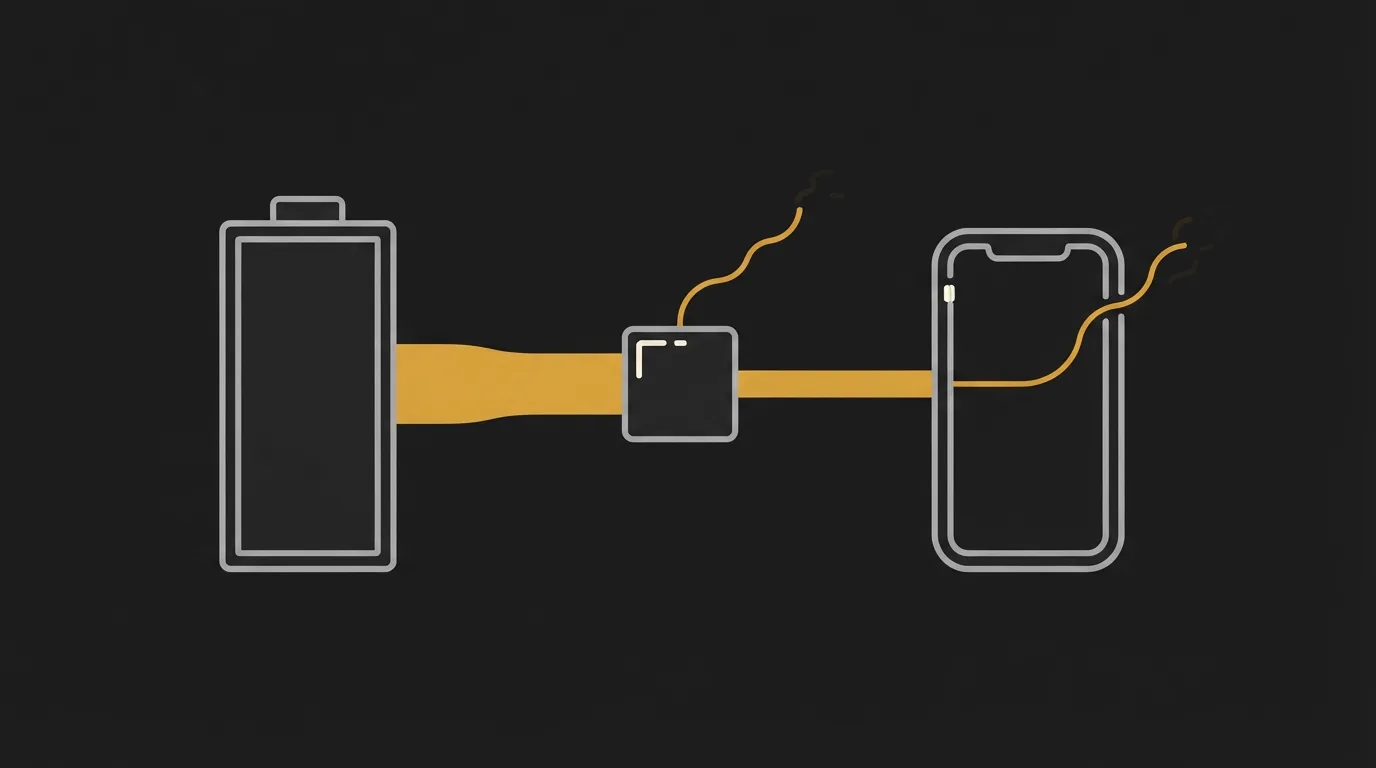
The cells inside a bank sit near 3.7 volts and a USB port puts out 5 volts or more, so a small converter has to step the voltage up. Anker puts that step at 80 to 85 percent efficient, and the calculator starts at 82. The rest leaves as heat, which is why a bank feels warm while it works. Fast-charge modes that push 9 or 12 volts do the same job at higher voltage, and the losses do not go away.
This is also why many labels carry a second, smaller capacity. Anker shows that a 20,000 mAh bank delivers about 60.7 Wh after the converter, which works out to roughly 12,140 mAh at 5 volts, and that figure is often printed as the "rated capacity." Enter the big cell figure, not the rated one, or the calculator will count the loss twice.
3. What the phone loses
At the other end, the phone steps the 5 volts back down to charge its own cell, and its charging circuit wastes about 15 percent more, by Anker's estimate. That is the 85 percent default. Android Authority's Gary Sims measured the whole chain on real banks and phones: a 3,100 mAh Samsung bank filled a 3,000 mAh Galaxy S7 from empty to 71 percent, and his rule of thumb is that a bank delivers about two thirds of its advertised mAh (Android Authority, does a 3000 mAh power bank charge a 3000 mAh phone). Take 85 percent of 82 percent and you are left with about 70 percent, close to his two thirds. Wireless pads and magnetic snap-on banks waste more than a cable does, so lower the phone figure if that is how you charge.
4. What the shelf takes
A bank that went into the drawer full in spring is not full in a December ice storm. Anker says lithium banks self-discharge about 2 to 3 percent a month and that most hold 80 to 90 percent for up to a month in normal conditions (Anker, how long a power bank holds a charge). Heat speeds that up. The "charge they hold now" box scales everything you entered, so put in what the bank's lights show, rounded down.
How many phone charges from a power bank
With the defaults (3.7 volts, 82 percent out of the bank, 85 percent into the phone), a full bank charges a 4,000 mAh phone from empty this many times:
- 5,000 mAh pocket bank: 18.5 Wh, which runs out at about 90 percent of one fill.
- 10,000 mAh bank: 37 Wh and 1.7 charges, the size most people carry.
- 20,000 mAh bank: twice that, so 3.5 charges from 74 Wh.
- 26,800 mAh bank: just under 100 Wh, good for 4.7 fills.
- 500 Wh station through its USB ports: roughly 23 charges.
The 5,000 mAh pocket bank surprises people most. It does not fill one phone from empty, which is fine for topping up on a commute and thin for a week without power. A bigger phone shifts every row down: a 4,855 mAh Ultra gets about 1.4 charges from the same 10,000 mAh bank. The power station row assumes its USB ports lose about what a power bank does. If you charge through its AC outlet and a wall plug instead, the inverter adds its own loss on top, so use the USB ports.
What size power bank do you need for a power outage
Work it backwards from the days you want covered. Multiply the days by the share of a battery each phone uses in a day, take off one charge if the phones start full, and you have the charges each phone needs from the banks. Multiply by the phone's watt-hours, divide by 0.70 for the losses, and divide by 3.7 volts to get back to the mAh printed on a bank. The calculator does this for the whole household and tells you how far short you are, in 10,000 mAh banks.
Two habits change the answer more than any purchase:
- If each phone uses a full battery every day, a week needs about 34,000 mAh of power banks per person. That is a 20,000 mAh bank and a 10,000 mAh bank each, plus a little more.
- If the phones stay in airplane mode and only come on at the family's check-in times, half a battery a day is a fair target, and the same week needs about 14,000 mAh per person. One 20,000 mAh bank each covers it with room for a cold snap.
For a household of four on the first plan, that is about 138,000 mAh, or over 500 Wh of cells. At that point a portable station with a folding panel costs less per watt-hour than a pile of banks and refills from the sun, which is where the solar generator runtime calculator takes over.
A worked example: the default household
The defaults describe a couple with mid-size phones, two 10,000 mAh banks and one 20,000 mAh bank in the kitchen drawer, all fully charged before the storm.
- Stored in the banks: 37 + 37 + 74 = 148 Wh at the cells.
- Out of the bank ports: 148 times 0.82 is about 121 Wh.
- Into the phone batteries: 121 times 0.85 is about 103 Wh.
- One phone battery: 4,000 mAh times 3.7 volts is 14.8 Wh.
- Full charges in all: 103 divided by 14.8 is about 7, or 3.5 per phone.
- Days of use: the full battery each phone starts with plus 3.5 charges, at one battery a day, comes to about 4.5 days.
- To reach 7 days: each phone needs 6 charges from the banks, which takes about 255 Wh of cells for the pair. That leaves the house roughly 29,000 mAh short, or three more 10,000 mAh banks.
Change one number, battery used per day, from 100 to 50, and the same drawer of banks lasts about 9 days with nothing bought. That is the cheapest week of phone power there is, and it costs only discipline.
Keeping phones charged in a power outage
The FCC and FEMA give the same short list every hurricane season: charge devices before the storm, keep a spare battery, keep a charging cord in the car, dim the screen, close apps running in the background, switch to airplane mode when you can, and text instead of calling, since a text takes less power and is more likely to get through a busy network (FCC and FEMA, tips for communicating in an emergency). Each one moves the "battery used per day" box.
Airplane mode matters most once towers start to fail. A phone that cannot find a signal raises its radio power and keeps searching, and that drains a battery in hours. Our page on whether cell phones work when the grid goes down explains how long towers run on backup and why the bars fade in stages. Agree on check-in times as a family, for example 8 a.m. and 6 p.m., turn the radios on, send and receive, and switch them off again. Low power mode, a dark wallpaper and a dimmed screen each trim a little more.
Charge from the bank while the phone is between about 20 and 80 percent rather than running it to zero. You lose nothing in efficiency, and a phone that never hits empty is still able to call 911 when someone gets hurt.
How to charge a phone without power
Banks are the first line, but they run out. These are the ways to recharge them, starting with what most households already own:
- The car. A 12-volt USB adapter charges phones and banks with the engine running. Run it in the open driveway only, never in a garage, even with the door up. Our carbon monoxide guide covers why.
- A laptop. The FCC points out that a charged laptop or tablet can charge a phone over its USB cable. A laptop holds several phone batteries' worth, and it is easy to forget it is there.
- A battery station and a folding panel. A station refills on any day with some sun and charges phones through its USB ports. Our solar runtime calculator shows how much a panel puts back in your winter sun hours.
- A generator. If you run a generator for the fridge a few hours a day, run an extension cord from it to a power strip and charge every phone and bank while it runs. The generator fuel calculator tells you how much gas those hours take.
- A crank radio with a USB port. Slow work by hand, but it needs nothing else and brings in the news. Our NOAA weather radio guide covers what to look for.
- A small solar panel straight into the phone. It works in full sun and falters every time a cloud passes. Charging a bank from the panel and the phone from the bank is steadier.
Keeping the banks ready between outages
A bank that is dead when the lights go out counts for nothing in the calculator. Anker recommends topping up a bank you are not using at least every three months, since a cell left to run all the way down can slip into deep discharge and lose capacity for good. For storage measured in months, its advice is about half charge in a cool, dry place, out of hot cars and attics, with nothing plugged in. A strip of tape with the date of the last charge is the simplest reminder.
For a household that preps, that means a routine rather than a fixed rule. Keep the banks near half full most of the year, and charge them all to 100 percent when a hurricane, ice storm or heat wave shows up in the forecast. Charge them again on the twice-a-year day you test the smoke alarms. Retire any bank that swells, rattles or runs hot. Lithium cells that fail can catch fire, and a fire is the last thing a house without power and with a slow 911 response needs.
What I'd keep in the drawer
I'd plan on one 20,000 mAh bank per person as the floor, and I'd write the family's check-in times on the family emergency plan so everyone knows the phones go into airplane mode between them. That pair of choices gets most households through a week on what fits in one kitchen drawer. I would not buy a stack of small banks to reach a bigger number. Past about 40,000 mAh per person, a small station with a panel is the better buy, because it refills and the banks do not.
Then run the calculator with what you actually own, the charge the banks hold today and a realistic battery-a-day figure. If it comes back short, the cheapest fix is usually the habit, and the second cheapest is a panel. The power outage checklist puts the charging jobs in the first hour, while everything is still full.
Frequently asked questions
Why does my 10,000 mAh power bank not charge my 4,000 mAh phone two and a half times?
Is it safe to leave a phone charging from a power bank overnight?
Can a power bank charge my phone while it is plugged in itself?
Do power banks work after an EMP?

Written by
Walt Brenner
Grid-down threats, home security and family plans
Walt Brenner is the pen name of the writer who covers grid-down threats, home security and family emergency plans for Dark Grid Prep. He draws on FEMA and Ready.gov guidance, utility and government reports, manufacturer manuals and long-running prepper forums, and he says plainly where those sources disagree. His beat is the household: what a family of four in a suburb or on a rural lot should have, know and do before the lights go out.
Last checked 2026-11-19
Comments
No comments yet. Questions and your own experience are welcome.
Thank you. Your comment will appear once it has been reviewed.