Bug-out and evacuation
The INCH bag, explained for families
An INCH bag, short for I'm Never Coming Home, is packed for leaving your house for good, with gear meant to keep you going for months instead of the three days a bug-out bag covers. That makes it bigger, heavier and heavier on tools, often 50 to 70 pounds loaded, which is why most people who build one plan to move it on wheels.
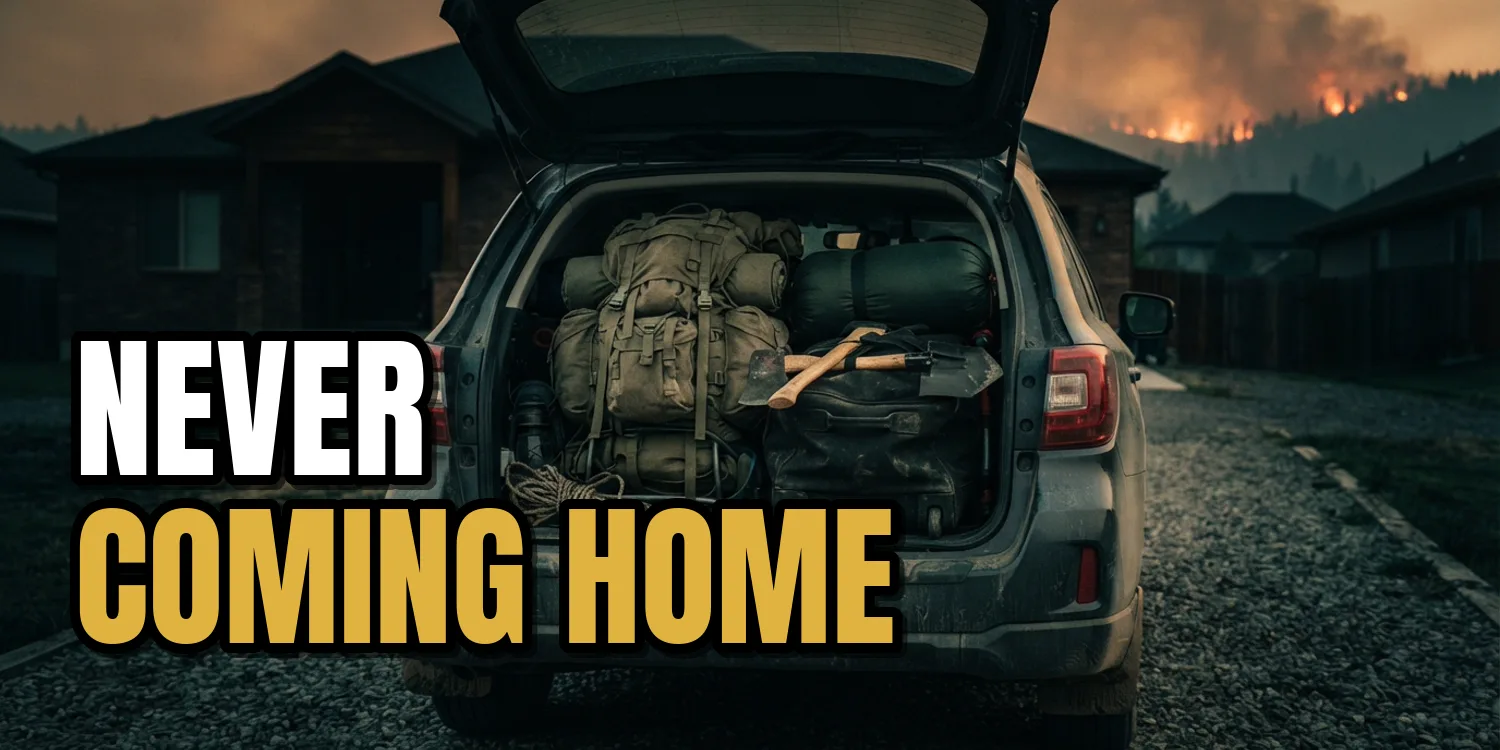
Every evacuation plan assumes a return. You leave for the hurricane, the chemical spill or the fire, you wait it out at a relative's house or a motel, and you drive home to clean up. The INCH bag is built for the version where there is nothing to drive back to.
This page covers what the term means, how an INCH bag differs from the 72-hour bug-out bag, what goes on an INCH bag list, and the weight limits that decide whether you can move one at all. Like every page on Dark Grid Prep, it is written from public sources: long-running prepper guides and forums on the concept, outdoor-industry guidance on pack weight, and news reporting from a town that lost most of its homes in one day. We have not hauled one of these kits down a road ourselves, and we say so where it matters.
What is an INCH bag?
The phrase comes out of the online prepper forums of the 2000s. Word historian Barry Popik traces "INCH (I'm Never Coming Home)" to a post on the Survivor's SKS Boards in October 2006, with the variant "I'm not coming home" turning up on the Zombie Squad forum in 2008 (Barry Popik, INCH bag). By the end of 2012 it had reached a Boston Globe column on doomsday-prepper jargon, which explained that if you are never coming back from your bug-out location, you need an INCH kit.
TruePrepper, one of the larger prepping guides, defines it as a bug-out bag variant for leaving home permanently. In its words, the kit is meant to sustain you "indefinitely" by combining what is in the bag with natural resources, and it fits a plan with no fixed bug-out location or one that has to stay flexible (TruePrepper, INCH bag list).
The labels are looser than that definition suggests. The same Popik file quotes a 2013 prepper handbook that lumps bug-out bag, get-out-of-Dodge kit and INCH bag together as one thing under different names. When a store sells you "an INCH bag", it is usually a large backpack. What makes a kit an INCH kit is the plan behind it: no return date and no guaranteed place to land.
INCH bag vs bug-out bag: what actually changes
Four things separate the two, and each one pushes the INCH bag toward more weight.
- Time. A bug-out bag covers about 72 hours, or the trip from your house to a place you have already arranged. An INCH kit is packed for months, and its makers talk about it lasting indefinitely.
- Destination. A bug-out plan ends at a friend's house, a motel or a public shelter, where someone else supplies the roof and the water. An INCH plan either has no destination or has one you will have to make livable yourself.
- What the gear does. A bug-out bag is mostly consumables: food bars, water, a first aid kit you will restock later. An INCH kit leans on things you reuse for a long time, such as a real tent, a sleeping bag, an axe, a shovel, snares and seeds.
- Weight. Survival Sullivan puts a bug-out bag at 25 to 35 pounds with a ceiling near 40, and a fully equipped INCH bag at 50, 60 or even 70 pounds (Survival Sullivan, INCH bag vs BOB).
TruePrepper's founder describes his own INCH kit as more than double the size and weight of his bug-out setup. It lives in a 120-liter rolling duffel that he treats as an add-on to the bug-out bag he already owns, so the two are layers of one plan.
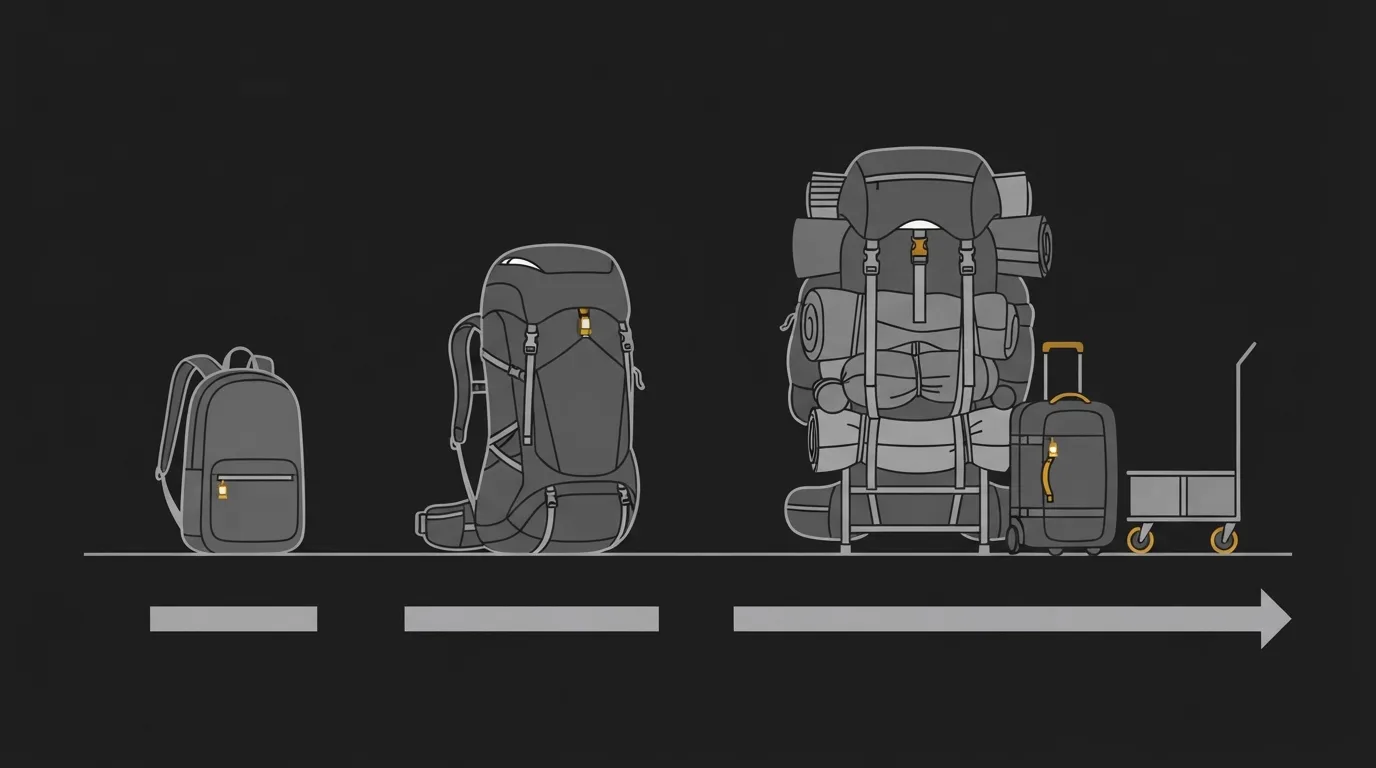
There is a third bag in this family, and it points the other way. A get-home bag lives in the car or at work and carries you back to your own supplies, so it can be the smallest of the three.
Who actually needs one
Most INCH guides picture a family walking into the hills after a war or a collapse. For an American household, the never-coming-home day that actually happens looks different. It is a fire or a flood that takes the house, followed by a drive to somewhere else and months of paperwork.
Paradise, California, is the clearest recent case. The Camp Fire on November 8, 2018, destroyed about 11,000 homes, roughly 90 percent of the town's structures, and killed 85 people. Five years later the town had under 10,000 residents, against 26,000 before the fire, and only six of its 36 mobile home parks had reopened. One couple the Associated Press interviewed moved to Yuma, Arizona, and lives in a used RV bought with their insurance money (Associated Press via KVIA).
Those families were never coming home, and none of them needed a snare. What decided how fast they got back on their feet was paperwork: insurance policies, identification, bank records, prescriptions, and the money to rent or buy somewhere new. A business owner in the same story started by calling her insurers and had bought a building within 30 days.
So I would split the readers of this page into two groups. Anyone in wildfire, hurricane-surge or flood country needs the paperwork and medicine half of an INCH kit, whatever their age. The woods-living half makes sense for a smaller group: people who are fit, already hunt, camp or garden, own a vehicle that can carry the load, and have thought hard about a plan that has no destination. If your realistic plan is a sister's house three counties away, our guide to deciding whether to bug in or bug out will do more for you than an axe.
What an INCH bag adds to a bug-out bag
Start with a complete bug-out bag. Our bug-out bag checklist for adults over 50 covers that layer: water, three days of food, medicine, light, a radio and clothes. The INCH kit is everything you add on top for a stay with no end date.
The paperwork to start over. FEMA and Operation HOPE publish the Emergency Financial First Aid Kit, a free set of checklists and forms for gathering financial documents and contacts, reviewing your insurance policies, and keeping both current (Ready.gov, Emergency Financial First Aid Kit). Copies of the deed, the insurance policies, vehicle titles, birth certificates, passports, recent tax returns and a list of every account go in a waterproof pouch. Most forum lists leave this out, and it is the part that decides how the next year goes.
Shelter for months. A tent big enough for everyone, larger tarps, more cordage and a proper insulated sleeping bag. TruePrepper's advice is to skip the emergency bivvy and pack a real bag, since sleep is what fails first when nights are cold.
Clothes for more than one season. A bug-out bag holds a change of clothes for the weather outside today. An INCH kit has to cover the next season too, plus boots that can be resoled and a sewing kit.
Tools that make things. An axe or hatchet, a folding shovel, a saw, snare wire, fishing gear and a packet of open-pollinated seeds. TruePrepper also lists a takedown bow because arrows are quiet and can be reused. Every item in this group assumes a skill, and a tool you have never used is only weight.
More medicine and first aid. As many months of prescriptions as your doctor and insurer will allow, a written medication list, spare glasses and a larger trauma kit. Our guide to building a medication reserve covers how to get extra supply legally.
A food runway. TruePrepper estimates an INCH kit carries about ten days of food and water, and calls survival skills the bridge between that and "forever". Some builders add a 30-day bucket of freeze-dried food to buy time while a longer plan takes shape.
Power. A small battery power station with a folding solar panel keeps a phone, a radio, a headlamp and a GPS running for as long as there is sun.
An INCH bag list you can work from
Here is the add-on layer as one list, to pack beside a finished bug-out bag. Cross off what your plan does not need. A family heading to a relative's empty cabin can drop most of the trapping gear, and a solo hunter can drop the family tent for a smaller one.
- Waterproof document pouch: IDs, passports, birth and marriage certificates, deed or lease, titles, insurance policies, tax returns, account list, family photos on a USB drive
- Cash in small bills, enough for a deposit and a first month somewhere new
- A 90-day medicine supply where possible, the written medication list, spare glasses and hearing-aid batteries
- Expanded first aid and trauma kit
- Family-size tent, two large tarps and 100 feet or more of cordage
- One insulated sleeping bag and pad per person
- Clothes for two seasons, rain gear, a spare pair of boots and a sewing kit
- Cook pot, a stove with fuel, and a backup fire kit
- Water filter with spare cartridges and a collapsible water container
- Axe or hatchet, folding saw, folding shovel, work gloves
- Snare wire, a fishing kit and open-pollinated seeds
- Small power station and folding solar panel
- Paper road maps for your state and the next two over, plus a compass
- Two to four weeks of food beyond the bug-out bag's three days
TruePrepper also packs threat-specific gear such as gas masks and potassium iodide. If those fit your threats, the threats section covers which scenarios they answer.
INCH bag weight limits
Weight is where most INCH plans fall apart. REI's guidance for backpackers is that a loaded pack should weigh no more than about 20 percent of your body weight, and a day pack about 10 percent (REI, how much should your pack weigh). Survival Sullivan allows an INCH bag up to 25 percent and warns that a 50 to 70 pound bag is not workable for anyone who is not already used to carrying heavy loads for long stretches.
Run your own numbers. A 180-pound adult at 20 percent can carry 36 pounds, and at 25 percent, 45. A 60-pound INCH bag is past both limits for anyone under 240 pounds. Builders posting on r/prepping in 2024 reported bags at 50 pounds with no food or water in them and another at 72 pounds with tools. One poster who described their build as 6 foot 5 and 230 pounds, and fit, said a 63-pound bag could not be carried easily or very far in a day.
My reading of all this is blunt. An INCH bag that fits a body-weight rule is a bug-out bag with a longer name. Everything past that limit needs a vehicle, a trailer or a cart, and the plan has to say what happens when the wheels stop. For readers past 50, our bug-out checklist sets a lower target of about 15 percent of body weight on your back.
Wheels, the split load and what stays on your back
TruePrepper's own INCH duffel rolls and is sized to fit both a bug-out SUV and a bike trailer. That arrangement is the practical one: a bug-out bag on each person's back and the INCH gear in a duffel or a pair of lidded bins in the vehicle.
Decide in advance what goes where. The document pouch, the medicine and the cash belong in the pack on your body, because a car can be stolen, stuck or abandoned in a jam. The tent, the tools and the extra food ride in the vehicle, and they are what you leave if you have to walk. Pack the duffel with the dense items at the end nearest the wheels, as TruePrepper suggests, and long-handled tools along the sides where they stiffen the bag.
A vehicle plan also needs fuel. Gas pumps stop when the power does, so the tank rule from our bug-in or bug-out guide applies twice over here: never below half.
Keeping an INCH kit current
A kit packed for years of use still goes stale in storage. TruePrepper's routine is a full inventory at least once a year, checking dates on food, bottled water, batteries and seed packets, and putting back any tool that was borrowed for a project around the house. Use up near-dated food at home and replace it.
The bigger changes are in your life. New prescriptions, a child who outgrew the clothes, a new dog, a renewed insurance policy with a new number: each one means updating the pouch and the list. Store the kit somewhere cool and dry. A garage attic that bakes in July cuts the life of food, batteries and seeds.
Where I would start
I'd build the INCH kit backwards from how most guides present it. The first evening goes to the part that weighs about a pound: the document pouch, filled from the FEMA checklists, with copies of every policy and ID, the medication list and a stack of small bills. That pouch is useful in every evacuation, permanent or not, and it is what Paradise families needed most.
Next comes a complete bug-out bag for each person, weighed on a bathroom scale. Only after both are done would I start on the duffel, and I'd buy each tool after learning to use it, beginning with the sleeping bag and the water filter. If you never get as far as the axe and the snares, you still have the part of an INCH kit that matters for the disasters that actually take homes.
Frequently asked questions
What does INCH stand for?
Can one bag be both my bug-out bag and my INCH bag?
How much should an INCH bag weigh?
Is an INCH bag worth it for someone over 60?
Where should I keep it?

Written by
Walt Brenner
Grid-down threats, home security and family plans
Walt Brenner is the pen name of the writer who covers grid-down threats, home security and family emergency plans for Dark Grid Prep. He draws on FEMA and Ready.gov guidance, utility and government reports, manufacturer manuals and long-running prepper forums, and he says plainly where those sources disagree. His beat is the household: what a family of four in a suburb or on a rural lot should have, know and do before the lights go out.
Last checked 2026-11-17
Comments
No comments yet. Questions and your own experience are welcome.
Thank you. Your comment will appear once it has been reviewed.