Home defense
How to reinforce a front door against a kick-in
A kicked front door almost always gives way at the frame, where short screws hold the strike plate to a thin strip of trim. Reinforce it from the frame outward: 3-inch screws into the studs, a longer strike plate, a solid door, a deadbolt with a full one-inch throw, and a brace on the inside for the nights when help is far away.
This page is the hands-on companion to our layered home defense plan, which treats the doors as one ring among four. Here the front door gets the whole page: why it fails, what to change, in what order, and what to leave alone so the house stays safe to get out of in a fire.
It is written from police crime-prevention guides, a locksmith's published screw math, hardware standards and a televised kick demonstration. Nobody on this site kicked a door for it. The work it describes needs a drill, a box of long screws and a free weekend afternoon for the first and biggest step.
Why a front door fails at the frame
Picture the door from above. The deadbolt slides out of the door edge into a hole in the jamb, the vertical board the door closes against. The jamb on most houses is about three-quarters of an inch of soft wood. Behind it there is a shim gap, and behind that sit the doubled 2x4 studs of the rough opening, which carry the real strength of the wall.
The builder installs the strike plate with screws about three-quarters of an inch long. They bite into the jamb and stop there. When a boot lands beside the lock, all the force runs through the bolt into that strip of trim, the wood splits along the grain, and the door swings in with the deadbolt still locked. ACME Locksmith, an Arizona shop that writes about this at length, says a door "can be bypassed several ways and as quickly as 1 second" when nothing has been done to the frame (ACME Locksmith, How to Reinforce a Door Frame).
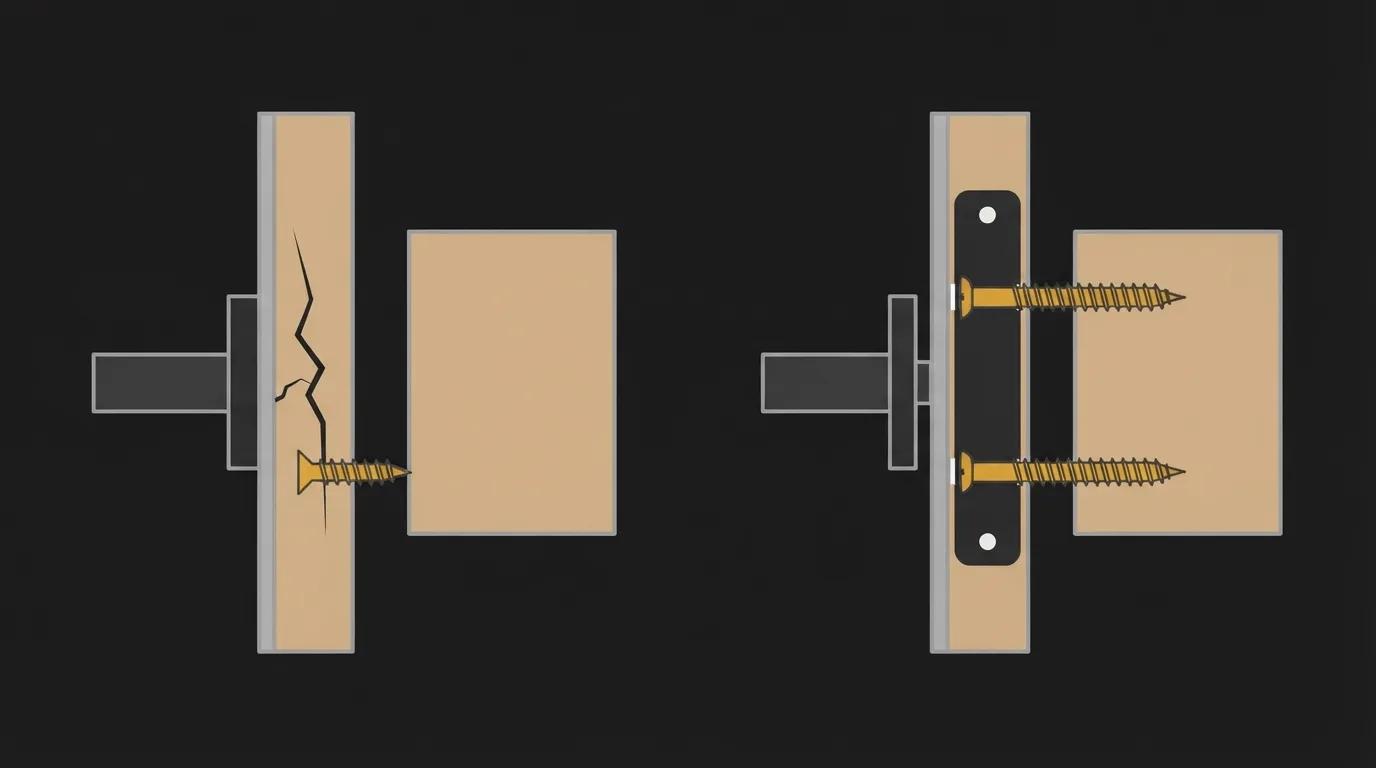
A Salt Lake City TV station showed the difference in 2017. With a locksmith, the reporter opened a stock door with one kick. On the next door the locksmith drove in two 3-inch screws reaching "two 2x4s that Torkelsen says are behind every entry-way door if the home was built to code," and that door held through more than 30 kicks (KUTV, Get Gephardt Investigates). One demonstration on camera proves little by itself, but it lines up with the engineering below and with every police guide we read.
Step 1: long screws in the strike and the hinges
Start here, because no other change gives as much for as little. Seattle Police put it plainly in their burglary-prevention list: "All strike plates and frames for exterior doors should be anchored to the home's main construction," with "Three-inch screws, heavy-duty strike plates and tamper-proof hinges" (Seattle Police, Home Security and Burglary Prevention).
ACME's article works out why it matters, using the American Wood Council's withdrawal formula for wood screws. A stock screw with about half an inch of thread in the jamb holds roughly 41 pounds straight out. A 3-inch screw with about two and a quarter inches of thread in the jamb and stud holds roughly 185 pounds, about four and a half times as much. The shop is careful to say these are reference values for pulling a screw out, not a kick test, and it claims "at least" a tripling of kick resistance rather than the full ratio.
The job, door by door:
- Take out the two screws in the deadbolt strike plate and drive 3-inch screws in their place. If the latch strike sits close by, do it too.
- On the top and bottom hinges, swap at least one jamb-side screw each for a 3-inch screw, two if the hinge leaf allows it. ACME's count is six long screws per door: two per hinge and two in the strike.
- Drive each one until it is snug and stop. The shim gap means an overtightened screw pulls the jamb toward the stud and bows it, and then the bolt rubs or will not throw.
- Close the door and throw the deadbolt. It should slide home without pushing or lifting the door. If it binds, back the screw off a quarter turn.
Use the same treatment on the back door, the door from the garage into the house and any basement door, since a burglar who finds the front door solid simply walks around the house. Hardened steel screws with a coarse thread are what most kits include. The hinge side matters because a hard kick near the lock also levers the hinge leaves, and they are the easiest screws on the door to swap.
Step 2: a longer strike plate or a full jamb plate
Long screws tie the jamb to the stud at two points. A longer strike spreads the load further. ACME describes the next upgrade as swapping the small factory strike for an elongated one that takes four or more 3-inch screws, which "prevents the door from being kicked in by distributing force across multiple points."
Beyond that are the jamb reinforcement kits sold by several makers. They usually bundle a steel channel or plate that runs down the jamb for a few feet past the lock, hinge shields, a wrap for the door edge, and the long screws to mount all of it. ACME calls them the most expensive route and the easiest one, because a single box holds everything. A kit earns its money on a frame that is soft, dried out, cracked, or was patched after an earlier break-in, where screws alone have little sound wood to grip. On a sound frame with long screws already in, it is a second step you can take later.
Installing one is mostly mortising: you chisel the jamb so the plate sits flush, then paint it to match. If the door has weatherstripping in the stop, plan around it so the plate does not leave a draft.
Step 3: the door slab and the gaps around it
A strong frame is wasted on a weak door. Halton Regional Police in Ontario are blunt about it: "Hollow-core or corrugated cardboard-filled doors should be replaced with steel or solid-core wooden doors" (Halton Police, Doors and Locks). Tap the door. A hollow drum sound on an exterior door means it was meant for a closet, and it is the one case where replacing the slab comes before anything else here.
A sound slab can still fail around the lock. The bore holes for the deadbolt and the handle leave the door thinnest exactly where a kick lands, and the wood between them can split out. A door edge wrap is a U-shaped steel sleeve that slides over the edge around both holes and spreads the impact across a wider area. Most reinforcement kits include one, and hardware stores sell them alone.
Look at the frame as a whole too. Halton's guide asks homeowners to reinforce doorframes "by filling gaps between the wall and the frame, making it harder to force the door off the frame." A frame with wide hollow shim gaps flexes when it is hit or pried. Seattle's list adds that doors should "fit snugly against the frame" and frames should be "free of warping, cracks, and other signs of wear and tear." If you can slide a pry bar into the gap at the lock, so can a burglar.
Step 4: the deadbolt and its throw
Seattle Police set the floor: "All exterior doors should be secured with a deadbolt lock that has a minimum one-inch throw." The throw is how far the bolt reaches out of the door into the frame. A short bolt can be sprung out of its hole by spreading the frame with a bar or a wedge, and a one-inch bolt seated behind a long strike is much harder to free.
The grade on the package tells you something too. ANSI/BHMA grades lock hardware 1 to 3, with Grade 1 the highest, and the tests behind a grade are run by accredited outside labs rather than reported by the maker (SecurityParts, ANSI/BHMA standards guide). The same guide warns that some cheap hardware prints "Grade 1" on the box without real BHMA certification, which you can confirm in BHMA's own certified products directory. ACME's advice for homes is Grade 2 at the least and to throw out the Grade 3 sets many builders install.
Keep the grade in proportion. A Grade 1 deadbolt held in a three-quarter-inch jamb by short screws still fails at the jamb. Spend on the lock after the frame is done, and put the money into the bolt and the strike before a smart keypad.
Glass in or beside the door
A front door with a window in it, or narrow sidelights beside it, has a different weak spot. Someone breaks the pane, reaches in and turns the thumb latch. The usual answers each carry a trade-off:
- Security film on the glass holds the shards together, so getting an arm through takes long, noisy work. Seattle's guide lists safety glass and security film for any easily reached glass.
- A double-cylinder deadbolt needs a key on both sides, so a broken pane gains nothing. The cost is an escape problem in a fire. Halton's advice is to "leave a key in the inside cylinder in case you need to exit in an emergency," and fire codes in many places limit them on the main exit, so look up your local rule before installing one.
- A second bolt with no outside keyhole, mounted high or low out of arm's reach of the glass, keeps the door shut while you are home and leaves the normal deadbolt for coming and going.
For French or double doors, Halton recommends making one leaf fixed with long slide bolts at the top and bottom, and putting the deadbolt on the active leaf so it locks the pair together. A sliding patio door is a different mechanism, with a latch and a track, and our guide to securing a sliding glass door covers it.
Doors that open outward
On an outward-swinging door the hinge pins sit outside, where anyone can tap them out and lift the door off on its lock side. Halton's fix is non-removable hinge pins. Security hinges with a fixed stud that drops into the opposite leaf do the same job and cost little. A kick against an outswing door pushes it into the stop, so frame screws matter less there and prying matters more, which is where the one-inch deadbolt throw does the work.
Braces and bars on the inside
For a long emergency, the most useful layer is the one you set at night from the inside. ACME's barricade guide sorts these into portable braces, floor braces, bars that span the door, and one-sided deadbolts that show nothing on the outside face (ACME Locksmith, Door Barricade Devices). Three points from that guide decide which type fits a house:
- Placement. "The strongest brace will be installed near the middle of the door, where most people kick or hit the door." A brace at the floor can hold while the top of the door flexes.
- Swing. The common types work only on doors that open inward, which most American front doors do.
- Floor. Braces that rely on friction may slip on carpet or vinyl. The better floor types screw a plate down through the flooring, which is permanent work.
Whatever you install, practice taking it off in the dark. A brace that takes two hands and a minute to remove is a brace that slows your own family in a fire, and in a blackout people run candles, heaters and stoves indoors far more than usual. Our indoor heater guide and carbon monoxide guide cover that side of the night.
Keep a way out
Seattle's guide puts the warning in bold: "Security improvements should not be made at the expense of fire safety." Every room needs a door or window someone can get through quickly, and the family should practice the routes. For the front door that means the brace sits where an adult can reach and lift it without looking, the inside key for any double-cylinder lock hangs on a hook beside it, and the children know both. The grid-down drill is a good night to test it with the lights off.
The order of work, and what it takes
Here is the sequence by effort, with the cheapest and most effective change first:
- An afternoon: 3-inch screws in the strike and hinges of every exterior door, including the garage entry.
- A weekend: a long strike or jamb plate on the main door, plus an edge wrap if the slab is wooden.
- When budget allows: a solid-core or steel slab to replace any hollow one, and a deadbolt with BHMA certification and a one-inch bolt.
- Last: film on the glass, security hinge pins where they apply, and an inside brace or a one-sided deadbolt.
If you would rather have a second pair of eyes first, many police departments run free home security visits. Halton's auxiliary officers do them, and your local department's crime-prevention unit may too.
Where I'd start
I'd start with a box of 3-inch screws and a drill on Saturday morning, every exterior door before lunch. Of everything on this page, that change has the best support from both the screw math and the kick demonstration, and it takes no skill beyond stopping before the jamb bows.
Then I'd look hard at the main door's frame. A solid frame needs only a long strike for now. A split, dried or patched one should get a full jamb kit before any money goes toward a new lock. The brace comes after both, and my pick would be one that mounts mid-door and comes off with one hand, because the night you need it is also a night with candles burning.
None of this makes a house impossible to enter. It turns one kick into many loud ones, which is the time a family needs to wake up, get to the room in the layered plan, and call for help.
Frequently asked questions
How long should the screws in a strike plate be?
Is a door reinforcement kit worth buying if I already changed the screws?
Will a steel door stop a kick on its own?
Do door braces work on doors that open outward?

Written by
Walt Brenner
Grid-down threats, home security and family plans
Walt Brenner is the pen name of the writer who covers grid-down threats, home security and family emergency plans for Dark Grid Prep. He draws on FEMA and Ready.gov guidance, utility and government reports, manufacturer manuals and long-running prepper forums, and he says plainly where those sources disagree. His beat is the household: what a family of four in a suburb or on a rural lot should have, know and do before the lights go out.
Last checked 2026-11-12
Comments
No comments yet. Questions and your own experience are welcome.
Thank you. Your comment will appear once it has been reviewed.