Home defense
How to secure a sliding glass door
A sliding glass door is held shut by a latch, and it can be opened two ways: forced sideways along its track or lifted up and out of it. Secure it with a bar in the bottom track and screws or a pin against the lift, put security film on the glass, and give every ground-floor window the same treatment while keeping bedroom windows easy to open from inside.
Our guide to reinforcing a front door deals with the door most people worry about. This page covers the openings at the back and sides of the house: the patio slider, the kitchen window over the sink, the basement windows half hidden by shrubs. They usually face a fenced yard where nobody on the street can see what happens, and in a long blackout that yard is darker still.
Everything here comes from sheriff's and police crime-prevention pages, the National Fire Protection Association's escape-planning advice and a security-film installer's own description of what film can and cannot do. None of it comes from break-in trials of our own. Most of the work takes a saw, a drill and an afternoon.
Why the slider is the weak spot
The King County Sheriff's Office in Washington starts its sliding door advice with one line: "Sliding glass doors are secured by latches not locks. These latches are vulnerable to being forced open from the outside" (King County Sheriff, Doors and locks). A swinging door has a bolt that sits an inch inside a wooden frame. The hook on a typical slider grabs a small keeper on the jamb, and a pry bar in the gap at the latch side can bend one or the other.
The same page notes that the back door, like the garage door, gives a burglar "the most cover." A slider is usually that back door. It sits behind a fence, often under a deck or pergola, and the glass that makes it pleasant in daylight also lets anyone in the yard see the room behind it at night.
The two ways a slider gets opened
The sheriff's office and the Village of Shorewood police in Wisconsin describe the same pair of weaknesses, almost word for word. The first is the latch, forced from outside so the panel slides open. The second catches more people out: "Older sliding glass doors can be lifted up and off their track and thereby defeat the latch mechanism" (Village of Shorewood, Sliding-Glass Patio Doors and Windows).
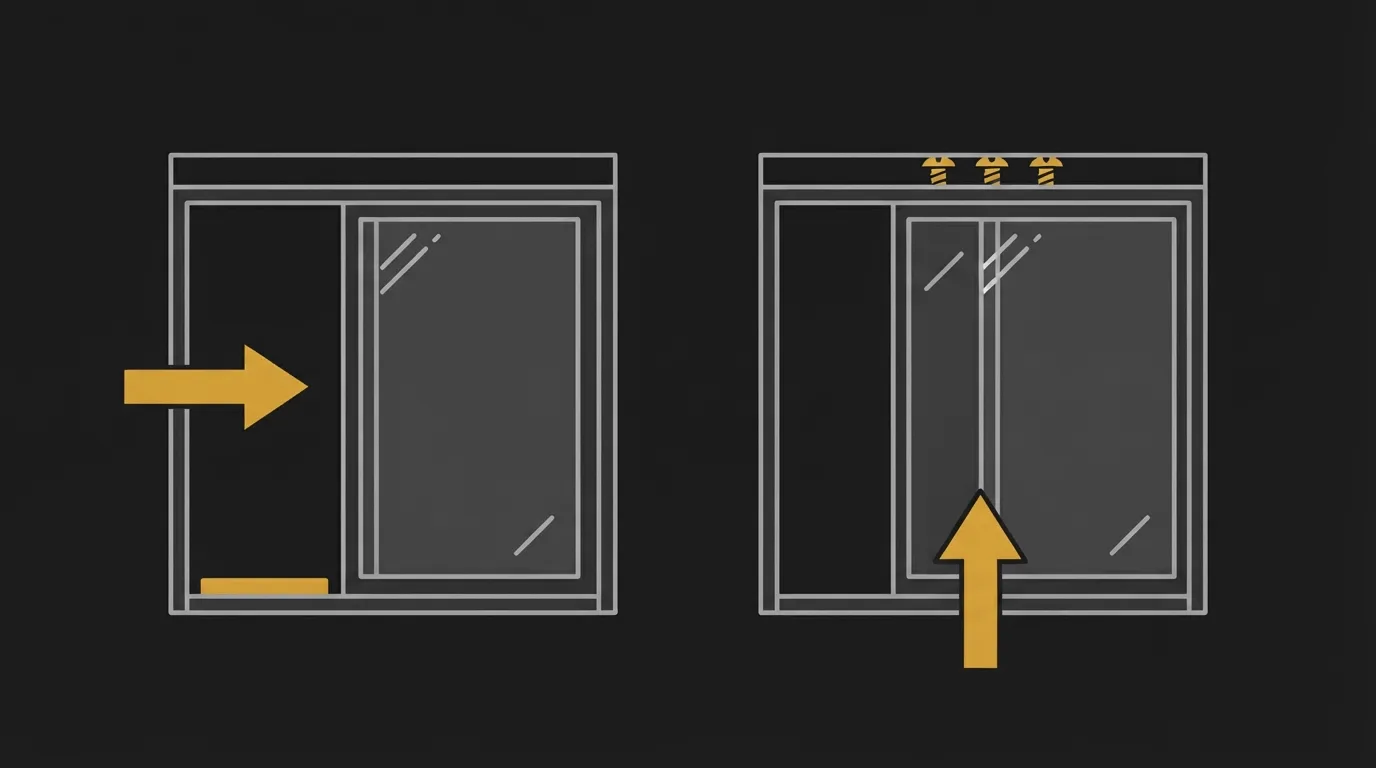
The lift works because the panel rides on rollers in a bottom channel and is held at the top only by a deeper channel with room to spare. Push the panel up into that space, swing the bottom out, and it comes free with the latch still hooked. Shorewood's page calls the track bar "half the equation" for exactly this reason. A family that has dropped a broomstick in the track and stopped there has handled the attack that needs a pry bar and left open the one that needs only two hands.
Stop the slide: a bar in the bottom track
The cheapest fix is the one both departments name first: "inserting a wooden dowel or stick into the track thus limiting the door movement." Close the door, measure from the edge of the sliding half to the far end of the frame along the bottom channel, and cut a hardwood dowel or a length of metal to that size. It should drop in snugly with no more than a finger's width to spare. A loose bar lets the panel open far enough to get a tool in.
Three other types do the same job:
- A fold-down bar, which King County calls a "charley bar," hinges from the fixed side of the frame and drops across the door at about waist height. It stays mounted, so nobody has to find a stick in the dark, and it can be seen through the glass from the yard.
- Track blockers screw or clamp into the bottom channel. Some flip up to let the door open a few inches for air.
- Adjustable bars wedge between the panel and the frame and come off with one hand, which suits renters who cannot drill.
Whichever you choose, keep the bottom track clean. Grit and leaves let a cut dowel ride up, and a dirty track makes people leave the bar out because the door is a chore to open.
Stop the lift: rollers, screws and a pin
Shorewood lists the anti-lift steps in order: keep the rollers "in good condition and properly adjusted," then add "anti-lift devices such as through-the-door pins or upper track screws." Each one shrinks the gap a panel needs to come out.
Rollers. Most sliders have adjustment screws at the bottom corners of the moving panel, behind small caps or holes in the edge. Raising the panel on its rollers closes some of the space above it. Worn rollers do the opposite: the panel sinks, the gap at the top grows, and the latch no longer lines up with its keeper.
Screws in the top track. Shorewood calls this "the least expensive and easiest method": screws driven halfway into the channel overhead. Slide the panel open, drive two or three pan-head screws into the head channel where the panel sits when closed, and leave the heads standing just high enough that the panel still slides under them without rubbing. Close it and try to lift it with both hands. If it rises more than a fraction of an inch, back the screws out a little further.
A pin through both frames. Where the two panels overlap in the middle, drill a hole through the inner frame and into the outer one, angled slightly downward, and drop in a steel pin. With the pin in, the panels can neither slide apart nor lift separately. Keep the drill bit well away from the glass and stop before it comes out the far side. Vinyl and some aluminum frames have hollow channels, so a pin that sits in a short sleeve or a store-bought keyed pin holds better than a bare nail.
The glass itself
None of the hardware above matters to someone willing to break the pane, which is why Seattle Police and others recommend security film on easily reached glass. The film is a clear polyester laminate applied to the inside surface. Its value and its limit are in an installer's own words: "Security window films will not strengthen, keep from breaking or make glass 'bullet proof'" (Window Film Depot, Security Window Films: Buying Time to Respond). The glass still breaks. The film holds the shards together the way a car windshield holds after a crash, so getting through takes repeated blows instead of one.
The same installer recommends anchoring the film to the frame with a structural caulk or a mechanical attachment, which keeps the whole broken sheet from being pushed in as one piece. Unanchored film on a large slider buys less time than the marketing suggests. Anchored film on a small kitchen window next to the back door gives the most protection per square foot, because that is the pane someone breaks to reach in for the latch.
Film also takes time to cure, so the installer's 30 to 60 days is a reason to do it now and not when the news turns bad. Tinted versions add daytime privacy, though they reverse at night, when a lit room is plain to see from the dark yard.
Ground-floor windows
Shorewood makes a point most homeowners skip: "Windows are left unlocked and open at a much higher rate than doors." And like sliders, "Windows have latches, not locks," so each one needs a second block of its own. The method depends on how the window opens:
- Horizontal sliding windows take the same treatment as a patio door at a smaller scale: a cut dowel in the track, and on aluminum frames, screws halfway into the head of the frame against the lift.
- Double-hung windows, where the sashes move up and down, take a pin through the frame where the inner and outer sash overlap, the same move as the slider pin.
- Basement windows and those behind shrubs deserve more attention than their size suggests. Ask who could fit through each one and how long it would take, then trim whatever hides it.
For airflow on a hot night, Shorewood's rule is to block the window open "no more than 6 inches" and to make sure nobody outside can reach in and pull the stop or reach through to unlock a nearby door. A second pin hole drilled a few inches above the first lets a double-hung window lock partway open. In a summer blackout with no air conditioning, that small detail is the difference between a secured window and one left wide open all night.
Upper-floor windows count too, when a fence, a tree, a stairway or a balcony puts them within reach. Walk the outside of the house and look up.
Keep every bedroom window a way out
This is where window security goes wrong most often. Shorewood's own page says blocking devices in sleeping rooms "should be capable of being removed easily from the inside to comply with fire codes." The NFPA asks households to mark "two ways out of each room, including windows and doors," and it is specific about bars: they need "emergency release devices inside so that they can be opened immediately in an emergency" (NFPA, Home Fire Escape Planning). The NFPA also warns that a family may have as little as one or two minutes to get out once the smoke alarm sounds.
That rules out screws through a bedroom sash, pins that need pliers, and plywood over a bedroom window except on the street side during a riot, as our civil unrest guide explains. A long outage raises the stakes, because families light candles and run heaters and camp stoves inside. Our indoor heater guide covers that risk, and a dark-house run of the grid-down drill is the time to have every child pull the pin, lift the bar and open the window by feel.
The slider can be an exit as well. A fold-down bar or a one-hand wedge comes off in a second, while a dowel lying flat in the track is easy for an adult to miss in smoke. If the slider is a family room's second way out, pick a bar you can find by reaching for one spot on the frame.
What changes in a blackout
The decals both departments suggest, stickers near the latch saying an alarm, a dog or a block watch is in place, are cheap and worth having. Alarm panels and cameras need power, though, and once their batteries run down the sticker is all that is left. Our page on home security without power covers how long they last and what to add. The physical blocks on this page work the same with the grid down, which is the reason to install them first.
Light is the other change. A slider is a picture window into the main room, and on a dark street a lantern behind uncovered glass shows the yard who is home, how many people are there and what is stacked against the wall. Heavy curtains or blackout blinds over the slider and the ground-floor windows do as much for security in a long outage as a bar in the track. The low-profile section of our layered home defense plan goes further into light, noise and what neighbors can see.
The order of work
- Tonight: a cut dowel or bar in every slider and horizontal window track, and a walk around the house to latch every window.
- One afternoon: adjust the slider rollers, then add screws to the upper tracks of sliders and aluminum windows.
- One weekend: pins through the overlapping frames of the slider and the double-hung windows, with a second hole for a vent stop, and quick-release hardware on every bedroom window.
- When budget allows: anchored security film, starting with the glass nearest a latch or lock, then curtains or blinds that close off the slider at night.
Many police departments offer free home security walk-throughs, and a crime-prevention officer will spot the window behind the hedge faster than you will.
Where I'd start
I'd start with the lift, because it is the attack most families have left open. A bar in the track feels like the job is done, and on an older slider it covers half of it. Three pan-head screws above the door take a few minutes, and lifting the panel afterward shows straight away whether they worked.
After that, my pick for a family slider is a fold-down bar over a loose dowel. It stays put, it can be seen from outside, and a child can lift it in the dark. Film comes later and goes first on the small pane beside a latch, where a broken window turns into an open door.
None of this makes glass impossible to get through. It forces anyone outside into breaking it, and breaking anchored, filmed glass takes time and makes noise, which is what a family needs to wake up and move to the room in the layered plan.
Frequently asked questions
Is a broomstick in the track enough to secure a sliding door?
Which panel of a sliding door gets the bar?
Can I put security pins in a bedroom window?
Does window film make glass unbreakable?

Written by
Walt Brenner
Grid-down threats, home security and family plans
Walt Brenner is the pen name of the writer who covers grid-down threats, home security and family emergency plans for Dark Grid Prep. He draws on FEMA and Ready.gov guidance, utility and government reports, manufacturer manuals and long-running prepper forums, and he says plainly where those sources disagree. His beat is the household: what a family of four in a suburb or on a rural lot should have, know and do before the lights go out.
Last checked 2026-11-13
Comments
No comments yet. Questions and your own experience are welcome.
Thank you. Your comment will appear once it has been reviewed.