Threats and scenarios
How to prepare your home and family for civil unrest
Most families get through a riot by staying away from it: enough water, food, medicine, cash and fuel at home that nobody has to go out for two weeks, a house made ready against fire and break-ins before a known flashpoint, and a written plan for when to leave. American riots have burned for days at a time and hit commercial streets hardest, so the goal is to outlast them at a distance.
A verdict is due on Friday, or an election is too close to call, and the local news is already showing a crowd downtown. You live twenty minutes from that crowd, in a neighborhood where nothing like this has ever happened. The question is what to do this week so your family never has to find out how close it can get.
This page draws on public records of past riots, official guidance from Ready.gov and articles by long-running preparedness writers. It covers the household: supplies, the house, the family and the decision to leave. The detailed work on doors, locks and neighborhood watch lives in our layered home defense plan, and this article points there rather than repeating it.
Start your family emergency plan
What a riot does to the neighborhoods around it
The Los Angeles riots of 1992 are the best documented American case. They ran from April 29 to May 4, more than 50 people died, and a dusk-to-dawn curfew covered the city and much of the county. A PBS NewsHour report from the second day, kept in the American Archive of Public Broadcasting, describes what ordinary residents dealt with: "numerous power outages, closed banks, post offices, schools and other businesses." Lines formed at gas stations. With hundreds of stores shut, some people started hoarding food, "not knowing where or if it will be readily available in their neighborhoods."
That list matters more to a family than the fires on television. Most households in a riot-hit city are never touched by a mob. They are touched by the shutdown around it: the bank branch that does not open, the pharmacy with plywood over the door, the grocery store that was looted on Wednesday and stays closed for a month.
The 2020 unrest showed the second lesson, which is that suburbs are not exempt. Insurance Journal reported that destruction and looting after George Floyd's death reached at least 25 cities "and spread into many suburbs as well." The Insurance Information Institute put the 1992 damage at $775 million, and insurers expected 2020 to pass it, because the losses were spread across the country instead of one metro area.
Put together, those records describe a threat that is usually short, concentrated on commercial corridors and fierce where it lands. A family's plan should match that shape: hold out at home for a week or two, keep the house from becoming an easy or burning target, and move early if the trouble comes up your street.
Read the warning signs before the trigger
Many flashpoints are on the calendar. A trial verdict, a sentencing, a contested election count or a planned rally gives you days of notice. Daisy Luther of The Organic Prepper, who has written about preparing apartments and suburban homes for unrest since 2020, puts the rule simply in her guide to getting a home ready fast: "As soon as you feel that unrest is a possibility, it's time to take action if you plan to stay in place. Don't just 'wait and see.'"
Other events give no notice at all, such as a police shooting filmed on a phone that spreads overnight. For those, the early signs are local: crowds forming at a known gathering spot, stores near you closing early, police cars moving in groups, a sudden wave of posts from your town. Agree as a family that any two of those signs mean the week-of steps below start that evening.
Set up official alerts now, while the phones are quiet. Ready.gov's alerts page explains that Wireless Emergency Alerts reach any capable phone in a targeted area with no sign-up, and that NOAA Weather Radio also carries non-weather public safety alerts through the Emergency Alert System. A curfew order usually arrives that way. Check that government alerts are switched on in each family phone's settings, and keep a battery radio in the house for the hours when the cell network is jammed with calls.
Stock the house so nobody has to go out
The most dangerous trip during unrest is the ordinary one: running to the store for milk, to the pharmacy for a refill or to the ATM for cash, through streets you can no longer read. Every supply you already have at home is one of those trips cancelled. I would aim for two weeks, because it covers the five days of a riot like 1992 plus the slow reopening of the stores and banks that were damaged.
- Water. Unrest rarely cuts the water supply, but power outages and fires can drop pressure. Our guide to water for a two-week grid-down works out the gallons and the containers.
- Food that needs no store run. Two weeks of meals your family already eats, with a way to cook if the power fails.
- Prescriptions. A closed pharmacy is the shortage that hurts fastest. Refill before a known flashpoint, and build a reserve using our emergency medication guide.
- Cash. Closed banks were on the 1992 list, and card readers fail when the power does. Our page on how much cash to keep at home sets an amount and says how to store it.
- Fuel. Fill every car the day you decide a flashpoint is coming. Gas lines formed in Los Angeles within two days, and a full tank is also your way out.
- Light, power and a radio. Flashlights, a charged power bank per person and a battery or hand-crank radio, so a local outage does not leave you blind and without news.
- First aid. Hospitals near unrest fill up and ambulances may not reach you. A home trauma kit and someone trained to use it cover the gap.
None of this is special to unrest. The same shelves carry you through an ice storm or a long blackout, which is why I would build them first and spend money on security hardware second.
Get the house ready for fire first, then for entry
Fire is the threat most likely to reach a house near a riot. Luther notes that fires are "very common during incidents of civil unrest," usually set in cars and commercial buildings, and that homes have burned too. Fires spread between buildings, and fire crews may be held back from a street that is not safe for them. A family that can put out a small fire and get out of a large one has covered the worst case.
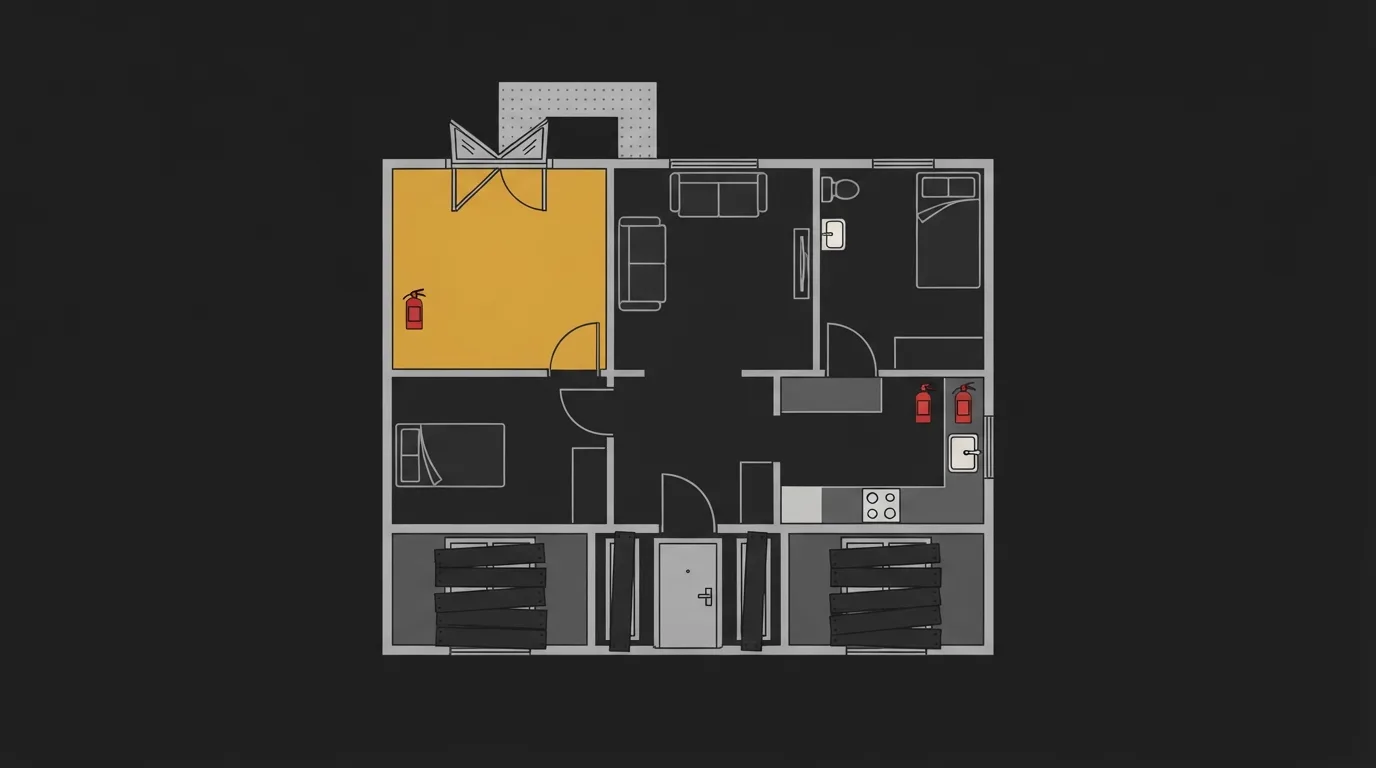
- Keep at least one charged fire extinguisher on each floor and one in the room where the family gathers. Ready.gov's home fire guidance also asks for working smoke alarms on every level.
- Know two ways out of every room, as Ready.gov recommends, and check that windows open, screens come out and any security bars release from inside.
- Upstairs bedrooms need an escape ladder that the children have practiced with.
- Move firewood, the grill's propane tank, trash cans and patio cushions away from the walls, and hook up a garden hose long enough to reach every side of the house.
Only then turn to break-ins. The strike plate, hinge screws, sliding-door bar and window film covered in our guide to layered home security do most of the work and cost little. Two steps belong specifically to unrest. First, bring in anything that could be thrown through a window or carried off: planters, lawn furniture, bikes and toys. Lock gates and keep pets indoors, where they cannot be hurt or used to draw you outside.
Second, decide about plywood now, while lumber is still in stock. Luther's advice is to buy it ahead, cut it to size and pre-drill the holes so the panels go up in minutes. She also warns against covering every window: "You don't want to create a prison from which you have no escape. Generally, just cover the front windows and sidelights by your doors." I would add her other caution. On a street where nobody else has boarded up, a house covered in plywood announces that someone inside has something worth protecting.
Keep a low profile while it lasts
A house that looks like every other house on the block is the hardest one to single out. In practice that means curtains closed at night with only dim lights behind them, a generator only if the neighbors run theirs, cars in the garage and the porch empty. Luther suggests testing it in advance: stand in the street after dark and see whether you can make out the television or people moving through the blinds.
The same rule applies online. A post showing your boarded windows or your full pantry tells strangers where the supplies are. Keep the preparations inside the family and a few trusted neighbors, and keep everyone, teenagers included, away from the protests and the cleanup crowds while things are still volatile. Watching from a sidewalk is how bystanders end up in the middle of a crowd that turns.
The family plan for unrest
Unrest usually starts on a weekday afternoon, with the family scattered between school, work and errands. The plan has to answer who picks up whom, by which road, and where everyone meets if a route is blocked. Our family communication plan covers the out-of-area contact, text-first check-ins and meeting places. For unrest, add one rule: nobody drives toward the trouble to rescue anyone, they call first and take the agreed route around it.
At home, pick one room for the family to spend the evenings in, ideally at the back of the house, far from the street and the front door, with a solid door and a window you can climb out of. Luther calls it a safe zone and suggests making it comfortable with a spare mattress, since you may sit there for several nights. Stock it with the radio, phone chargers, water, the first aid kit and a fire extinguisher. If the house is ever broken into, that room is also where you call 911 from, even if help is slow to arrive.
Talk to the children before the first night, in plain words they can repeat back: there is trouble in part of the city, we are staying home together, and here is what we do if a grown-up says it is time to leave. A child with a job, such as keeping the flashlights by the door, is calmer than one who is only watching the news.
Write down what would make you leave
Staying home is the right default for most suburban families, as our page on bugging in versus bugging out explains. It stops being right when the house itself becomes the risk. Decide your reasons to leave now, write them on the plan and agree that any one of them is enough:
- Fire on your block or smoke you cannot account for.
- An evacuation order from police or fire officials.
- The crowd moving onto your street or the one behind it.
- Water, power or phone service gone with no end announced, and someone at home who cannot manage without them.
Map two routes out that skirt downtown and the main roads where crowds tend to gather, and pick a destination ahead of time: a relative across town, a friend in the next county. Keep a bug-out bag packed for each person so leaving takes ten minutes, and leave in daylight if you possibly can, before a curfew starts and while the roads are still open.
Firearms, force and the law
Many readers keep a gun for exactly this scenario. The rings-of-security guide covers safe storage, training and the state laws to read. Two points belong here. Self-defense law and castle doctrine differ from state to state, and a shooting that is ruled lawful can still be followed by a long and expensive civil case. Luther warns her readers to expect exactly that, and adds that anything you set up in advance may be used against you in court.
Booby traps of any kind are illegal and leave you liable for whatever injury they cause. Alarms are fine: bells on door handles, a chime on a back window or a motion light by the gate tell you someone is there without hurting anyone. For most families the best use of force is never needing it, which is what the supplies, the low profile and the early departure are for.
After it ends: insurance and the paperwork
The damage from unrest is settled through insurance, and the claim is easier if the paperwork exists before the trouble. The Insurance Information Institute says riot, civil commotion, vandalism, looting and fire are covered perils under virtually all commercial property policies. Home policies are written differently, so read your declarations page or ask your agent which of those perils your policy names.
Ready.gov's fire guidance applies here too: make digital copies of birth certificates and other valuable records, and keep them somewhere outside the house. Walk through every room with a phone video now, opening closets and drawers. If something is damaged, photograph it before you clean up, keep every receipt for repairs and lodging, and throw nothing away until the adjuster has seen it.
My take: where I'd start this week
I'd start with supplies and skip the tactical gear until they are done. I'd spend the first weekend on the things that pay off in every emergency: two weeks of water, food and prescriptions, a cash envelope, and a battery radio with government alerts switched on in every phone. The second weekend goes to fire: an extinguisher on each floor, smoke alarms tested, a ladder for each upstairs bedroom and a practiced way out of every room.
Plywood, pre-cut and drilled for the front windows only, comes third, along with the 3-inch strike-plate screws. Last, I would sit the family down with a sheet of paper and write the four reasons to leave, the two routes and the destination, then pin it inside a kitchen cabinet. All of it fits in a month of weekends, long before the next flashpoint is on the news.
Frequently asked questions
How long does civil unrest usually last?
Should I board up my windows before a riot?
Is it safer to stay home or leave town?
Does homeowners insurance cover riot damage?
What should I tell my kids?

Written by
Walt Brenner
Grid-down threats, home security and family plans
Walt Brenner is the pen name of the writer who covers grid-down threats, home security and family emergency plans for Dark Grid Prep. He draws on FEMA and Ready.gov guidance, utility and government reports, manufacturer manuals and long-running prepper forums, and he says plainly where those sources disagree. His beat is the household: what a family of four in a suburb or on a rural lot should have, know and do before the lights go out.
Last checked 2026-11-12
Comments
No comments yet. Questions and your own experience are welcome.
Thank you. Your comment will appear once it has been reviewed.