Stockpiling
Pet emergency supply calculator
A dog drinks about an ounce of water per pound each day and a cat about four fifths of that. Enter your animals and the days to cover, and this page turns those rules into gallons, cups of food and a medicine target.
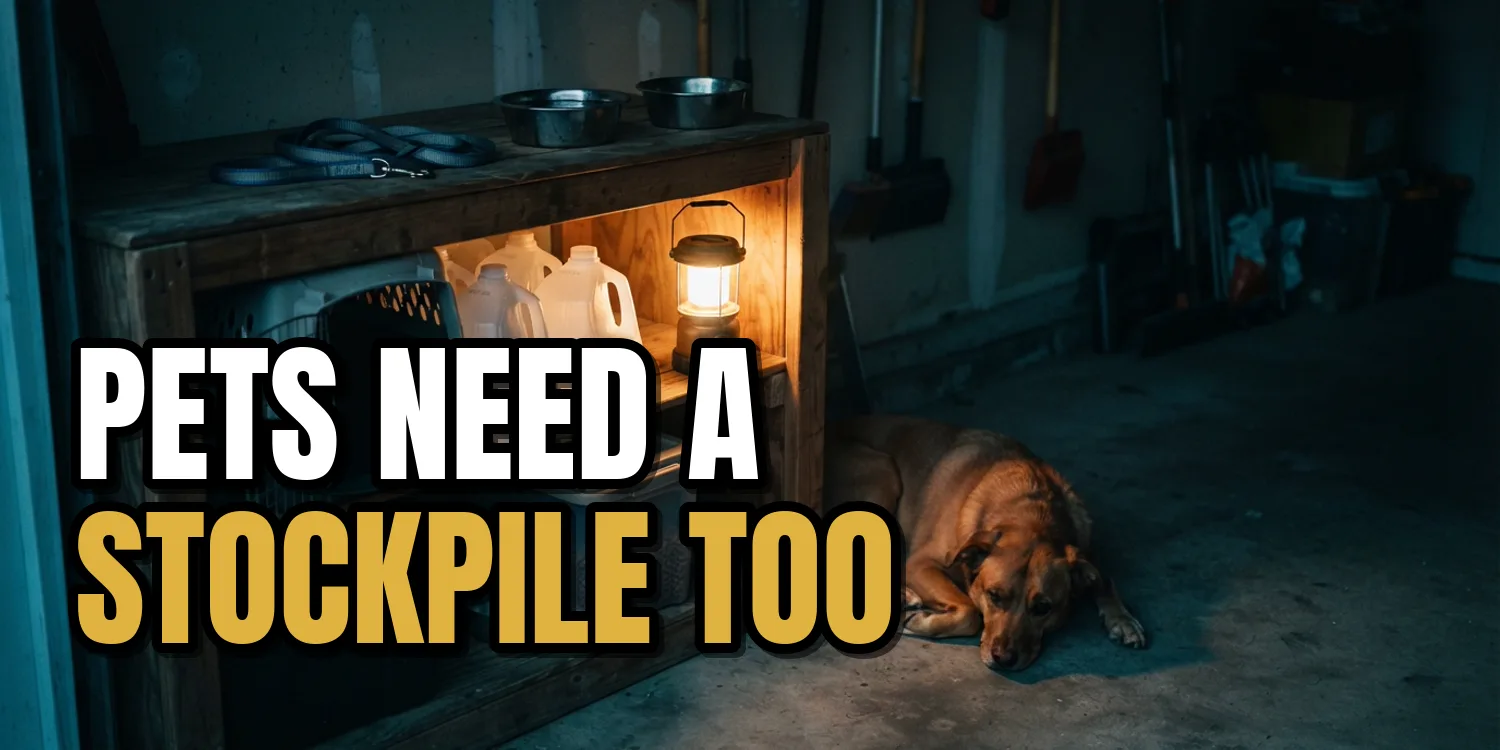
When the taps stop or the evacuation order comes, the dog and the cat still need water measured by their weight, the same food they ate last week, and the next dose of any daily pill. Dogs need roughly 1 ounce of water per pound of body weight per day (PetMD, the importance of water for dogs). Cats need about 4 ounces per 5 pounds of lean body weight, which is 0.8 ounce per pound (Cornell Feline Health Center, hydration). Multiply by the number of animals and the days you want to cover, and you have the pet line of your stockpile.
Ready.gov is plain about the stakes: if local officials ask you to evacuate, your pet should evacuate too, with its own kit of food, water, medicine, ID and a carrier (Ready.gov, pets). The numbers below are planning estimates built from those veterinary and federal rules. They are not advice for a particular animal. A pet that is sick, nursing, very old or on a prescription diet needs its own figures from the vet who knows it.
Work out the water, food and medicine
The form opens with one 45 lb dog and one 10 lb cat for seven days, the worked example further down. Change the counts and weights to your own animals. If you have two dogs of very different sizes, enter their average weight, or run the form once per dog and add the results. The food field is optional because the right amount is printed on your own bag, and this page will not guess it for you.
Gallons are rounded up to whole jugs, because a half-full jug still takes a jug. The ounce totals sit beside them so you can see what the rounding added. The result never changes the water your people need. That is a separate line, and the household stockpile calculator covers it for every person in the house.
How the water math works
People get a flat number. The American Red Cross plans one gallon per person per day, with a three-day supply for evacuation and a two-week supply for home (American Red Cross, survival kit supplies). Animals vary too much in size for a flat number to work. A Chihuahua and a mastiff can live in the same house, and one gallon would be far too much for one and too little for the other. That is why the pet rules are written per pound.
Dogs: an ounce a pound
PetMD’s vet-reviewed guidance puts a dog at approximately 1 ounce of water, an eighth of a cup, per pound of body weight each day. The ASPCA gives the same ounce-a-pound rule for a pet go bag (ASPCA, staying prepared for natural disasters). The University of Florida’s small animal hospital writes it into its hurricane checklist, with a 7-day supply as the plan (UF Small Animal Hospital, hurricane checklist for companion animals). Three sources, one figure. For a dog, the calculator multiplies pounds by days and stops there.
Cats: four ounces per five pounds
For cats the sources give two different figures. UF applies its ounce-per-pound line to cats and dogs alike. Cornell’s Feline Health Center, which studies cats alone, gives about 4 ounces per 5 pounds of lean body weight. For a 10 lb cat that is 8 ounces a day under Cornell and 10 under UF. The calculator uses Cornell for cats because it is the more specific source. If you would rather store the UF figure, enter your cat as a small dog of the same weight and the form will give you the larger number.
A sanity check from Virginia Tech
Virginia Tech’s emergency management office publishes worked examples at 10, 20 and 50 pounds, and says a 50-pound animal drinks about a half-gallon of water per day (Virginia Tech Emergency Management, pet kit). The strict ounce rule gives 50 ounces, which is about 0.39 gallon. Their rounding sits a little above the formula, and UF’s own gloss of half a gallon to a whole gallon per animal per day sits higher still. Read those as cushions. The formula is the floor, and a jug or two more than the floor costs very little.
The cushion box in the form adds a quarter to the water. That figure is my choice for a summer outage, when bowls get knocked over and some water goes to rinsing them. It is not a veterinary number. Turn it on if you store water in a hot garage or your dog is the kind that tips the bowl.
Once you have the gallons, they have to live somewhere. The emergency water storage planner turns a gallon total into containers, weight and floor space. The full household picture, including the water hiding in the heater and the pipes, is in the two-week household water math.
Food: stay on the same bag
A disaster is the wrong week to change what the animal eats. PetMD, quoting Humane Society rescue staff, warns that pets are already stressed in a crisis, and breaking their routine adds to the stress (PetMD, tips for feeding your pet during a disaster). The emergency bag should be the brand in the kitchen today, bought one bag ahead and used in rotation, the same way the human pantry works.
That is why the food field asks for your own label. Feeding charts differ by brand and by the calories in each cup, so a single table from this page would be wrong for most bags. Type the cups a day the chart gives for your animal’s weight, and the calculator multiplies by the number of pets and the days. Leave it blank and the result tells you to read the chart. The household stockpile calculator handles pet food the same way in its own FAQ, so the two pages agree.
If you keep canned pet food in the kit, pack a hand opener with it or buy pull-tab cans. Ready.gov lists one in the basic household kit (Ready.gov, build a kit), and the same tool opens both kinds of can. Ready.gov also names pet food and extra water for your pet among the additional supplies a household kit should hold, so the pet line belongs on the same shopping list as your own.
Dry food rotates like any other bag on the shelf. Keep one bag ahead and open the older bag first, the same first-in, first-out habit the rest of the pantry follows. The pantry rotation planner will take a pet food bag as an Other row with the date printed on it.
Medicine: two weeks if the vet will write it
Medicine is where the published lists ask for the most time. AVMA’s pet evacuation kit calls for a two-week supply of medicine (AVMA, pets and disasters), and the ASPCA asks for two weeks’ worth of your pet’s medication in the go bag. UF sets a lower but standing floor: keep a 7-day supply throughout hurricane season, and get extra refills before a storm. I would not plan on reaching the clinic during a regional outage. The refill you get ahead of time is the one you can count on.
Tick the prescription box in the form and the result adds those targets beside the water and food. It does not count pills, because the dose is on your label and only your vet can change it. Ask at the next visit whether the clinic will write a refill early so you can hold the extra week. Then rotate it like the human supply: the oldest bottle gets used first, and the new one goes behind it.
The same refill problem applies to the people in the house, at greater depth. Getting extra supplies past insurance limits, storing heat-sensitive drugs and rotating the reserve are covered in the prescription medication stockpile guide.
What goes in a pet emergency kit
The lists published by Ready.gov, the Red Cross, AVMA and Virginia Tech overlap heavily. Merged, they come to a short list of things an animal cannot go without when you leave the house or the power stays off. None of it needs to be bought as a packed kit, and most households already own half of it.
- Water, sized by the calculator above for the days you chose.
- Food, the same brand the animal eats now, enough for those days.
- Medicine, two weeks of any daily prescription where your vet allows it.
- A collar with ID on every animal.
- A leash for each dog.
- A carrier for any animal that travels in one.
- Bowls for food and water, which the Red Cross list names alongside the carrier.
- A manual can opener if any of the food is in cans.
The Red Cross puts most of this into one line of its survival kit list: collar, leash, ID, food, carrier and bowl. Ready.gov adds medicine to that core. Virginia Tech’s pet go kit sets at least a three-day supply of water, food and medications as its baseline.
Two kits, one plan
Ready.gov recommends two kits: a larger one if you are sheltering in place, and a lightweight version for evacuating. That matches how the days work in practice. The home kit holds the full week or two of water and food on the shelf. The go kit holds the carrier, the leash, the medicine and three days of food and water. It should be small enough to ride in the car beside the rest of your evacuation grab list. Run the calculator once at 3 days and once at 14, and you have the size of both.
Where the animals go if you leave
The hardest part of a pet emergency plan is the destination. Ready.gov’s evacuation page tells households to take their pets, and also warns that only service animals may be allowed in public shelters (Ready.gov, evacuation). A family that plans to use the shelter at the high school needs a second answer for the dog and cat, and that answer has to exist before the order comes.
Write it into the family emergency plan as a named place and a phone number: the relative out of town, the friend with a fenced yard, the boarding kennel outside the flood zone. Put the vet’s number in the family communication plan alongside the other contacts, so whoever reaches the animals first can call. If the plan says the pets go with you, the carrier has to fit in the car with the people and the bags, and I’d load it once on an ordinary weekend to find out.
How many days to plan for
The sources do not agree on a single number of days. They are answering different questions: a bag you carry, a storm you sit through, a two-week home supply. The table lines them up so you can pick the one that matches the plan.
| Source | Food | Water | Medicine |
|---|---|---|---|
| Virginia Tech go kit | 3 days or more | 3 days or more | 3 days or more |
| AVMA evacuation kit | 3 to 7 days | 7 days or more | 14 days |
| Humane Society via PetMD | 5 to 7 days | 5 to 7 days | Not stated |
| UF hurricane checklist | 7 days | 7 days | 7 days all season |
| ASPCA go bag | 7 to 10 days | 7 to 10 days | 14 days |
| Red Cross, people | 3 days away, 14 at home | 3 days away, 14 at home | Not in this line |
Three days sizes the go bag that Virginia Tech describes. A week is where the veterinary lists cluster for food and water, and it is the form’s default for that reason. Fourteen days is where medicine lands on two of the lists, and where a household that already keeps the Red Cross two-week home supply would bring the pets level with the people. Prepper forums often talk about weeks or months of pet food. That is a choice some households make, and none of the sources above asks for it.
One dog and one cat for a week
The form’s starting values are a 45 lb dog and a 10 lb cat for seven days, and each line below is a step the button repeats.
- The dog drinks 45 ounces a day, one per pound, so a week comes to 315 ounces. Divided by 128 ounces in a gallon, that is about 2.5 gallons, which rounds up to 3 one-gallon jugs.
- The cat drinks 8 ounces a day, 10 lb times 0.8, which makes 56 ounces for the week, under half a gallon. One jug covers it with room left.
- Together they need 371 ounces, about 2.9 gallons. Kept on one shelf, 3 jugs do it. Packed as two separate kits, it takes 4.
Turn on the 25% cushion and the dog’s week becomes about 394 ounces and the cat’s 70, which pushes the combined total to 4 jugs on one shelf, or 5 packed as two kits. Tick the prescription box and the result adds the two-week medicine target from AVMA and the ASPCA, with UF’s seven-day floor beside it. Add the cups from your bag label and the food line fills in. Without a label figure, it tells you to read the chart on the bag.
Change the plan to fourteen days and the water doubles: 630 ounces for the dog and 112 for the cat, about 5.8 gallons, or 6 jugs on a shared shelf. That is the figure to add on top of the household’s 14 gallons a person if the pets are staying home through a two-week outage.
My take: count the pets as dependents
I’d start with seven days of water and food for every animal you could not board somewhere else, because that is where AVMA, UF, PetMD’s rescue source and the ASPCA overlap. I’d go to fourteen days on medicine as soon as the vet will write the refill, since a missed dose is the part of a pet kit you cannot improvise with tap water or a different brand of kibble.
I’d put the pets on the same sheet as the people. On this site the stockpile is sized for a two-week grid-down, and the animals in the house drink from the same jugs and eat from the same budget. Ready.gov lists pet food and extra water inside the household kit, on the same page as the people’s supplies. If money is tight, the water comes first, a bag ahead of the food comes second, and the order for the rest is in stockpiling on a budget. The menu for the humans sharing that shelf is the two-week human food list.
I’d also decide the destination before buying a single extra bag. A full kit in a house you have to leave is only useful if you know where the dog is going. Everything else for the same pantry is on the Stockpiling hub.
Sources and method
Written from the public pages below. The calculator applies their published rules to the weights and days you enter. It is a planning estimate, and we did not measure what any animal drank.
- PetMD: The importance of water for dogs
- Cornell Feline Health Center: Hydration
- UF Small Animal Hospital: Hurricane checklist for companion animals
- AVMA: Pets and disasters
- ASPCA: How to stay prepared and keep your pet safe during natural disasters
- Virginia Tech Emergency Management: Pet kit
- PetMD: Tips for feeding your pet during a disaster
- Ready.gov: Pets
- Ready.gov: Evacuation
- Ready.gov: Build a kit
- American Red Cross: Survival kit supplies
Frequently asked questions
How much water does a dog need per day in an emergency?
Do cats need less water than dogs per pound?
How long should pet emergency food last?
Can I use the same stockpile as my family?

Written by
Walt Brenner
Grid-down threats, home security and family plans
Walt Brenner is the pen name of the writer who covers grid-down threats, home security and family emergency plans for Dark Grid Prep. He draws on FEMA and Ready.gov guidance, utility and government reports, manufacturer manuals and long-running prepper forums, and he says plainly where those sources disagree. His beat is the household: what a family of four in a suburb or on a rural lot should have, know and do before the lights go out.
Last checked 2026-11-24
Comments
No comments yet. Questions and your own experience are welcome.
Thank you. Your comment will appear once it has been reviewed.