Stockpiling
Stockpiling on a budget: what to buy first
Do the free things first: a written plan, alerts on your phone, and an honest look at what the house already holds. Then spend in this order: water, two weeks of the food you already eat, a spare supply of your medicines, light and a radio, and a carbon monoxide alarm, a few dollars at a time on every grocery trip.

Most prepping advice is written as if the reader has a spare thousand dollars and an empty basement. Plenty of the people who read this site live on a pension or a Social Security check, in a house or apartment that is already full, and they still want to be the household that can ride out a week without power. That is entirely doable on a few dollars a week, as long as the money goes to the right things in the right order.
This page is built from public guidance a reader can open and check: Ready.gov's food, kit and low-cost preparedness pages, Utah State University Extension's research on storing staples, and long-running preparedness writers who budget for a living. We have not run a family through an outage on these supplies. The order below is what those sources point to when you line them up.
What costs nothing: do these before spending a dollar
FEMA keeps a whole page called Low and No Cost Preparedness, and nearly everything at the top of it is free. Know which disasters are common where you live. Write a household communication plan on FEMA's free template. Keep important phone numbers somewhere other than your cell phone. Sign up for local emergency alerts. Talk through where you would go if you were told to leave.
Two items on that list are worth a phone call this week. Your local fire department may run a program that gives out smoke or carbon monoxide detectors, and many communities offer free or discounted CPR classes. For a household where someone has a heart condition or lives alone, a free CPR class is worth more than most of what a prepper catalog sells.
Then walk the house with a notepad. Flashlights in the junk drawer, a camping stove in the garage, spare blankets, a cooler, an old backpack, the extra cans at the back of the cupboard: all of it counts. Writing it down stops you from buying a second lantern you did not know you owned, and it shows you where the real gaps are. Our prepping for beginners guide turns these free steps into a first week of work if you want a schedule.
How much to spend, and when
No agency sets a figure. The writers at Common Sense Home suggest that a household unsure of where to start set aside about 5 percent, "$5 for ever $100 of real income." On a fixed income a flat amount usually works better than a percentage, because the check is the same every month and so is the habit. Ten dollars on the day the deposit lands is a plan you can keep for a year.
Ready.gov's own method is even simpler: when you shop, pick up one extra item that you use regularly, especially if it is on sale. One can of chili, one jar of peanut butter, one pack of AA batteries. Spread over a couple of months of normal shopping, that builds a real supply without a single large receipt, and it never empties a shelf for anyone else.
The buying order
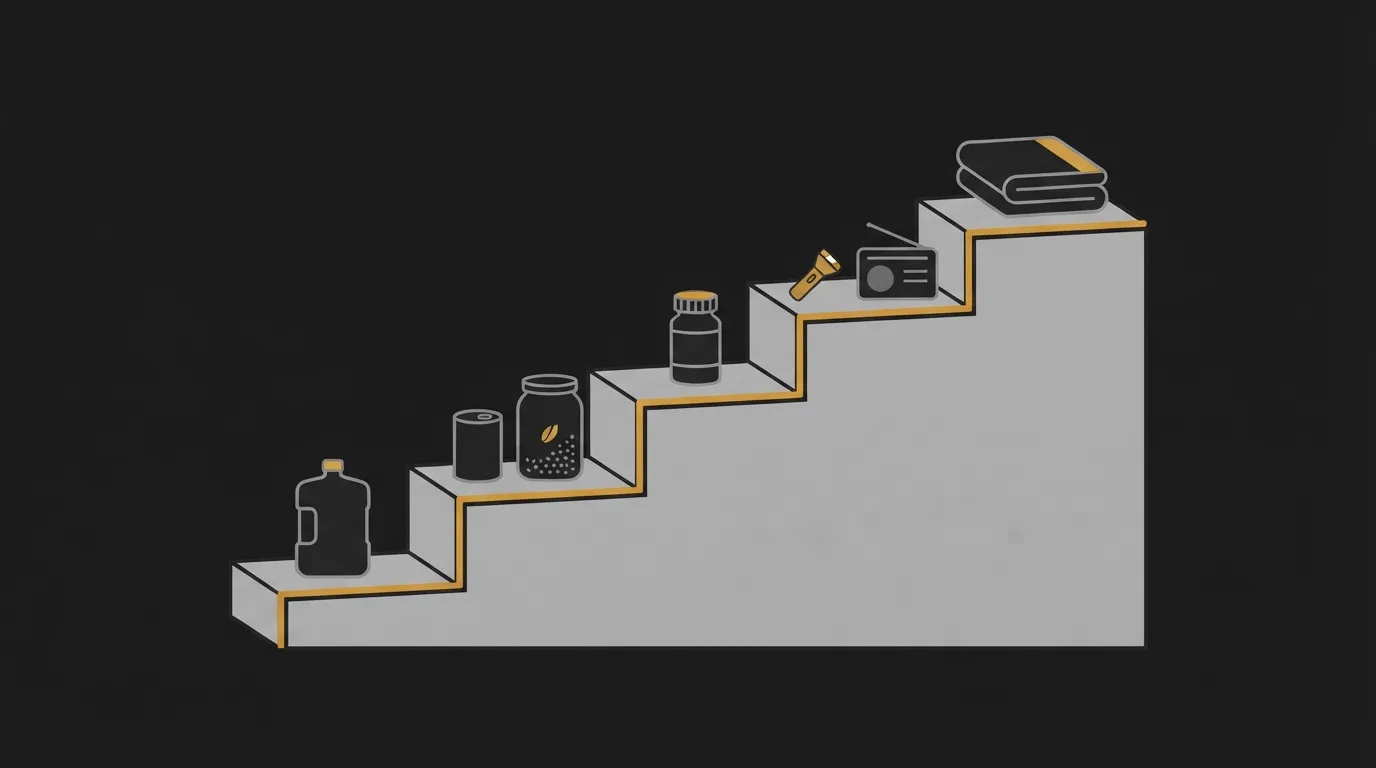
Each layer below covers a need that would hurt sooner, or more often, than the one after it. Finish a layer, or get most of the way, before you spend on the next.
Water
Water is the cheapest layer and the one a body runs out of fastest. Ready.gov's figure is one gallon per person per day, for drinking and basic hygiene. Sealed store-bought jugs are the simplest buy, kept in their original containers somewhere cool and dark. Filling your own costs less if you have food-grade containers: Ready.gov's water page says to wash them with dish soap, sanitize them with a teaspoon of unscented bleach in a quart of water, fill them from the tap and replace that water every six months.
Three days for each person in the house is the first target, then two weeks. Our page on water for a two-week outage works out the gallons for your household and shows the free water already sitting in your water heater and pipes, which matters a great deal if you are on a well.
Food you already eat
The best budget stockpile is a deeper version of your normal grocery list. Ready.gov's food guidance asks for foods that need no refrigeration, cooking, water or special preparation, and it names canned meats, fruits and vegetables, peanut butter, dry cereal, dried fruit and shelf-stable milk. Commercially canned food can be eaten cold straight from the can. That makes cans the right first purchase for a short outage, before you own a way to cook without power.
For calories per dollar, a few staples are hard to beat. A one-pound bag of white rice holds roughly 1,600 calories, dried beans about the same, and a pound of peanut butter more than 2,500, according to the nutrition labels on the packages. Rolled oats, pasta, canned tuna and store-brand canned vegetables round out the list without much extra cost. Store brands sit on the same shelf as the name brands and usually cost less.
Rice and beans have one catch: you need water and fuel to cook them. Buy them as the deeper layer once you have cans you can open and eat, and once you have an outdoor way to boil water. Ready.gov is plain that charcoal grills and camp stoves are for outdoor use only.
Choose what keeps. Utah State University Extension reports that white rice stored at a constant 70°F with oxygen absorbers keeps well for up to 10 years, and up to 30 years in cooler storage. Brown rice is a different story because its oils turn rancid, which is why Common Sense Home warns that a bulk bag of it is only cheaper "if" you use it before it spoils. On a budget, white rice is the safer buy.
Put a manual can opener on the shelf beside the cans. If you want numbers for your household, the stockpile calculator turns ages and days into calories and pounds of staples.
Medicine and the small necessities
About half of Americans take a prescription medicine every day, by Ready.gov's count, and for many readers over 60 that number is higher. A week of missing pills hurts faster than a week of missing groceries. The cheapest step here is timing: refill as early as your plan allows, every time, so a few spare days build up over the year. Our guide to an emergency supply of prescription medications covers early refills, 90-day fills and what to ask your pharmacist.
Next to the pills go the inexpensive things people forget until the store is closed: pain reliever, antacid, any allergy tablets you use, soap, toilet paper, unscented bleach and heavy trash bags. A dollar-store trip covers most of this.
Light and news
One flashlight per person, kept where you can find it in the dark, and batteries in the sizes your gear actually takes. The Red Cross tells households to use flashlights instead of candles when the power is out. A battery or hand-crank radio brings in local news when the cell network is overloaded or down. Our NOAA weather radio guide explains what the alert models do and why the very cheapest units tend to have the most trouble with reception.
Warmth and safety
This layer is where people on a tight budget get hurt by improvising. A carbon monoxide alarm with a battery backup is the one piece of safety gear I would pay for even before a radio if the household plans to use any fuel-burning heat or a generator, and the free detector programs mentioned above may cover it. Blankets, wool socks, hats and a sleeping bag you already own cover most of the rest. Our page on staying warm without power in winter covers keeping one room warm, and the carbon monoxide safety page explains why a gas oven or a grill never heats a home.
Where the money goes further
Ready.gov points shoppers to garage sales and thrift stores for camping gear, tools, cookware and backpacks at a fraction of retail, and to seasonal sales on emergency supplies. Camping stoves, lanterns and coolers show up there all the time, because people buy them for one trip and never use them again. Look the gear over carefully, and skip anything that burns fuel if its valves or hoses look damaged.
Splitting a bulk purchase with a neighbor or a relative is another way to get the warehouse price without the warehouse quantity. A 25-pound bag of rice is a lot for one person, and half of it is easy to store.
If money for food itself is short, Ready.gov says outright that community food banks are a resource for households building an emergency supply. There is no shame in using one for this. Keeping your household fed through a storm is exactly what they exist for.
One discount to pass up is the bin of badly dented cans. Ready.gov tells readers not to eat from cans that are swollen, dented or corroded, and a can that fails on the shelf wastes the money you saved.
What to skip for now
Freeze-dried buckets advertised as a year of food are the most common budget mistake. They cost many times more per day of eating than rice, beans and canned goods, and a family that never eats them at home tends to leave them sealed until the date passes. The same goes for tactical gear, gadget multitools and anything sold with a countdown clock.
A whole-house generator, or even a large portable one, is also a later purchase for most fixed-income households. Fuel storage, safe placement and regular running all cost money on top of the machine. Our generator sizing guide is there for when the basics are done, and for the one exception: a household with a powered medical device should plan its power early, starting with the supplier and the doctor.
Do not store your food in a hot attic or a garage that bakes in summer. USU's research ties the long shelf lives to cool, dry storage, and heat cuts them short.
A plan for the first eight shopping trips
Here is one way to spread the order across about two months of ordinary shopping, at roughly ten to fifteen dollars extra per trip for a couple. Adjust it to the foods your household eats and the trips you already make.
- Trip one: two gallon jugs of water and a manual can opener.
- Trip two: canned meat or fish and canned vegetables, enough for three days of meals.
- Trip three: peanut butter, dry cereal or oats, shelf-stable milk and canned fruit.
- Trip four: batteries for the flashlights you found, and one more flashlight if someone in the house has none.
- Trip five: soap, toilet paper, trash bags, bleach and the over-the-counter medicines you use.
- Trip six: more water, toward two weeks for each person.
- Trip seven: a bag of white rice and dried beans, for the deeper layer.
- Trip eight: a battery or crank radio, or a carbon monoxide alarm if no free one turned up.
Ask for an early prescription refill during those same weeks, and build up a small amount of cash at home when you can, since card readers stop working once the power goes out.
Storing it in a small house or apartment
You do not need a basement. Two weeks of food for two people fits in a closet, under a bed, or on a shelf unit in a spare room. Choose the coolest dry place inside the living space and keep cans off a damp concrete floor.
Write the purchase month on each item with a marker and put new things at the back. Cook from the front of the shelf as part of normal meals, so nothing sits until it expires. The pantry rotation planner sorts those marked months onto one sheet. That rotation is what keeps a budget stockpile from turning into money thrown away.
My take: water and cans this month, the rest by spring
I would start with the free list tonight: alerts, the written plan, the inventory and a call to the fire department about a CO alarm. Then I would put the first two or three trips into water and cans you can eat cold, because a cupboard of food you can open without power covers the outages that actually happen, the storm that takes the lines down for three or four days.
After that, keep the habit small and steady. One or two extra items a trip, an early refill each month, and by spring a fixed-income household can hold two weeks of water, food, medicine and light for less than the price of one freeze-dried bucket. When it is on the shelf, try a weekend with the main breaker off using our power outage checklist, and let what goes wrong decide what you buy next. If you are wondering whether a bigger stockpile is warranted, our look at why people are stockpiling food sets out who has good reason to go past two weeks.
Frequently asked questions
What is the very first thing to buy when prepping with little money?
How much should someone on Social Security spend on preps each month?
Are freeze-dried emergency buckets worth it on a budget?
Can I use a food bank to build an emergency supply?

Written by
Walt Brenner
Grid-down threats, home security and family plans
Walt Brenner is the pen name of the writer who covers grid-down threats, home security and family emergency plans for Dark Grid Prep. He draws on FEMA and Ready.gov guidance, utility and government reports, manufacturer manuals and long-running prepper forums, and he says plainly where those sources disagree. His beat is the household: what a family of four in a suburb or on a rural lot should have, know and do before the lights go out.
Last checked 2026-11-16
Comments
No comments yet. Questions and your own experience are welcome.
Thank you. Your comment will appear once it has been reviewed.