Communications
Walkie-talkie range calculator
Two handheld radios held about six feet off flat ground can reach each other at most about 7 miles before the curve of the earth cuts the signal. Houses, trees and hills shrink that to somewhere between a quarter mile and a few miles in most neighborhoods. The 35-mile figure on the box describes two radios on hilltops with nothing in between. Enter your own antenna heights below to see your limit.
The blister pack promised 35 miles, and the kids cannot hear you from the far end of the subdivision. Nothing is broken. Radios on the FRS, GMRS and amateur VHF and UHF bands travel close to a straight line, so the range you get depends on how high each antenna sits and what stands between the two of them. This calculator works out that straight-line limit from the heights you enter, trims it for the ground you live on, and shows what the FCC lets each kind of radio transmit.
Work out your radio range
The result is an estimate for planning. It assumes radio-to-radio contact on one channel with no repeater, and it stores nothing you type. The terrain choice is our own shortcut, fitted loosely to published field ranges, and carries no FCC standing. Write the range you settle on into your household plan, next to the channel everyone uses.
Print a family plan with your radio channels
How the calculator gets its numbers
The radio horizon
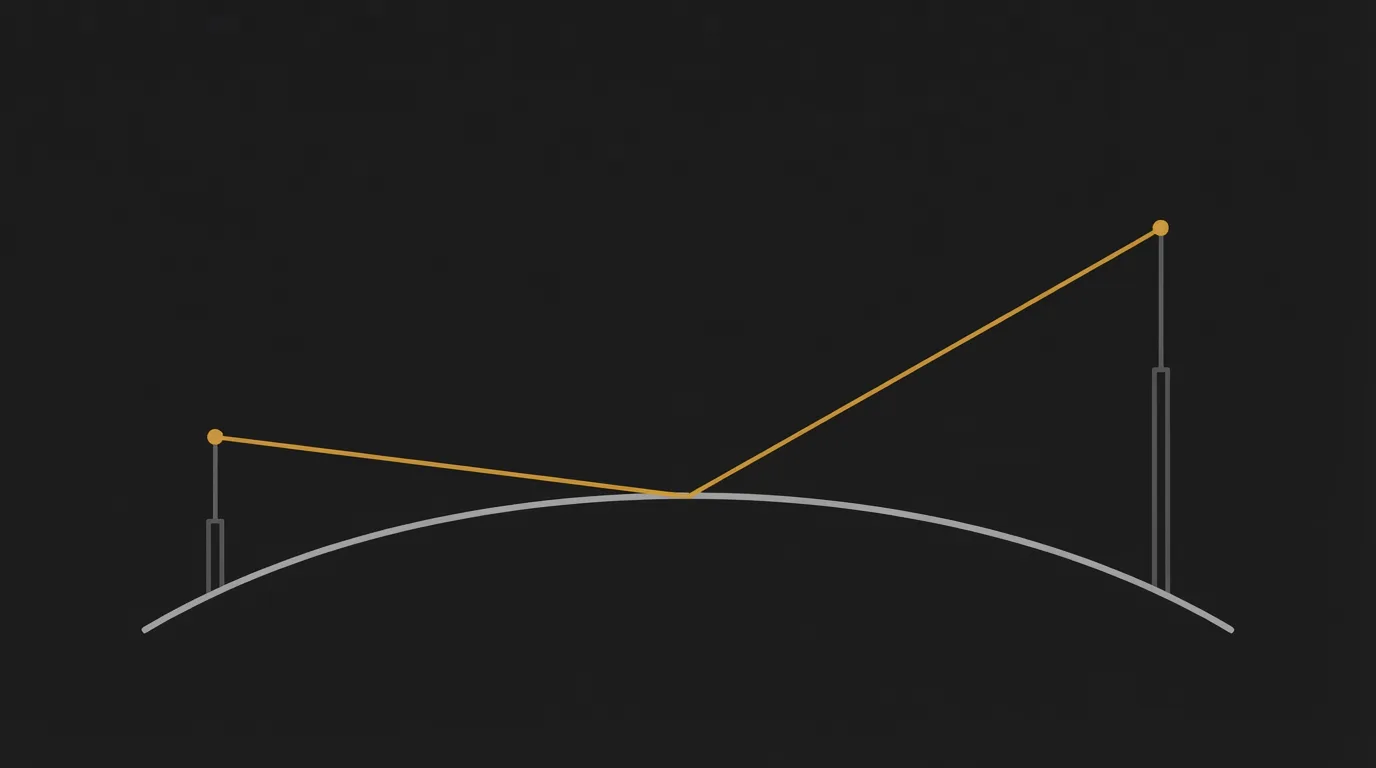
Each antenna can see a fixed distance across a smooth earth before the curve hides the ground beyond it. Ham Radio School gives the formula hams learn: the distance in miles equals the square root of the antenna's height in feet, times 1.415. Two stations each have a horizon, and they can talk as long as those two horizons touch, so you add them (Ham Radio School, how far can I talk with a handheld radio).
The telecom standards body ATIS defines the same quantity, radio horizon range, as 1.23 times the sum of the square roots of the two antenna heights, in nautical miles (ATIS glossary, radio horizon range). Convert 1.23 nautical miles to statute miles and you land on 1.415 again. ATIS bases it on an earth whose radius is taken as four thirds of the real one, which is how engineers account for the air bending a radio signal slightly downward. That bend is why the radio horizon sits a little past the point where you lose sight of the ground.
The terrain allowance
The horizon assumes a billiard ball with nothing on it. Real ground has roofs, pine stands and ridges, and each one eats into the signal before the curve does. The calculator multiplies the line-of-sight figure by a planning allowance:
- Open flat land or water: 1.0, the full horizon.
- Rolling land or suburbs: 0.55.
- Forest or hills: 0.35.
- Dense city: 0.25.
These factors are our own rough fit to the field figures quoted further down. They are not measured constants, and a single hill in the wrong place can beat any of them. They exist so the number you plan around starts closer to what families report than to what the formula alone promises.
The power note
The service you pick changes one line of the result: the most power the rules allow on that service. It does not change the distance, for reasons the section on height covers. If you enter the distance between home and school, the result also says whether that trip sits inside your planning range.
Three worked examples
Start with the case most families have: two handhelds, each held by an adult at about six feet. The square root of 6 is about 2.45. Times 1.415, each radio sees roughly 3.47 miles, the figure Ham Radio School works through, and together they reach about 6.9 miles on perfectly smooth ground. Over suburbs, the 0.55 allowance brings the plan down to about 3.8 miles. A practical guide from ProductsForOurLives puts realistic dense-city use at 0.25 to 1 mile for FRS radios and 0.5 to 2 miles for GMRS handhelds (ProductsForOurLives, how far long-range walkie-talkies work), which is why the city setting drops to about 1.7.
Now move one antenna up. Put radio A on a GMRS base station with its antenna 30 feet up on the roof, and leave radio B as a handheld at 6 feet. The roof antenna alone sees about 7.75 miles. Added to the handheld's 3.47, the pair can now reach about 11.2 miles of line of sight, more than half again what two handhelds manage, with no added watts at all. Repeaters work on this principle, taken further: a single radio on a tower or a ridge that everyone in the valley can see.
Last, the box claim. For two radios to reach 35 miles of line of sight, the square roots of their heights have to add up to about 24.7. Two antennas each 150 feet above the land between them get there, at about 34.7 miles. In practice that means two people on two hilltops with a clear valley between, which is the scene the packaging has in mind.
Why range depends on height more than watts
Family radios on 462 MHz, and ham radios on the 2-meter and 70-centimeter bands, all behave like line-of-sight signals. HamWiki's range page sums it up: everyday VHF and UHF range depends mostly on how high the antennas are and what lies between them, and much less on transmitter power (HamWiki, VHF and UHF range).
The arithmetic of power is unkind to buyers. HamWiki notes that doubling transmitter power adds only 3 dB, about half an S-unit on a receiver's signal meter. Going from 2 watts to 4 makes a weak voice a little clearer through a stand of oaks or a brick wall. It does nothing about a ridge or the curve of the earth, because the signal never reaches the far radio to be made clearer.
Height pays off in a different way. Every foot you raise an antenna moves its horizon out, and it also lifts the signal over the cars, fences and first-floor walls that soak up a handheld's power at waist height. Lift a handheld from 6 feet to 12, say from a second-floor window, and its own horizon grows from about 3.5 miles to 4.9. If you are still choosing which kind of radio to buy, our guide to FRS vs GMRS vs ham radio for your family compares the licenses and what each one lets you install.
What FCC Part 95 allows for FRS and GMRS
The Family Radio Service is defined in the FCC rules as a short-distance two-way voice service between low-power hand-held radios (47 CFR 95.533 and the FRS rules, as published by CustomsMobile). The power caps follow from that. Channels 1 through 7 and 15 through 22 allow up to 2 watts of effective radiated power, and channels 8 through 14 only half a watt. An FRS radio must also have its antenna built in so it cannot be removed. You cannot screw a better one on, and you cannot run a cable to the roof.
GMRS needs an FCC license, and in return it allows more. On the 462 MHz interstitial channels it shares with FRS, any GMRS station, handheld, mobile or base, is held to 5 watts of effective radiated power. Mobile, base and repeater stations may use up to 50 watts of transmitter output (47 CFR 95.1767, GMRS power limits). Real GMRS range comes from the license allowing a mobile radio with an outside antenna and access to repeaters, more than from any added watts.
The calculator handles repeaters only in the sense that you can type a tall antenna height for one end. It cannot tell you which repeaters cover your area or whether they stay up in a long outage, and repeater coverage maps are outside what it does. Buying a radio that pushes more power than its service allows on FRS channels is illegal, and the 3 dB arithmetic above shows how little it would gain you.
Ham radio follows the same physics
A licensed amateur on the VHF and UHF bands talks over exactly the same geometry. HamWiki gives typical handheld-to-handheld simplex range as a mile or two in town, five miles or more across open ground, and far more between two hilltops. Those figures sit right where the calculator's suburb and open settings land for two radios at head height.
Where ham radio pulls ahead is everything around the handheld. A licensed operator may put a larger antenna on a mast at home and reach the network of amateur repeaters on towers and ridges, and HamWiki notes that repeaters extend coverage well past simplex. The ham choice in the calculator therefore shows no single watt figure. Power limits come with the license class, and our FRS, GMRS and ham comparison covers what the exam involves. If an EMP is part of your threat list, a spare handheld stored in a Faraday cage for your radios covers the one event that could damage radios sitting in a drawer.
Why the box says 35 miles
ProductsForOurLives puts it plainly: a "30+ mile range" on a box usually comes from a best-case test with one radio on a mountain, the other in a valley, and nothing in between. The third worked example above is that test. Put both antennas 150 feet above the ground between them and the horizon formula agrees with the sticker.
A field test on Beans, Bullets, Bandages and You shows what the same claim means on ordinary land. The writers took a pair of Cobra radios rated at 37 miles into small hills and trees and found that 5 miles on high power in GMRS mode was the absolute limit. On low power they got half a mile at most (Beans, Bullets, Bandages and You, Cobra ACXT1035R review). A reader commenting on that review made the point that range claims are line-of-sight figures, and that two people standing on mountaintops with no obstacles might achieve them.
On high power that is about a seventh of the label, and on low power about a seventieth. The radios were working as designed. The ground was doing what ground does. So trust a test over the sticker. The half-mile drive test on our FRS and GMRS page takes one afternoon: one person drives the route to school or work and calls every half mile, and you mark on a map where the voice drops out.
Plan around the range you actually get
Once you have a planning number, compare it with the trips your family makes. If school is 2 miles away through suburbs and two handhelds plan out at 3.8, a direct call should work most days, and the drive test confirms it. If work is 9 miles away across wooded hills, no handheld pair will cover it, and you need a different link in the chain.
For those longer trips, three things change the geometry:
- A base or mobile antenna up high. A GMRS base station or a mobile radio with an outdoor antenna, used under a GMRS license, lifts one end of the link. Try a roof height in the calculator to see what it adds.
- A repeater. GMRS and ham repeaters sit on towers and ridges. They work only while they have power, so keep a direct radio-to-radio channel in the plan as well.
- A different medium. Cell towers carry backup power for a while, and the network fades in stages rather than all at once. Our page on whether cell phones work if the grid goes down covers how the towers hold up.
Whatever you settle on, put it in writing. Our guide to the family communication plan sets out the primary channel, the backup, the check-in times and what to do when nobody answers. For news from beyond your own radio range, a NOAA weather radio picks up the National Weather Service's alert broadcasts with no transmitter of your own.
What I would buy and test
I'd buy for a mile you can test rather than a mountain you do not have. For most households that means a pair of FRS radios for the kids and the yard, then a GMRS license and one radio with a roof antenna at home, since that single antenna does more for range than any handheld upgrade. Run the calculator with your real heights, pick the terrain setting that looks most like the drive between home and school, and treat the answer as a ceiling.
Then make the drive test the deciding vote. If the voice drops out short of the planning number, believe the test. Write the working range and the channel on the plan card that lives in every bag and every car.
Frequently asked questions
How far do walkie-talkies reach in a neighborhood?
What is the realistic GMRS range in miles?
Will a 50-watt radio talk over a hill?
Can FRS and GMRS radios talk to each other?
Is the calculator result a legal or engineering finding?

Written by
Walt Brenner
Grid-down threats, home security and family plans
Walt Brenner is the pen name of the writer who covers grid-down threats, home security and family emergency plans for Dark Grid Prep. He draws on FEMA and Ready.gov guidance, utility and government reports, manufacturer manuals and long-running prepper forums, and he says plainly where those sources disagree. His beat is the household: what a family of four in a suburb or on a rural lot should have, know and do before the lights go out.
Last checked 2026-11-22
Comments
No comments yet. Questions and your own experience are welcome.
Thank you. Your comment will appear once it has been reviewed.