Threats and scenarios
How to prepare for economic collapse
A household gets ready for economic collapse the same way it gets through a layoff or a bank closure: cash it can reach, little debt, a deep pantry, skills someone will pay for and neighbors it trusts. The collapses on record, such as Argentina in 2001 and Greece in 2015, froze bank accounts and ate savings while people kept going to work, so the plan is about staying fed and solvent through months or years of instability.
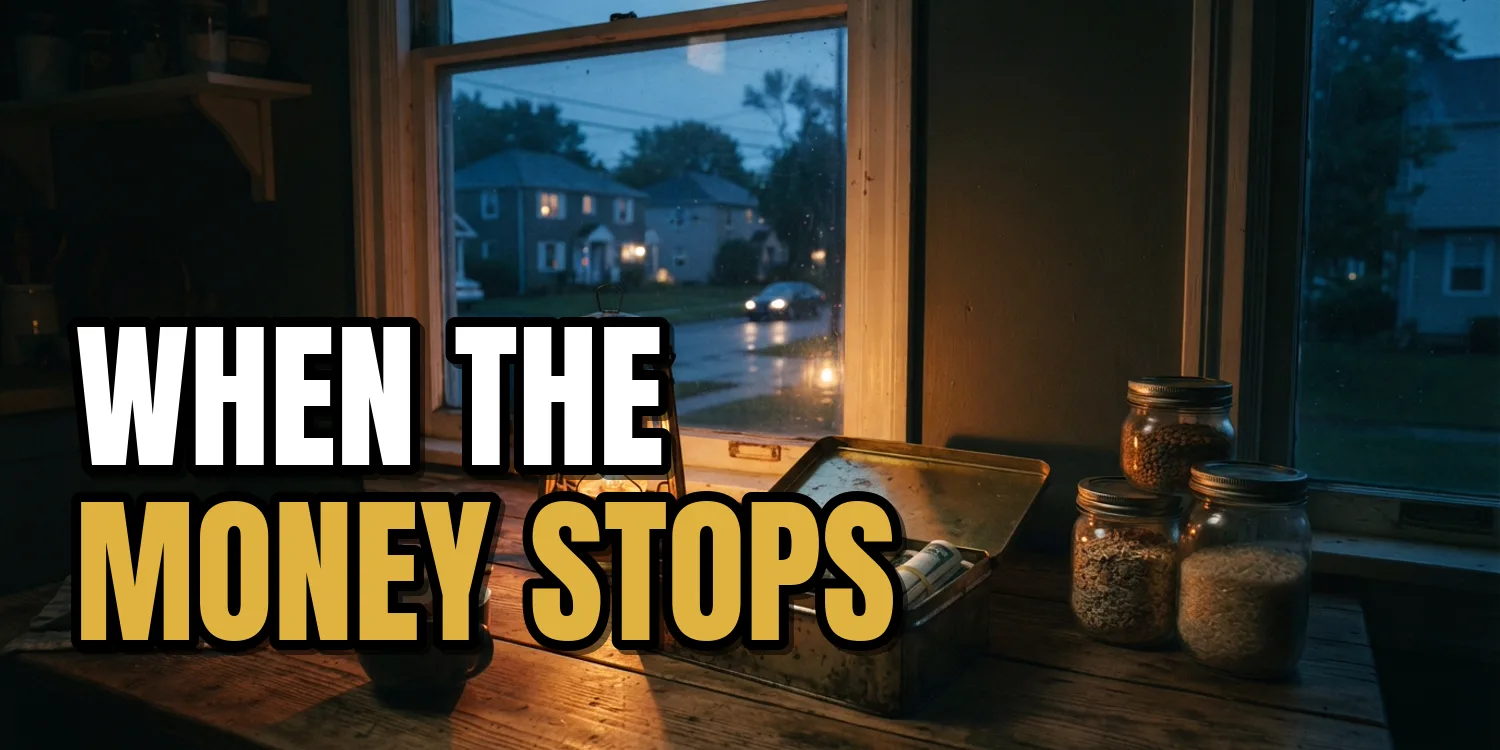
Most talk about economic collapse pictures one terrible morning when everything stops. The cases we can study look slower and stranger than that. Shops stay open, the lights stay on, the kids go to school, and the money in your account quietly stops being money you can use the way you used to.
This article draws on official data from the Federal Reserve and the FDIC, news reports from the Greek bank closure and the writing of preparedness authors who have studied Argentina's crisis for years. It covers the household: what to watch, what to build and in what order. Cash at home, food storage and home security each have their own guide on this site, linked where they come up, so this page stays on the money side of the plan.
Work out your family's stockpile
What an economic collapse looks like from inside a house
Greece gives the clearest recent picture of a bank shutdown in a modern economy. On June 29, 2015, after bailout talks with its creditors broke down, the government closed every bank in the country. A Reuters factbox published that morning set out the rules. Banks stayed shut until at least July 6, ATMs reopened with a daily limit of 60 euros, and transfers to accounts outside Greece were banned. The finance minister could stretch the closure or change the limit at will.
Look at what still worked. Card payments inside the country went through, pensions were exempt, and a special committee approved urgent payments such as medical bills. A Greek family could still buy groceries with a card. What it lost was choice: it could not pull its savings out, move them abroad or pay anyone who only took cash beyond 60 euros a day.
Argentina in 2001 went further, and lasted longer. Steve Charles, writing in The Revolver Dispatch, sums up the first months: "Banks froze accounts. Inflation spiraled out of control. Unemployment exploded." He also describes what did not happen: "People still went to work. Children still went to school." Families kept shopping and commuting while a large part of the middle class slid into poverty, and crime climbed around them.
Those two cases set the shape of the threat for a household. Expect locked or shrinking savings, prices that outrun pay, a job that may disappear and streets that get rougher, all spread over months. A bunker full of rifles answers very little of that. A paid-off car, a full pantry and a skill the neighbors need answer most of it.
The warning signs a household can actually watch
No indicator gives a date. What the numbers can do is tell you when to speed up plans you should be making anyway. Three national signals are worth a glance once a month, and none needs an economics degree.
- Unemployment turning up. The Sahm rule, named for the economist Claudia Sahm, flags a recession when the three-month average jobless rate rises half a percentage point above its low of the past year. The Federal Reserve Bank of Saint Louis publishes it as the real-time Sahm rule indicator, a single number you can bookmark.
- Prices outrunning pay. In the Federal Reserve's 2025 survey of household finances, just above nine in ten adults called price increases a concern, and 58 percent said price changes had left them worse off than a year earlier.
- Strain in the banks. Withdrawal limits, a bank holiday or a run on a regional lender are the signs that came right before Greece's closure. They tend to arrive with days of warning at most.
The signals closest to your own kitchen matter more. Overtime that dries up, a hiring freeze at work, layoffs at the plant across town, a landlord or lender tightening terms: these reach your family long before a headline uses the word collapse. The same Fed survey found that 42 percent of adults worried about finding or keeping a job, up from 37 percent the year before, and that only about a quarter rated the national economy good or excellent.
Treat any two of those local signs together as your cue to move the steps below up the calendar. Panic selling and hoarding come too late to help, and they cost more than steady preparation started early.
Build a cash cushion before anything else
Most American households are one surprise bill from trouble. The Fed survey found that 63 percent of adults would cover a $400 emergency with cash, savings or a card paid off at the next statement. Among adults earning under $50,000, four in ten could not cover even $100 from savings alone. A family in that position has no room for a layoff, let alone a crisis that lasts a year.
The first goal is a $1,000 starter fund, the second is three months of essential spending: housing, utilities, food, insurance, transport and minimum debt payments. Six months is a better target for a household with one earner or a job in a cyclical trade. It is slow, dull work, and it protects you in every scenario on this site, from a job loss to a long blackout.
Keep most of it in the bank. The FDIC insures deposits up to $250,000 per depositor, per insured bank, per ownership category, and says that since it was founded in 1933 "no depositor has lost a penny of FDIC-insured funds." Check that your bank is covered. The insurance applies to checking, savings, money market deposit accounts and CDs. It does not cover stocks, bonds, mutual funds, annuities, crypto or the contents of a safe deposit box.
Insurance protects the balance. It does not promise you can reach it on a given day, and Greece showed how quickly access can be rationed. That is the case for a few weeks of spending in small bills at home, stored where a burglar or a house fire will not find it. Our guide on how much cash to keep at home sets an amount and covers storage. Splitting savings across two unrelated banks also helps if one of them hits trouble.
Shrink the bills that keep coming
Debt is what turns a lost paycheck into a lost house. Every fixed payment you carry is money you owe whether or not the economy is working, and lenders tighten fastest when borrowers need them most. The Fed found that average card balances grew by more than 35 percent since 2023 among people who said they were finding it difficult to get by, which is the pattern to stay out of.
- Pay down variable-rate debt first, starting with credit cards, since its cost climbs if rates rise.
- Hold off on a new car loan or a bigger house while the warning signs are flashing.
- Cancel the subscriptions and services nobody would miss, and put that money into the cash fund.
- Keep your insurance. Six percent of homeowners in the Fed survey had dropped homeowners coverage entirely, mostly over cost, which leaves a fire or a storm to be paid out of savings.
A household with a fixed-rate mortgage, no card balance and paid-off cars can ride out a pay cut that would sink a neighbor carrying the same income and three loans.
A deep pantry is a hedge against prices
Food bought today at today's price is food you will not have to buy after prices jump. That makes a working pantry one of the few investments a family can make that pays back in every kind of crisis, economic or otherwise. The rule is to store what you already cook and eat it in rotation, oldest first, so nothing is wasted and nothing sits there untested. Which goods tend to vanish first when buying turns to panic, and which stay short for months, is in our page on what disappears from store shelves first.
Build it in steps. Two weeks of meals for everyone in the house comes first, then a month, then three. Rice, dried beans, oats, flour, canned meat and vegetables, peanut butter, cooking oil, salt and coffee are the backbone of most long pantries because they store well and cost little per meal. Our stockpile calculator turns your household into pounds of staples and gallons of water, and our explainer on why people are stockpiling food covers the price trends and the difference between building a pantry and panic buying.
Medicines belong on the same shelf. A crisis that costs you your job may also cost you your health insurance, and a 90-day supply of a daily prescription buys time to sort out coverage. Our guide to an emergency medication supply explains how to build one with your doctor and pharmacist.
Skills and income that hold up
In Argentina, Charles writes, "someone who could repair generators or fix vehicles often possessed more immediate economic power than someone sitting on a cache of gold coins." People bartered with "food, fuel, batteries, medicine, alcohol, cigarettes, tools, and services," and the services were often worth the most.
That lesson travels well. Look at your household and ask what each adult could earn money doing if the main job vanished. Small engine and auto repair, plumbing and electrical basics, sewing and mending, bookkeeping, tutoring, childcare, haircutting and home care for the elderly are all paid for in good times and bad. A trade certificate from a community college, or a side income that already brings in a few hundred dollars a month, is worth more in a downturn than any piece of gear.
Keep the main job, too. The Fed survey recorded a small rise in layoffs in 2025. Being the person your employer keeps, current in your field and easy to work with, is ordinary advice that matters more when cuts come.
What about gold, silver and barter?
Precious metals get more attention in collapse writing than anything else, and the Argentine record is cooler about them than the advertisements are. Charles reports that people holding gold "frequently discovered that it was difficult or outright impractical to use in day-to-day survival," because a shopkeeper had no wish to weigh coins or gamble on purity. His sharpest line: "You cannot shave a few dollars' worth of gold off a coin to buy bread, fuel, medicine, or diapers."
What changed hands in Argentina was cash, especially U.S. dollars, along with goods people used every day. For an American household the dollar is the local currency, so the lesson is to keep some of it on hand and to hold a modest stock of trade goods that are useful to you anyway: extra batteries, coffee, toilet paper, soap, basic tools and over-the-counter medicines. Metals can be part of long-term savings once the cash fund, the pantry and the debt are handled. They should never be the emergency fund.
Crime, security and keeping your head down
Hard times raise crime more reliably than they raise riots. Charles describes the danger in Argentina as "kidnappings, robberies, carjackings, burglaries, home invasions, and constant street crime," with criminals working ordinary streets while their victims lived ordinary lives. He credits the people who did well with becoming "forgettable": ordinary clothes, ordinary cars and quiet habits.
For a household, that means a house that does not advertise its pantry, no posts about supplies or savings, cash kept out of sight and the same daily routine as the neighbors. The physical work on doors, locks, lighting and a safe room is laid out in our layered home defense plan. If hard times bring protests and looting to your city, our guide to preparing for civil unrest covers the weeks when staying home is the safest choice.
Neighbors and family are part of the plan
"Families pooled resources. Neighbors shared information," Charles writes of Argentina, and trusted relationships "became invaluable." The lone survivor guarding his supplies is a movie character. Real downturns reward the household that can share a car, a garden, a skill or a spare room.
Start small. Know the names of the families on your street and what they do for a living. Agree with relatives where everyone would go if one branch lost its home, since moving in together is the oldest response to hard times there is. Write down who has which skill, from the nurse two doors down to the cousin who fixes engines. Our family communication plan keeps everyone reachable, and our page on bugging in versus bugging out helps decide whether your house is where the family should gather.
My take: where I'd start this month
I'd start with the boring money and leave the metals and the gear for later. In the first month I would write down every fixed bill, cancel what nobody uses and open a separate savings account at an insured bank with an automatic transfer on payday, however small. I would also pull a few hundred dollars in small bills and put them somewhere safe at home.
Month two goes to the pantry: two weeks of food the family already eats, plus a 90-day supply of any daily prescription. Month three is for debt, starting with the card that has the highest rate. After that, I would pick one skill per adult worth learning this year and start building the list of neighbors. None of it depends on predicting a crash, and every step still pays off if one never comes.
Frequently asked questions
What are the first signs of an economic collapse?
Is my money safe in the bank if the economy collapses?
Should I buy gold to prepare for a collapse?
How much food should I store for an economic crisis?
Should I pull all my money out of the bank?

Written by
Walt Brenner
Grid-down threats, home security and family plans
Walt Brenner is the pen name of the writer who covers grid-down threats, home security and family emergency plans for Dark Grid Prep. He draws on FEMA and Ready.gov guidance, utility and government reports, manufacturer manuals and long-running prepper forums, and he says plainly where those sources disagree. His beat is the household: what a family of four in a suburb or on a rural lot should have, know and do before the lights go out.
Last checked 2026-11-12
Comments
No comments yet. Questions and your own experience are welcome.
Thank you. Your comment will appear once it has been reviewed.