Threats and scenarios
What disappears from store shelves first
The order in which shelves empty during a panic run, a hurricane run and a real break in deliveries, taken from grocery industry reports and storm coverage, and what to have at home before it starts.
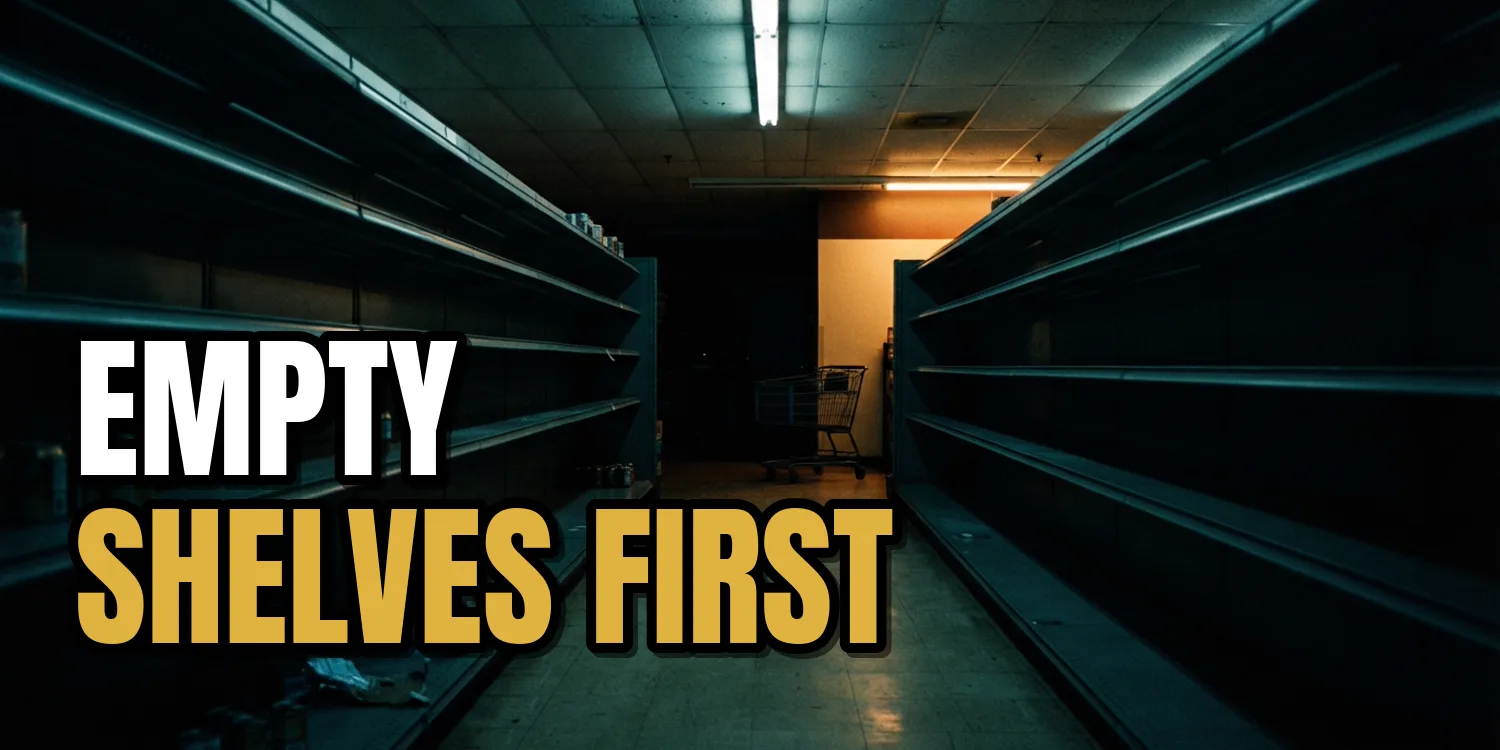
When a crowd buys in a panic, cleaning and hygiene products, bottled water, toilet paper and shelf-stable staples are usually the first things gone, often within hours, because stores keep very little in the back room and the warehouses behind them run lean. When a hurricane is coming, batteries and flashlights tend to go first at hardware stores, then water and generators. In a real break in deliveries, fresh food and prescription refills run short before the dry-goods aisle does.
In none of the documented cases did the country run out of food. The shelf ran out before the trucks could refill it, which is a gap a household can cover by having the basics at home before the rush starts.
Build the two-week food supply list
Three kinds of empty shelves
Most lists of what disappears first mix three different events together, and they do not empty the same aisles. It helps to know which one you are planning for.
A demand spike. Everyone buys at once, but the farms, plants, warehouses and trucks keep working. This is what happened in March 2020. The president of FMI, the trade group for American food retailers, told Supermarket News at the time: "This is a demand issue. This is not a supply issue." He put the lag at about two to three days behind demand while supply kept flowing.
A weather run. A storm is forecast, a region buys the same short list in the same 48 hours, and after landfall the roads, power and stores themselves may be shut. It is local and it has an end date, but the end can be weeks away.
A physical break in the chain. Something stops the goods from moving. FMI drew the line clearly in that same interview: a flood, a power outage or debris across a major highway is, in its words, "an actual disruption of a supply chain." A grid failure, a fuel shortage or a cyberattack on logistics belongs here. This is the case people mean when they say supply chain collapse, and it is also the least documented, so this page does not pretend to know its exact order. What it can show is how lean the system is to begin with, and which goods were slow to recover even when the trucks were running.
If the worry behind your search is money, prices and jobs, our page on preparing a household for economic collapse covers cash and debt. If it is the stockpiling headlines themselves, our explainer on why grocery runs happen now looks at what is driving them.
Why grocery shelves go bare so fast
A supermarket is built to sell, with very little room to store. The Maine Grocers and Food Producers Association put it plainly to the Portland Press Herald in April 2020: grocery stores "have a fairly small storage space compared to selling store space" and do not keep large rooms full of backup product. What you see on the shelf is close to everything the store has.
Behind the store sits a distribution system tuned for ordinary weeks. Nallan Suresh, a supply-chain professor at the University at Buffalo, described American grocery chains as offering a plentiful and affordable range of products "while keeping very little in inventory." That works well until demand jumps. It then shows up as gaps in the shelves within a day or two.
Retail software companies that sell inventory tools describe the same model, known as just-in-time ordering. Upshop, one of them, sums up the weak point in one sentence: "A late truck can lead to an empty shelf." Without a buffer of safety stock, a store has to react to every jump in demand and every delivery hiccup as it happens. Upshop sells software for this, so read it as a description of how the model works rather than as a neutral verdict on it.
The warehouses carry the buffer the stores do not, and in 2020 it went fast. The Press Herald reported that the mid-March surge "wiped out weeks of supplies" that chains and wholesalers normally hold in their distribution centers. Once that cushion was gone, product went out to stores as fast as it arrived, and the shelf only filled when a truck came.
None of this means the food was missing. C&S Wholesale Grocers told the same paper that there is typically inventory in the supply chain, "it is just not currently in a position to be purchased by shoppers." Suresh made the same point from the other side: he saw plenty of surge capacity to meet higher demand overall, and the empty shelves were a short-term mismatch between the shelf and the warehouse. If you are new to all of this, prepping for beginners starts from the same idea: keep a small buffer at home so a two-day lag never reaches your table.
What sells out first in a panic buying wave
No national count ranks the single first aisle to empty in March 2020. It varied by city and by week. What the record does show is a pattern that repeated from place to place.
Cleaning and hygiene products moved first. On March 11, 2020, FMI noted on its blog that communities with their first reported cases of the coronavirus were securing sanitizing wipes and hand sanitizer, before the wider stockpiling began. In a thread on r/preppers from early March, a shopper near Boston wrote that disinfectants and hand sanitizers were very hard to find.
Water, paper goods and quick meals followed within days. Victor Valley News Group reported from the Costco in Victorville, California, on March 5, 2020, that everything on the water shelves was gone by 10:30 in the morning, and that toilet paper, paper towels, bleach and cups of noodles had sold out before noon. The same r/preppers thread shows how uneven it was. A poster in Kentucky found the bottled water about 90 percent gone and the rice and beans heavily picked over. A shopper at a Walmart in South Florida found that only bottled water and rubbing alcohol had sold out, while most of the store still looked stocked.
Batteries are the item preppers most often name as first to vanish, and the early 2020 reports gathered for this page do not bear that out for a pandemic run. They are a storm item, and the next section shows where they do go first.
If you are preparing for empty store shelves, the lesson from 2020 is about timing more than any one product. The first items to go were the ones people associated with the threat itself (sanitizer for a virus), followed by the things everyone already uses daily and fears running short of: water, toilet paper, rice, beans and easy meals. Having a few weeks of those at home meant a household could stay out of the crowded aisle altogether.
What sells out first when a hurricane is on the map
A storm run is shorter and sharper, and it hits hardware stores as hard as grocers. Ahead of Hurricane Laura in August 2020, a Home Depot worker in Houston told ABC13 that what typically sells first are batteries and flashlights, followed by water and generators. That store had run out of generators and plastic tarps by Tuesday morning, before the storm arrived.
The reason to buy early is what comes after landfall. Ready.gov's hurricane page lists the supplies to gather and warns that you "may not have access to these supplies for days or even weeks after a hurricane." Roads close, stores lose power and staff cannot get to work. A run on the shelves before the storm is followed by a stretch when there are no shelves to reach.
So the answer to what sells out first in an emergency depends on the emergency. For a storm, it is the gear that makes a dark, wet house livable: light, power, water and something to cover a broken roof. If you live where winter takes the power out instead, our page on winter storm grid failure prep covers the 72 hours before an ice storm, and the same rule of buying before the forecast hardens applies there too.
What comes back slowly
The first aisle to empty is not always the last to refill. In 2020 some lines took weeks or months to recover, and they point to where a longer disruption would bite.
Paper and cleaning products were among the slowest. These are bulky, low-value goods, and FMI described manufacturers skipping the warehouse entirely to drop shrink-wrapped pallets directly at a store to get them out faster. Even so, the gaps lasted, because the warehouse cushion behind them was already used up.
Canned and frozen vegetables stayed short even longer. An FMI spokesperson told the Press Herald in April 2020 that "we will probably see continued shortages for canned and frozen vegetables for a few more months," because the surge had pulled forward stock that normally lasts until the next harvest is packed. That is the case most relevant to a pantry: the cans you would want for a long stay at home were also the ones slowest to come back.
In a true logistics break, the fresh perimeter of the store thins first. Produce, dairy and meat are the goods a just-in-time system holds the least of, because they spoil, so a store missing its deliveries runs short on them soonest. Our timeline of what happens if the power grid goes down shows how fuel pumps, card payments and refrigeration fail in the first days of a wide outage, which is what turns a delivery problem into an empty cooler. Prescription refills belong on this list too, since a pharmacy with no deliveries has nothing to fill them from.
What to stock before the shelves empty
The way to stay out of every run described above is to have the items that empty first already at home. Think of it in layers, and fill each one before you start the next. This is how a household prepares for a supply chain disruption, and almost all of it is ordinary groceries.
Water and the food you already eat
Ready.gov's basic kit starts with one gallon of water per person per day for several days, for drinking and sanitation, and at least a several-day supply of non-perishable food. Water was the item that went first in Victorville and Kentucky alike, so it goes first here too. Our guides to water for a two-week grid-down and the two-week emergency food supply list stretch that floor to two weeks, which covers the 2020 lag many times over.
Prescriptions
This is the shortage you cannot buy your way out of on the day. Talk to your doctor or pharmacist about an emergency supply well before any crisis is in the news. Our page on the emergency medication stockpile covers that conversation and how to store what you get.
Light, power and news
The storm items from Houston. Ready.gov's kit lists a battery-powered or hand-crank radio and a NOAA Weather Radio, a flashlight, extra batteries and a manual can opener. The stockpile calculator works out how many batteries and how much fuel your household needs for the days you choose.
Cash
When the power is out, card readers are too. A little cash at home lets you buy what is left in a store whose card machines are down. Our page on how much cash to keep at home works through the amount.
Storm extras, if you live where storms hit
Generators and tarps were the items gone by Tuesday morning before Laura. If you plan to run a generator, buy it and its fuel well outside storm season and learn to run it safely. Our guide to home generators covers the safety rules, which matter more than the model.
How to buy it without causing the run
FMI's request in March 2020 was that shoppers buy no more than seven to fourteen days' worth of food and supplies at a time. That fits a calm build-up: add a few extra items on each ordinary trip, over a few months, and you end up with weeks of stock without ever emptying a shelf yourself. Once it is home, the food storage rotation planner tells you which cans to eat first so nothing expires. If money is tight, stockpiling on a budget puts the same layers in the cheapest order.
Threat pages that pair with this one
Empty shelves are usually a symptom of something else, and each cause has its own page here. A long outbreak that keeps the family home is covered in the pandemic preparedness checklist, with the fever supplies and sick-room rules that go beyond groceries. A wide blackout and the knock-on failures that follow it are in our hour-by-hour blackout timeline. Rising prices and a deeper pantry for hard times are in the economic collapse guide linked above. And the Colonial Pipeline shutdown that emptied East Coast gas stations, a supply break caused by hackers, is part of our briefing on a cyberattack on the power grid.
My take
I'd start with water and skip everything else until it is stored. After that comes two weeks of the groceries the family already eats, then the prescriptions, then batteries and a radio. That order follows the record we have: water and staples were the first to go in 2020, medicine is the one shortage you cannot fix in a hurry, and batteries matter most when a storm is coming, which usually gives a few days of warning.
I would leave the specialty survival foods until the basics are on the shelf and rotating. A pantry of ordinary cans that you eat and replace does more against an empty aisle than a bucket of freeze-dried meals nobody opens.
The honest limit is that the order changes from town to town and from crisis to crisis. Florida lost water and rubbing alcohol while Kentucky lost water and beans in the same week. What this page offers is pattern recognition: if you can tell which of the three kinds of empty shelf you are facing, you know which aisle goes next, and you will already have it at home.
Questions readers ask
Should I stockpile everything now?
No. Build it a little at a time on regular shopping trips, starting with water, everyday food and medicine. A slow build costs less and never leaves a neighbor facing an empty shelf.
Is the U.S. running out of food?
The 2020 shortages came from timing. Industry experts said the overall system had room to meet the extra demand, and the gaps were between warehouse and shelf.
Are batteries the first thing to disappear?
Before a hurricane, at hardware stores, often yes. In the early weeks of the pandemic, reports put sanitizer, water and paper goods ahead of them.
How long until shelves refill after panic buying?
Most staples lagged by a couple of days while trucks kept running. A few lines, such as canned and frozen vegetables, stayed short for months.
Sources
- Supermarket News, FMI: supermarkets facing a demand issue, not a supply issue (March 2020)
- FMI, How is the grocery supply chain responding to coronavirus (March 11, 2020)
- University at Buffalo, Expert on what is causing empty grocery store shelves
- Portland Press Herald, Shortages of some grocery staples could last for months (April 7, 2020)
- Victor Valley News Group, Long lines and empty shelves at Costco in Victorville (March 2020)
- ABC13 Houston, Stores restocking shelves as Houstonians prep for Laura (August 2020)
- Upshop, What is just-in-time inventory in grocery retail
- Ready.gov, Build a kit
- Ready.gov, Hurricanes
- r/preppers, Shortages at stores (March 2020)

Written by
Walt Brenner
Grid-down threats, home security and family plans
Walt Brenner is the pen name of the writer who covers grid-down threats, home security and family emergency plans for Dark Grid Prep. He draws on FEMA and Ready.gov guidance, utility and government reports, manufacturer manuals and long-running prepper forums, and he says plainly where those sources disagree. His beat is the household: what a family of four in a suburb or on a rural lot should have, know and do before the lights go out.
Last checked 2026-11-24
Comments
No comments yet. Questions and your own experience are welcome.
Thank you. Your comment will appear once it has been reviewed.