Garage and shed security
Secure a garage during a power outage
When the opener is dead, pulling the red emergency release disconnects the trolley and leaves the garage door movable by hand until it is re-engaged or mechanically locked. Keep that release usable, block access to it from above, lock the track when appropriate, harden the door into the house, and treat sheds holding fuel or a generator as theft targets on a dark street.
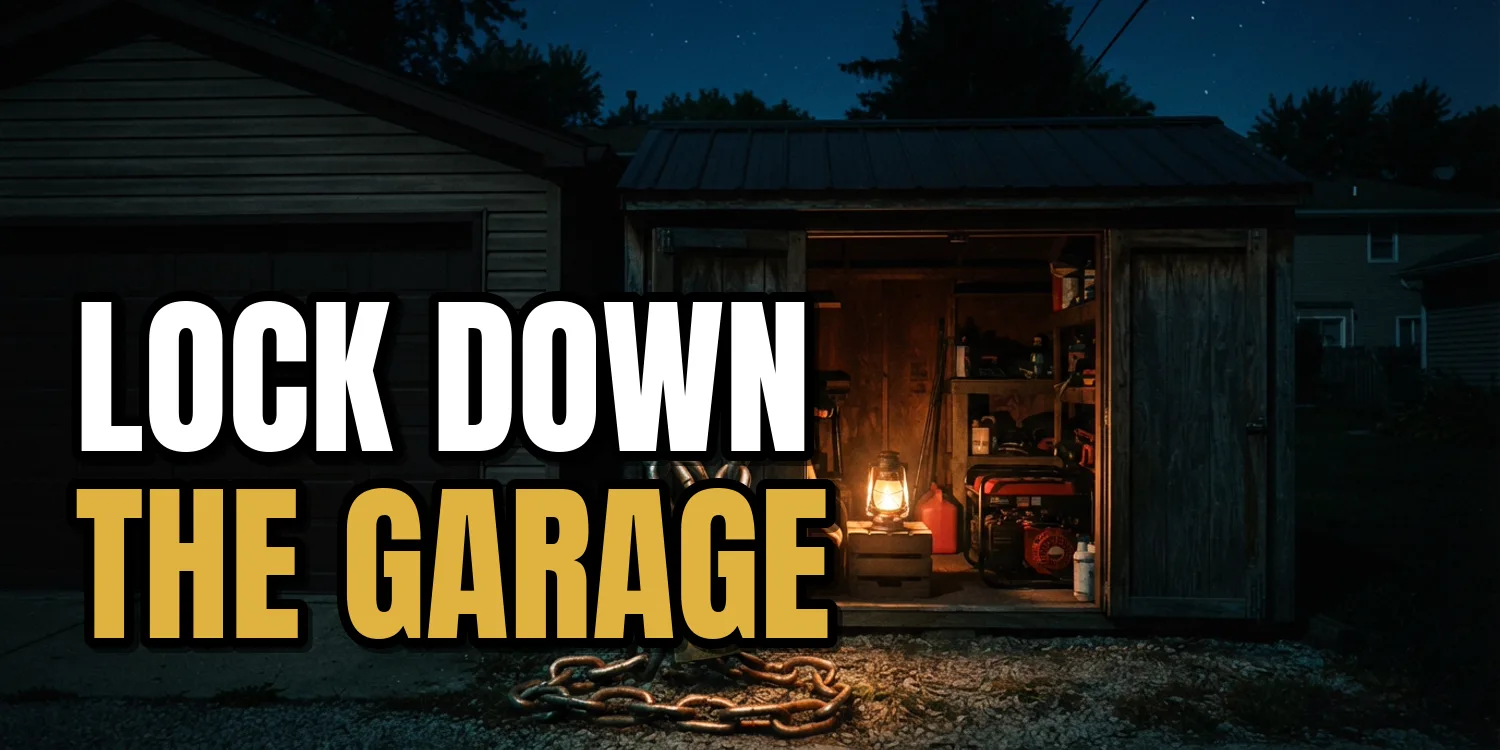
A blackout changes the garage from a powered entrance into a large door you may have to disconnect and lift yourself. The same outage makes generators, fuel cans, tools and ladders attractive targets on a dark street.
The practical answer is a short routine for the garage door, followed by physical layers around everything stored behind it.
Why a blackout changes garage security
An automatic opener normally moves the garage door through a trolley connected to the door arm. The red emergency cord releases that connection. Family Handyman's manual-opening instructions say to pull the cord to disengage the trolley, unplug the opener, unlock the door and lift it fully open. Once disconnected, the door can be moved by hand. That gets the car out, but it also removes the opener from the security equation until the trolley is re-engaged or the door gets a mechanical lock.
Use the release only with the door fully closed. A partly open door can fall when it is disconnected, according to Family Handyman's manual-opening guide. Practicing the motion while the power is on makes the release location and the door's weight familiar before the house is dark. The practice also shows whether every adult can lift the door and whether the trolley reconnects the way the opener manual expects.
The outage creates a second problem outside. GenDealers reports that portable generators are stolen from driveways and open garages during blackouts. Running one makes the house with power easy to locate, so the security tradeoff belongs in your OPSEC plan when the block goes dark. Exhaust safety sets the placement first. Ready.gov says generators and fuel belong outdoors at least 20 feet from windows, doors and attached garages. Our carbon monoxide rules for generators cover the operating distance and the risks of moving a running unit closer for concealment.
This page focuses on physical locks and storage buildings. Battery backup, solar lights, alarm panels and cameras have different failure points, which are covered in home security without power.
Protect the garage door manual release
The coat-hanger method starts at the top edge of the garage door. A person pushes the top panel inward enough to pass a stiff wire through the gap, hooks the red cord or release lever, pulls it, and then lifts the disconnected door by hand. Windows in the upper section make the cord easier to locate. Both Family Handyman and the Door & Access Systems Manufacturers Association describe the method. Family Handyman also says the maneuver is difficult or nearly impossible on some openers because the release must be pulled straight down.
The risk is real enough for the door industry to have discussed it for years, but the available sources do not establish how often it happens. A DASMA trade article records the attack and quotes major opener makers arguing that its incidence was low. That is a reason to fix the exposed mechanism without treating one viral video as the only way a garage gets breached.
The red handle must remain functional. 16 CFR 1211.9 requires a red manual-detach handle that releases with no more than 50 pounds of force when the door is down. The handle also has to remain reachable from the floor. That is why cinching the mechanism shut with a heavy zip tie is a poor primary fix. It can interfere with the one release you need during an outage or when smoke makes the powered opener irrelevant.
Block access while preserving the release
A release shield is the cleaner answer. It sits around the trolley or opener arm and blocks a wire approaching from above, while the cord stays reachable from inside the garage. Family Handyman shows a plywood version attached with breakaway brads. An Oklahoma door dealer gives the same principle for metal or plastic guards: stop the wire from reaching the lever, but leave the red cord usable for the person standing below it.
Family Handyman also describes an optional small zip tie through trolley holes. Its role is limited. The tie has to resist a light tug from a fishing wire and still break when a person inside gives the release cord a hard pull. That is different from tying the cord or lever so firmly that the release no longer works. Test any breakaway arrangement from inside with the door closed.
Covering or frosting upper garage-door windows removes the view a person would use to find the cord and check whether a vehicle is inside. It does not replace a shield, because a practiced person may still estimate where the trolley sits. It does remove information from the street and complements the same low-profile habits used elsewhere around the house.
My choice for garage door manual release security is the shield, followed by a deadbolt on the door between the garage and the living space. That combination protects the emergency function and assumes the overhead door may still be defeated. A tightly disabled release puts the household's exit mechanism at risk to solve one entry method.
How to lock the garage door when the power is out
Close the door before pulling the release. After using the car, lower it by hand and decide whether you need routine access again that day or whether the building should stay closed for an extended period. If you expect to leave again, reconnecting the trolley avoids forgetting a separate lock. If the garage must stay shut for days, Family Handyman recommends a padlock through a hole in the track just above one roller. The roller cannot travel past the lock, so the door cannot rise.
- Close the garage door before operating the emergency release.
- Pull the red cord to disconnect the trolley, unplug the opener and raise the door all the way when you need access.
- Lower the door by hand after the vehicle or tools are out.
- Reconnect the trolley for normal movement, or place a padlock through the track above a roller when the door must remain closed.
- Remove the padlock before restoring power or pressing the opener control.
The track padlock is a deliberate lockout, not an everyday convenience. Someone who forgets it and runs the opener asks the motor and hardware to pull against an immovable track. Keep its key with the person responsible for the garage and make removal part of the power outage checklist before the opener returns to service.
A detached garage with no side door presents an access problem after the opener loses power. One generic option is a locked exterior emergency-release panel near the top center of the door. Family Handyman describes it as a keyed way to reach the release from outside. The lock on that panel matters because the panel is also an intentional route to the release.
The vehicle entrance is only one way in. Family Handyman calls the walk-through service door the main weak spot in many garages and recommends a deadbolt with a heavy strike like any exterior door. For an attached garage, give the passage door the same long-screw and frame treatment used to reinforce a front door. A breach of the large door should meet a second locked boundary before anyone reaches the living space.
Fuel and generators in an attached garage
Portable generators are especially visible during a blackout. GenDealers says units are taken from driveways and open garages when surrounding blocks are dark. Their report is industry commentary rather than national crime data, but the exposure is plain: the machine must operate outside and its sound identifies a powered property. The response is to separate safe operation from secure storage. Run it outdoors at the Ready.gov distance, then return a cooled, non-running unit to a locked building and secure it to an anchor where your setup allows.
Never run a portable generator in a garage, even with the vehicle door open. Ready.gov's power-outage guidance places generators and fuel outdoors and at least 20 feet from openings and attached garages. The theft problem does not justify moving carbon monoxide exhaust toward the house. The site's generator for home guide explains placement and connection, while the fuel calculator covers generator fuel storage limits.
Fuel makes the attached garage both valuable and hazardous. Residential guidance from Lehi Fire, based on the International Fire Code, allows no more than 10 gallons of gasoline in an attached garage as part of a 25-gallon household total. Local rules can differ, so this is a concrete example of why a garage full of cans is a poor default. Our page on fire safety during a power outage covers extinguisher use, evacuation and ignition control.
The basic garage routine also covers quieter weaknesses: close the large door fully, lock the service entrance, lock the interior entry and keep the release protected. A shield cannot compensate for a door left cracked or an interior entry left unlocked. These ordinary openings deserve attention before another connected device or camera enters the plan.
Shed security and securing outbuildings on rural property
Outbuildings have longer sightlines, fewer witnesses and more tools that can be carried away or used against the house. A useful shed plan starts at the door hardware and moves inward. Wright's Sheds says a hasp is only as strong as the wood behind it. Use a hasp carriage-bolted through framing with a closed-shackle padlock, which leaves less shackle exposed to tools. Secure exposed hinge pins where a door opens outward.
Inside, run a hardened chain through generator handles, mower decks or bike frames and into a ground anchor bolted to the structure. That keeps the building lock and the valuable item from sharing one point of failure. Wright's also advises keeping the most valuable machines away from an easy view through the door. High or frosted windows provide daylight without putting the contents on display.
Victoria Police's rural property guidance adds the outer layers: lock sheds and garages with good-quality locks, use sensor lighting, and consider solar cameras where wiring is impractical. Solar power is useful only if the camera's recording or connection still works in the outage conditions you planned for. The limits of Wi-Fi and battery-backed equipment belong in the site's guide to powerless security systems.
Keep ladders and tools locked away. Victoria Police warns that thieves can use them to reach other buildings. On acreage, place fuel storage within the house sightline where practical, and aim a sensor light at the approach rather than across a public road. A battery shed alarm or a cellular camera can add warning where household Wi-Fi disappears, but the bolted hasp, anchor and chain remain the physical layer that does not depend on a signal.
Photographs of equipment and serial numbers can help identify what was taken and support an insurance record. This is paperwork, but it is part of securing outbuildings on rural property because the distance between a shed and the house can delay discovery. The physical plan should assume the camera may report late or not at all.
Tie the garage into the rest of the home-defense stack
A garage door is one part of the shell. The layered home defense plan starts at what the street can see, moves through the property line, and ends at the doors, windows and inner room. The garage belongs in that walk-around alongside slider and window hardening.
During an outage, a battery or solar motion light on the garage approach can preserve warning after grid-tied lighting fails. Neighbors add another layer. The site's guide to neighborhood mutual aid explains contact lists and check-ins without turning the street into an armed patrol. A neighbor who knows a generator should not be rolling down the drive can notice movement while your camera is offline.
Use the garage plan as a short branch of the household plan: who operates the release, who holds the track-lock key, where the generator is secured after use, and who confirms that the opener is clear before power returns. This keeps one person's security fix from becoming another person's jammed door or blocked vehicle.
My take
I would practice the manual release once with the power on and the door closed, install a shield around the release this weekend, and reserve the track padlock for a multi-day absence or a period when the garage will stay shut. I would add a deadbolt and long frame screws to the interior entry before buying another camera. Those steps protect both the emergency release and the boundary behind it.
On a rural property, I would put the money into the shed door framing and a bolted anchor before a smart camera. A camera can tell you what happened if its power and connection survive. A closed-shackle lock, bolted hasp, chain and anchor still make the theft take longer when the Wi-Fi is gone.
Frequently asked questions
Should I zip-tie the garage door release?
How do I lock a garage door during a power outage?
What kind of lock should I use on a shed?
Does pulling the manual release leave the garage insecure?

Written by
Walt Brenner
Grid-down threats, home security and family plans
Walt Brenner is the pen name of the writer who covers grid-down threats, home security and family emergency plans for Dark Grid Prep. He draws on FEMA and Ready.gov guidance, utility and government reports, manufacturer manuals and long-running prepper forums, and he says plainly where those sources disagree. His beat is the household: what a family of four in a suburb or on a rural lot should have, know and do before the lights go out.
Last checked 2026-11-25
Comments
No comments yet. Questions and your own experience are welcome.
Thank you. Your comment will appear once it has been reviewed.