Home defense
OPSEC for preppers: keeping your preps private
OPSEC for a prepper means keeping three facts inside your household: that you have supplies, how much, and where they are. Most stockpiles are given away by small things, such as a remark at work, a pile of boxes on the porch or a photo taken in the pantry, so the work is finding those clues and closing them before an emergency makes them matter.
A full pantry protects a family only as long as the people around it do not think of it as theirs. In normal times the risk is a burglar who heard about the guns or the cash. In a long outage it changes: a hungry neighbor, a cousin with three kids and no plan, a stranger who saw your generator running on a dark street. None of them needs to be a bad person to become a problem at your door.
This page draws on the federal definition of operations security, long-running prepper writers who have dealt with leaks in their own households for years, and a security firm's research on what photo files reveal. It covers the habits that give a stockpile away and how to change them. Hardware such as locks, bars and film is in our guides to the front door and the sliding door and windows.
What OPSEC means for a household
The term comes from the military, and the U.S. government still defines it in one sentence. The NIST glossary, quoting the Committee on National Security Systems, describes a process that "involves five steps: identification of critical information, analysis of threats, analysis of vulnerabilities, assessment of risks, and application of appropriate countermeasures" (NIST CSRC, Operations security).
Translated to a house, those steps become five questions you can answer at the kitchen table in an evening:
- What exactly are we protecting? Write it down in a few lines.
- Who would want it, now and in a long emergency?
- How could each of those people find out?
- Which of those leaks is likely and would hurt us most?
- What will we change, and who in the family owns each change?
The value of the process is that it keeps you from guarding everything equally. Most households worry about the wrong leak, such as the internet tracking their purchases, while the teenager tells the whole bus about the freeze-dryer.
Step one: decide what is worth hiding
Keeping a quiet profile is easier when the list is short. For most families the critical information comes down to these items:
- That the house holds weeks or months of food, water and fuel, more than the neighbors keep.
- Where the supplies sit: the basement, the spare closet, the shelf behind the water heater.
- Firearms, ammunition, cash and precious metals, which draw a different kind of attention even in normal times. Our cash reserve guide covers how much to keep and where.
- That you will have power, heat or running water when the street does not.
- When the house is empty, and for how long.
Some things belong off the list. That you care about preparedness, own a weather radio or keep a first-aid kit is ordinary, and pretending otherwise makes you look stranger than you are. The goal is a household that seems a little better organized than average, not one that seems to be hiding something.
Step two: who you are keeping it from
Ken Jorgustin, who has run Modern Survival Blog since 2010, lists the reasons in plain terms. Once people know, "You will be catalogued (consciously or subconsciously) as a potential resource," and "if it did happen, those who know may come a knocking" (Modern Survival Blog, How would a non prepper know).
That covers three groups, and each needs its own response. Burglars and thieves exist today and care mostly about guns, cash, tools and an empty house. People who know you, such as coworkers, relatives, friends of your kids and the neighbors, are harmless now and become the main concern on day ten of an outage, when they remember your basement. Strangers in a crisis notice whatever stands out on a dark street: light, noise, smell, a running engine.
The second group is the one most families underrate, because it is made of people they like. Being careful with them is not about trust. A friend who knows can repeat it to someone you have never met.
How small clues add up
The federal definition puts the core risk in a phrase worth remembering: "indicators and vulnerabilities" that "could be interpreted or pieced together to derive critical information." No single clue gives a stockpile away. A delivery driver, a remark in the break room and a photo of your garage shelves each look harmless. Seen together, by the same person, they make a picture.
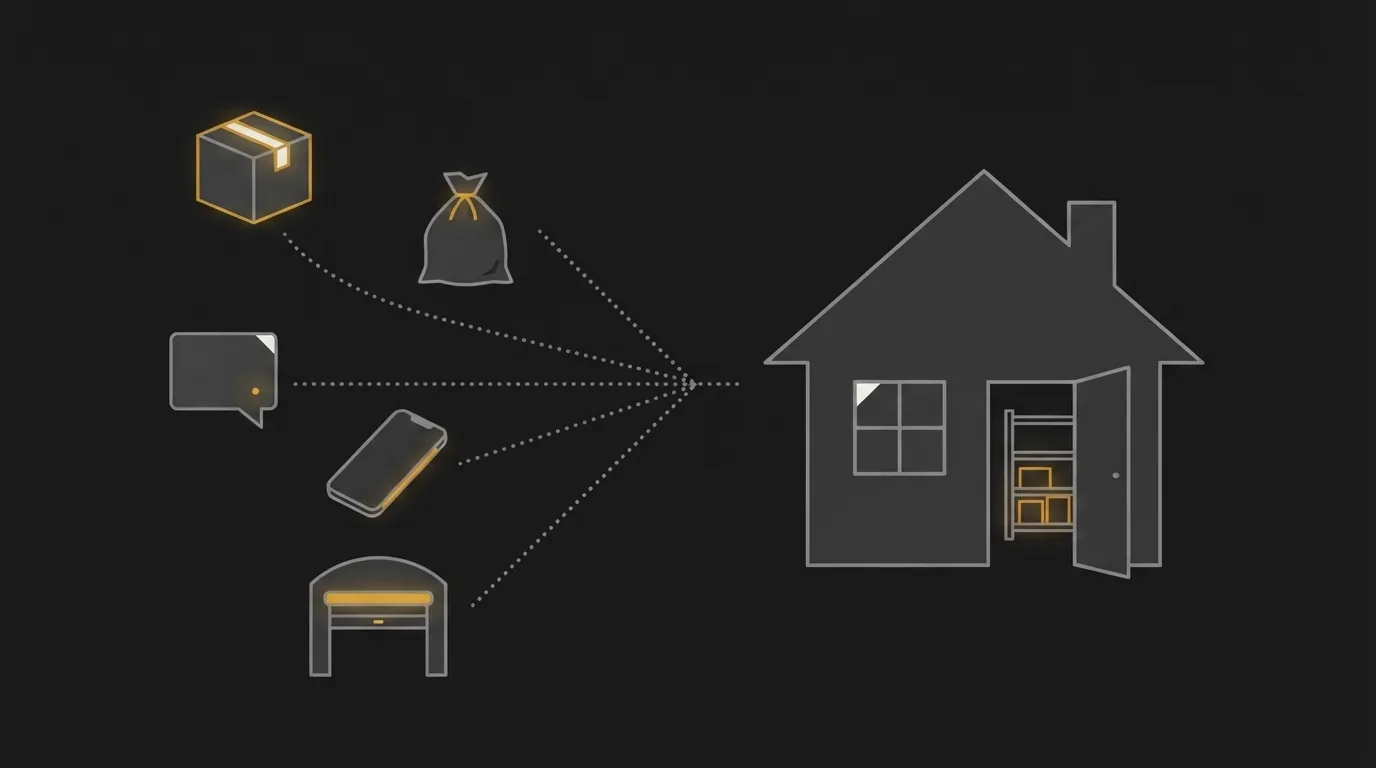
That is why OPSEC is a set of habits more than a single fix. Closing one leak while three stay open protects very little. The sections below go through the leaks in the order prepper writers rank them, starting with the largest.
Talk is the leak that matters most
Jorgustin is blunt about the order: "The number one reason that other people find out you're a prepper is by you or your spouse (anyone in your group) opening their mouth about it." He adds the part that makes it hard to control, that word passes on: "People talk. And those people talk."
A household rule works better than willpower. Agree on it together, say it out loud and give everyone, children included, a short answer to fall back on:
- For a friend who notices the full shelves: "We buy in bulk, it saves money." That is true for most families who stock up.
- For a coworker who asks after a storm how you managed: "We had a few days of food and a camp stove." It is honest and it closes the subject.
- For a relative who keeps pressing: "We have a plan, and I'd be glad to help you make yours." Help with the plan, not with an inventory.
A family member who loves to talk about prepping can still do so. Talk about skills, about the news, about what the Red Cross recommends. Keep quantities, locations and gear brands out of it. A letter writer on SurvivalBlog described the line his family drew: "We don't mention our preps to anyone outside of our family. We have coached our kids from an early age to keep their lips zipped" (SurvivalBlog, Keeping a low profile is crucial for preparedness).
Deliveries, boxes and trash
Bulk buying leaves a trail on the porch and at the curb. Any one of these tells the street exactly what you are doing: a stack of cases marked as emergency rations, a pallet of water on the driveway, forty empty pouches in the recycling bin.
The same SurvivalBlog writer had his packages sent to a private mailbox and handled them this way: "We are always sure to unload the van from inside my garage, with the garage door shut. All of the empty boxes have the 'to' and 'from' address labels cut out with a box cutter knife." He then disposed of the flattened cardboard away from home.
Few households need to go that far, and a mailbox rental costs money every year. A cheaper version covers most of it:
- Spread large orders over weeks so nothing arrives as a pallet.
- Bring boxes in the day they arrive, and open them inside.
- Break down cartons and turn the printed side in, or take them to a recycling drop-off.
- Bag food packaging before it goes in the can, so the lid does not show a month of freeze-dried meals.
- Shop in person for some of it, in ordinary amounts, a few cans at a time on regular trips.
What visitors and the street can see
Jorgustin's second-ranked leak is simply people seeing the stuff, and his readers added the moments it happens: the neighbor who drops by "when the garage is open" and asks why you have three freezers, and "the serviceman working on your furnace in the basement" who mentions how much toilet paper you have. Once you have lived with your shelves for a year, you stop noticing them. Guests notice straight away.
Walk through the house as if you were a plumber, then do the same from the sidewalk:
- Keep the garage closed unless someone is working out there, and store the generator, fuel cans and water barrels where an open door does not frame them.
- Put a door, a curtain or plain cabinets in front of storage shelves. Cases of food in a closet look like nothing, while the same cases on open racks look like a warehouse.
- Skip the labeled buckets and survival-brand totes in visible places. Plain bins on a shelf look like holiday decorations.
- Before a contractor comes, close the doors to rooms they do not need to enter. The SurvivalBlog writer kept his basement door locked whenever anyone visited, so to guests it looked like a closet.
- Watch the vehicles. Decals for gun brands, militia patches or survival slogans tell every parking lot who to follow home.
Your online footprint
The modern leak is the one people carry in their pocket. A phone photo usually stores where it was taken, and that data travels with the file. Kaspersky's researchers tested how services handle it and found that when you e-mail a photo or share it from cloud storage, "your file remains unaltered. Anyone with whom you share the photo can access the associated metadata." Some social networks strip the location before posting, and others keep it on their own servers (Kaspersky, Do your online photos respect your privacy?).
Their first recommendation is the simplest: "Disable geotagging on the device you use to take photos." After that, a few rules cover most households:
- Never post a photo of the pantry, the gun safe, the generator or the water storage, even in a closed group. Screenshots leave closed groups.
- Use a forum name that is not your own and that you have used nowhere else, and leave your town and employer out of your posts.
- Post trip photos after you are home. An empty house is critical information too.
- Think twice before writing product reviews under your real name for long-term food or ammunition.
Radio is part of the footprint as well. Anyone with a cheap handheld can listen to FRS and GMRS channels, so family check-ins should say where people are and that they are fine, never what the house holds. Our family communication plan sets up short check-in messages, and the FRS, GMRS and ham guide explains who can hear which service.
When the grid is down
Everything above is preparation for the week when it counts. In a long blackout the quiet habits change from privacy into security, and new clues appear: the only lit window on the block, an engine running at night, the smell of bacon on day eight, laundry on the line while everyone else is wearing the same clothes.
The street layer of our layered home defense plan covers light, generator noise and trash in detail. A few things to add for a household that wants to blend in:
- Match the street's routine. If neighbors are hauling water from a distribution point, someone from your house should be seen in that line too, even if you only bring back a jug.
- Cook early and simply. Boiling and simmering smell less than frying and grilling, and a meal made before dusk does not send cooking smells over a quiet street at night.
- Keep comings and goings ordinary. Unloading supplies from a vehicle in daylight is the one sight that tells everyone what you have.
- Run any generator in short, scheduled stretches. Choose its spot for safe exhaust before you think about noise. Our carbon monoxide guide explains the 20-foot rule, and quiet never comes before it.
- Look a little tired and a little worried in public, because everyone else will.
None of this works if the family has never practiced it. A dark-house evening from the grid-down drill is the time to check which windows leak light and how far cooking smells carry.
Where secrecy stops: neighbors and charity
OPSEC taken too far leaves a family alone on a street of strangers, and a street where households know each other is safer than any one house. The hub page for this section puts the balance simply: talk about preparedness in general, encourage neighbors to prepare, and keep the size and location of your own supplies to yourself. A family next door with two weeks of food in the house has no reason to come knocking at yours. Our guide to neighborhood mutual aid in a long outage shows how a street lists needs and capabilities without anyone listing what they store.
Many preppers also plan for giving, which keeps compassion from turning into a security problem. The SurvivalBlog writer kept a separate stock of charity bags and planned to hand them out "through an intermediary, like our church." The same idea works with a food pantry, a mutual-aid group or a neighborhood association. What is given through them does not point back to one house, and the family's own supplies stay intact.
Local emergency groups are another honest way to know people without broadcasting an inventory. Volunteering in one tells neighbors you are useful in a crisis, and it does not tell them what is in your basement. When you write your family emergency plan, add a line on who in the household speaks for the family and what they will and will not say.
Where I'd start
I'd start with talk, because the sources agree it is the biggest leak and fixing it costs nothing. Sit the household down once, write the short list of what stays private, and give each person, especially the kids, a sentence they can say when someone asks. That single conversation closes more than any mailbox rental.
Next I'd turn off location tagging on every phone in the house and delete any old photos of the storage that are already online. After that come the garage and the shelves visitors can see, which are a weekend of curtains and plain bins. I would leave the elaborate measures, such as private mailboxes and buying everything in cash, to households that already have the basics in place.
My one caution is about tone. A family that treats every question as a threat looks stranger than one that buys in bulk and does not talk about it. Aim to be boring, and save the planning for the kitchen table.
Frequently asked questions
Should I tell my extended family about my preps?
What should kids be told about the food in the basement?
Is it bad OPSEC to post on prepper forums?
Does OPSEC mean refusing to help neighbors?

Written by
Walt Brenner
Grid-down threats, home security and family plans
Walt Brenner is the pen name of the writer who covers grid-down threats, home security and family emergency plans for Dark Grid Prep. He draws on FEMA and Ready.gov guidance, utility and government reports, manufacturer manuals and long-running prepper forums, and he says plainly where those sources disagree. His beat is the household: what a family of four in a suburb or on a rural lot should have, know and do before the lights go out.
Last checked 2026-11-14
Comments
No comments yet. Questions and your own experience are welcome.
Thank you. Your comment will appear once it has been reviewed.