Medical prep when help is delayed
Storing insulin without power
Insulin in its original vial or cartridge stays usable for up to 28 days at ordinary room temperature, between 59°F and 86°F, so a blackout does not ruin the bottle you are using. The danger is the other direction: heat above 86°F, freezing, and a fridge full of spare stock warming up behind a closed door. The plan is to keep it cool, never frozen, and to know the day you need a fresh supply.
A long outage worries anyone who keeps medicine in the refrigerator door, and for a household with diabetes it is the first thing to think about when the lights go out. The good news is that insulin is tougher than most people fear, as long as it stays inside a fairly wide temperature band. The bad news is that summer heat, a cold garage in January, or a well-meant bag of ice can push it out of that band within hours.
This guide is written from the FDA's emergency guidance on insulin and on temperature-sensitive drugs, Harvard Health's advice on protecting your health in a power outage, and the food-safety timings Ready.gov and the Red Cross publish for refrigerators. It explains what the labels allow and how to set up a cooler. It also covers when to replace a supply. Your own prescriber and pharmacist know your insulin and your dose, and the questions at the end of each section are the ones to put to them before storm season.
What the labels actually allow
U.S. insulin makers all label their products for storage at about 36°F to 46°F. Kept that way and unopened, a vial or pen is good until the expiration date printed on it. Outside the fridge, the rule that matters is the room-temperature one. Vials and cartridges supplied by the manufacturers, opened or unopened, "may be left unrefrigerated at a temperature between 59°F and 86°F for up to 28 days and continue to work," according to the FDA's insulin storage guidance.
Three details on that page change how you plan:
- Insulin that has been diluted or drawn out of its original vial gets thrown away within two weeks.
- Prefilled pens do not all share one number. The once-weekly pen Awiqli, for example, may sit below 86°F for up to 12 weeks in total, opened or not. Other pens list their own windows in the leaflet that comes in the box.
- Each maker runs a customer service line for questions about whether a particular vial is still fit to use. The FDA prints the numbers for Lilly, Novo Nordisk, Sanofi and the smaller makers on the same page.
So start by reading the leaflet for every insulin in the house and writing its room-temperature days on a card. Most people have never looked, and the answer is often longer than they expected.
The first hours: leave the fridge shut
When the power goes, the fridge is still the coldest box you own. Ready.gov gives an unopened refrigerator about four hours before food starts to warm, and the Red Cross says a full freezer holds for about 48 hours, half that if it is half full. Opening the door to check on the insulin spends that time faster than anything else.
A cheap dial or digital thermometer on the fridge shelf answers the question without guesswork. Scott Goldberg, an emergency physician quoted by Harvard Health, suggests moving insulin to a small cooler with ice packs once the refrigerator climbs above 46°F (Harvard Health). That is the trigger to watch for. Until then, the spare stock is better off where it is.
The vial or pen you are using today can come out right away. It is covered by the 28-day window, and keeping it in a drawer at room temperature means one less reason to open the fridge.
A cooler that keeps it cool and never frozen
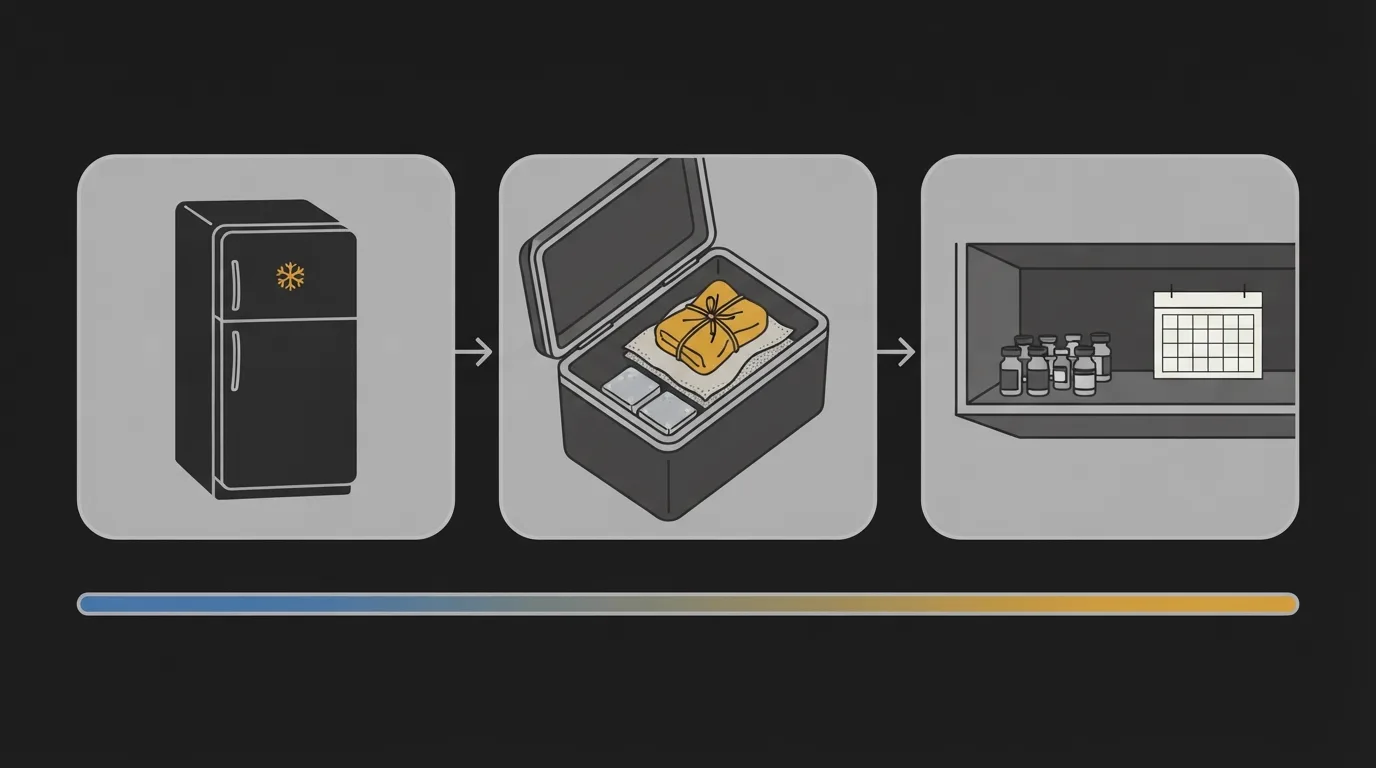
The FDA's general advice for drugs that need refrigeration is to plan ahead with "a cooler and ice or frozen gel packs available" (FDA, safe drug use after a disaster). The detail that trips people up is freezing. Its insulin page is blunt about it: "Do not use insulin that has been frozen." Ice in direct contact with a vial can freeze the liquid along that side long before the cooler itself feels cold.
A small cooler set up for medicine alone works better than tucking a vial in among the food:
- Two frozen gel packs or frozen water bottles on the bottom.
- A folded dish towel or a layer of cardboard over them.
- The insulin in a zip bag on top of the towel, so meltwater cannot soak the labels or the boxes.
- A thermometer inside, read through the lid each morning and evening.
Aim for the low end of room temperature, not fridge cold. Anything under 86°F keeps you inside the label, and a cooler that reads in the 40s or 50s is doing better than it needs to. Put the cooler in the coolest room of the house, off the floor in winter and away from windows in summer, and never in a parked car.
Keep a small medicine cooler separate from the food cooler for a practical reason as well. Family members open the food cooler all day. The medicine one gets opened twice, for the dose, and stays cold far longer.
Keeping the ice coming
Gel packs and bottles last a day or two, depending on the weather. The bottles have an edge here: as they thaw they turn into drinking water, and they are easy to swap at a neighbor's house, a relative's place on another circuit, or a shelter with a generator. If you run a generator for the refrigerator a few hours a day, refreeze the packs in the freezer during those hours. Our long power outage guide covers how to cycle a fridge on a generator without wasting fuel.
Heat and cold are the real threats
The FDA puts the risk simply: "The longer insulin is exposed to extreme heat or cold, the less effective it becomes." The danger in a blackout depends on the season.
Summer outages
A house without air conditioning in July can run well past 86°F by afternoon, and that is when the cooler stops being optional. Keep insulin out of sunlight even inside the house, because a vial on a sunny windowsill heats far beyond the room around it. If the house becomes too hot for people, the Red Cross advises leaving for a place with power, and the insulin goes with you in the cooler.
Winter outages
Cold catches people out more often than heat, because it feels like a refrigerator. An unheated garage, a porch or the car overnight can drop below freezing. A house that loses its heat for days can get cold enough in a back bedroom to put a vial near freezing. Keep insulin in the warmest lived-in room, near the people, and treat the 59°F lower edge of the room-temperature window as a reason to move it closer to the heat source you are using. Our guide to staying warm without power shows how to keep one room livable.
Pumps, pens and the supplies around them
Insulin in a pump has a tighter limit than a vial on a shelf. The FDA says insulin in the reservoir, tubing and catheter is usually thrown away after 48 hours, unless your pump and insulin instructions say otherwise. Some rapid-acting insulins are labeled for six or seven days in the reservoir. If pump insulin is exposed to temperatures above 98.6°F, it goes in the trash, which matters on a hot day when the pump sits against the body under a jacket.
A pump and a continuous glucose monitor also need power of their own, either batteries or a charger. Spare batteries for the pump and a charged power bank for the reader or phone belong in the same kit as the cooler. Our article on cell service in a blackout covers keeping phones charged for a week, and the same power bank keeps a glucose app alive.
Every pump user should have a backup plan for injections in case the pump fails or supplies run out. The FDA page sets out how a pump's 24-hour basal dose converts to injected long-acting or intermediate insulin, and it says plainly that any switch should happen under a doctor's guidance with close blood sugar checks. Ask your diabetes team to write your own conversion on a card now, and keep pens or syringes and a vial of long-acting insulin in the kit for it.
Other medicines in the refrigerator door
Insulin is the best-known case, but plenty of other prescriptions carry a "refrigerate" label. The FDA names certain liquid antibiotics as an example, and many injectable pens for other conditions come with storage instructions of their own. Each has its own tolerance for warmth, and the leaflet in the box is the place to find it.
The FDA's rule for any of them after an outage is to check the storage instructions or ask a pharmacist, the prescriber or the manufacturer whether the medicine can still be used. Temperature-sensitive medicines "may lose potency when they are not stored at the recommended temperature," and the agency asks you to replace anything that cannot be used as soon as possible. A medicine needed to sustain life, with insulin as its example, "may be used until you can get a new supply" when no replacement is at hand.
Make a short list of every refrigerated medicine in the house, with the room-temperature allowance from each leaflet beside it. Keep that list taped inside the cooler lid. In the dark, nobody wants to hunt for a package insert.
When to replace, and how to get more
Insulin that has frozen is the one clear case: discard it. For insulin that went through heat, the FDA allows that under emergency conditions you may still need to use insulin stored above 86°F, and asks you to throw out exposed vials and replace them once properly stored insulin is available. In practice that means using it if it is all you have, checking blood sugar more often because it may work less well, and getting a fresh supply at the first chance.
Getting more during a regional outage is the harder part. Pharmacies close when their own power and phone lines go, so do these before you need them:
- Refill on the earliest date your plan allows, so a month's spare is always on hand.
- Find out whether your state has an emergency refill law and how it works. Our guide to an emergency medication supply explains those laws and 90-day fills.
- Keep a printed list of every medicine, its strength and dose, and a copy of the prescriptions with your emergency supplies, as the FDA asks every household to do.
- Call the maker's customer line if you are unsure about a vial. The numbers are on the FDA page and in the package insert.
If you have to use a different brand or type than usual, the FDA's guidance on switching between insulins is worth printing ahead of time. It is a stopgap for when no doctor can be reached, and it comes with the instruction to monitor blood sugar closely and see a doctor as soon as you can.
Powering a small fridge
For an outage that runs into weeks, or a household that keeps a lot of refrigerated medicine, a small fridge on backup power takes the guesswork away. A compact fridge holds far less than a kitchen refrigerator and usually draws less, so a battery power station, or a generator a few hours a day, has a realistic chance of keeping it cold. Run the numbers for your own unit with our solar generator runtime calculator, using the wattage on its label.
A generator always runs outdoors, at least 20 feet from doors, windows and vents, with carbon monoxide alarms working inside, as Ready.gov advises. Our page on carbon monoxide safety in an outage covers the setup. For anyone who also uses a breathing machine or CPAP, the blackout plan for CPAP and oxygen shows how to share one backup supply between devices.
What goes in the insulin kit
Everything above fits in one small cooler and a bag kept beside it:
- A small hard-sided cooler used only for medicine.
- Two gel packs or frozen water bottles that live in the freezer year-round.
- A dish towel and zip bags.
- A fridge thermometer for the refrigerator and a second one for the cooler.
- The card of room-temperature days for each insulin and refrigerated drug.
- Spare pens or syringes, pump batteries and infusion sets, glucose meter strips, and fast sugar for lows.
- The printed medicine list, prescription copies, and your injection conversion card if you use a pump.
Try it once. During our weekend grid-down drill, move the insulin to the cooler on Friday night and log its temperature every few hours. You will learn how long your packs really last in your house, in your season, which no guide can tell you. A parent who lives alone needs the same kit, and the emergency plan for elderly parents covers who checks on it.
What I'd do first
I'd read every insulin leaflet in the house tonight and write the room-temperature days on an index card. That one step turns a frightening outage into a counting exercise, because most households discover they have weeks of margin on the vial in use. Next I'd put two gel packs in the freezer and leave them there, then put a thermometer on the fridge shelf and a second one in the cooler.
The expensive gear can wait. A power station for a mini fridge is worth it for someone holding several months of refrigerated stock, or in a region with long summer outages. For most families the cheaper plan covers it: a cooler, a towel between the ice and the vial, and a pharmacist call before the month runs out. The rest of the household's medical kit, from the home trauma kit up, is in the medical section.
Frequently asked questions
How long can insulin go without a refrigerator?
Can I put insulin straight on ice in a cooler?
My insulin got hot in the car. Should I throw it out?
Is a frozen water bottle better than a gel pack?

Written by
Walt Brenner
Grid-down threats, home security and family plans
Walt Brenner is the pen name of the writer who covers grid-down threats, home security and family emergency plans for Dark Grid Prep. He draws on FEMA and Ready.gov guidance, utility and government reports, manufacturer manuals and long-running prepper forums, and he says plainly where those sources disagree. His beat is the household: what a family of four in a suburb or on a rural lot should have, know and do before the lights go out.
Last checked 2026-11-17
Comments
No comments yet. Questions and your own experience are welcome.
Thank you. Your comment will appear once it has been reviewed.