Threats and scenarios
What happens in the first 72 hours after an EMP
A high-altitude nuclear EMP could knock out sections of the power grid and communications in seconds, while some electronics and vehicles would keep working and others could be upset or damaged. For the next three days, the family faces a widening blackout: confirm that the event is larger than your street, treat injuries and small fires first, store water while pressure remains, keep the refrigerator closed, listen to a battery radio and avoid unnecessary travel.
No country has experienced a continental high-altitude EMP against a modern civilian grid. The timeline below therefore has two kinds of evidence. CISA and DHS describe what the pulse can do to equipment and long conductors. The later stages use the record from large blackouts, because water pumps, cell sites, stores and hospitals run on the same backup power after the cause of the outage has passed.
That distinction matters. Federal guidance supports the risk of fast electronic disruption and grid damage. It does not support a claim that every car stops, every phone dies or the entire United States stays dark for a fixed number of months. The official duration bands, from a regional disruption to a recovery that can run for years if the big transformers are lost, are in how long the grid would stay down after an EMP.
The first seconds: power and signals may vanish together
A high-altitude nuclear burst produces three overlapping effects. The fast E1 component can induce abnormal voltage in cables, antennas and other conductors within nanoseconds. E2 follows with an effect closer to lightning. The slower E3 component couples into long transmission lines and can stress the grid in a way that resembles a severe geomagnetic disturbance. Our guide to EMP versus a solar storm explains those mechanisms and why only the nuclear case brings the fast pulse down to household electronics.
CISA's Resilient Power Best Practices says E1 can rise before ordinary lightning protection has time to respond. DHS adds that exposed semiconductor electronics may be temporarily upset, recover after a power cycle or be damaged permanently. Equipment connected to long wires has more opportunity to collect energy than a small unplugged device, while metal cases and other incidental shielding may spare some gear.
Inside a house, the first sign may be ordinary darkness. Lights, furnace blowers, well pumps, cable modems and appliances stop because utility power is gone, whether their own electronics survived or not. A battery clock, flashlight or radio may still work. Another may not.
The mixed result is expected and tells you little about the size of the event.
Outside, traffic signals could go dark. Some moving vehicles might stall or show warning lights, but the federal vehicle tests do not support the familiar picture of every road becoming a parking lot. The EMP Commission exposed 37 cars from model years 1986 through 2002. Three running cars stalled at higher test levels and restarted, one dashboard needed repair, and parked cars showed no effect. Newer vehicles have more electronics and have not been tested in the same public program, so nobody can say how a particular car would behave. The parked-versus-running split, the trucks and the field levels are in which cars still run after an EMP.
The first ten minutes: rule out the dangers inside your house
Start with what can kill someone before you know what happened. Look and smell for smoke, electrical arcing and gas. Check anyone who was using power tools, cooking, driving or riding an elevator when systems stopped. Use a flashlight around broken glass and dark stairs. If a fire is small and you have the right extinguisher, act while it is still small. Leave if the structure is burning or you smell gas.
Do not spend these minutes trying every switch or repeatedly starting the car. A power cycle may restore an upset device, but one attempt is enough. Disconnect sensitive equipment that still has a plug so later switching surges do not reach it when utility crews begin restoring circuits. Leave the main breaker alone unless you have a specific electrical hazard or your household plan calls for isolating a generator from the grid.
If the house is safe, compare several clues. Look beyond your street for lights. Try a battery radio on local AM and FM stations, then a NOAA Weather Radio. Send one short text to the family's out-of-area contact. A local outage may leave cellular data and stations working. A wide event may take power, broadcast, internet and several cell networks at once.
Silence across all of them is evidence of scale, though it still does not prove an EMP.
The first hour: use what still works
Water comes first.
A private well stops with its pump, but a pressure tank may still hold a small amount. City systems often keep pressure through water towers and generators, then weaken as pumps or backup fuel fail. Fill clean containers while the tap still runs. Ready.gov's basic emergency kit checklist uses one gallon per person per day for drinking and sanitation for at least three days. Our guide to water for a two-week outage covers containers, treatment and the much larger amount a household needs beyond day three.
Close the refrigerator and freezer and leave them closed. The American Red Cross says an unopened refrigerator holds a safe temperature for about four hours, while a full freezer holds it for about 48. Make a meal plan from memory or from a paper inventory. The refrigerator food goes first, then the freezer, then the pantry. Opening the door to inspect everything spends cold you cannot replace.
Move flashlights to the places where falls happen: stairs, bathrooms and the route to the breaker panel. Keep candles out of the plan if children, pets, oxygen equipment or a tired adult can knock them over. Check battery-backed smoke and carbon monoxide alarms. If anyone depends on a powered medical device, switch to the backup supply and call the utility, equipment provider or emergency service while a phone connection remains. The power-outage plan for oxygen and CPAP covers batteries, cylinders and the calls to make before backup power runs out.
Assign one person to listen and write. Record the time power stopped, what still works, every official message and the battery or fuel used. A paper log prevents six people from trying the same dead phone and gives the household a clearer picture when reports conflict.
Hours one to six: communications thin out
Cell service may survive the pulse and still fade with the grid. Typical site batteries last roughly two to four hours, while sites with generators can run for days if fuel and roads remain available. Call attempts also surge after a disaster. The EMP Commission modeled immediate congestion and call volumes above normal through the first day, even under a lower-level event with mostly transient direct effects on telecommunications.
Send texts instead of making voice calls. Put the phone in airplane mode between scheduled checks and reduce screen brightness. Keep one phone on for emergency alerts and switch the others off. If a message will not send, leave it queued and move on. Repeated calls consume battery and add load to the network.
A battery radio is now the main source of outside information.
Scan local AM and FM at the top and bottom of each hour, when stations are likely to repeat instructions. Write down frequencies that carry a signal. A radio protected in a metal container is useful only if you can power it and know how to tune it. The build guide for a Faraday container for spare radios also explains the limits of home shielding.
An EMP created by a high-altitude detonation is different from a ground burst. The pulse itself does not mean local blast damage or fallout at your house. A nuclear attack could include other detonations, so the radio matters. If authorities issue a fallout warning, go inside the most protective part of a substantial building and follow that instruction. Our page on sheltering from fallout for the first 24 hours covers where in the house to go and how long to stay. Do not assume that a clear sky means the wider attack is over.
Hours six to 24: the outage becomes the main problem
By evening, the work looks like any large blackout. Stop using tap water for washing if pressure is falling. Set aside drinking water by person and day, then a separate amount for cooking and sanitation. Line a toilet bowl or use a bucket system if the sewer utility asks residents to limit flushing. Low water pressure can let contamination into pipes, so treat a boil-water notice seriously even when boiling costs fuel.
Eat refrigerated meat, dairy and cooked leftovers while they are still within the safe window. A thermometer makes the decision easier. The Red Cross says to discard perishable food that has been above 40°F for two hours. Do not taste food to judge it. A day of groceries is cheaper than food poisoning when clinics are running on backup power.
Run engines only outdoors. Ready.gov places a generator at least 20 feet from windows, doors and attached garages, with the exhaust pointed away from the house. Keep camp stoves and charcoal grills outside as well. Carbon monoxide has no smell, and an outage is exactly when people bring outdoor burners into kitchens and garages. Read the carbon monoxide rules for a power outage before fuel is lit.
Avoid driving unless someone needs medical care or officials direct an evacuation. Dark intersections, disabled signals, stalled vehicles and emergency traffic make a short trip slower and more dangerous. Fuel pumps and card terminals need electricity. The gas in the tank may be the only transport fuel available for days, and the car can charge a phone outside without becoming a daily generator for the house.
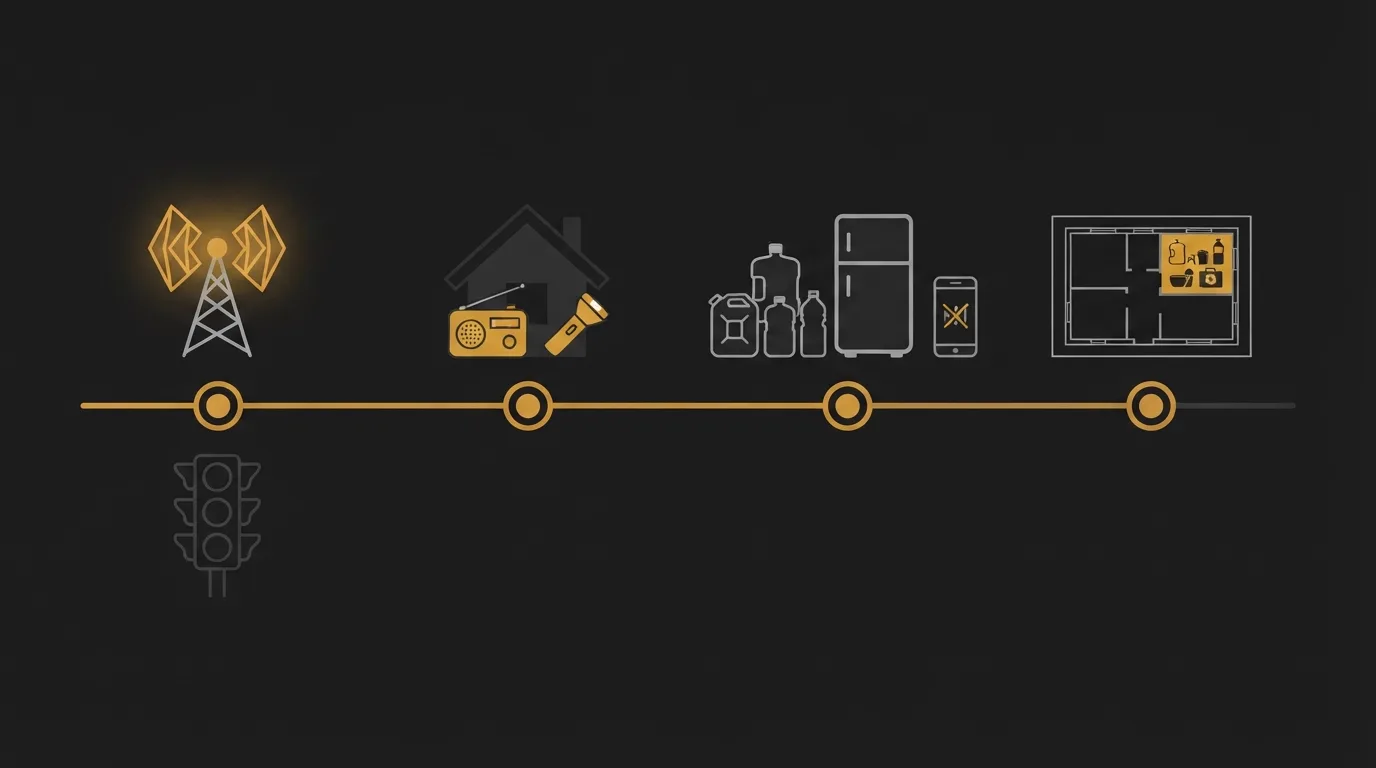
Day two: backup power and stored supplies set the pace
At 24 hours, a full freezer still has about a day of cold left if it stayed shut. Phone batteries are lower, some cell sites are off air and stores that opened on generators may accept cash only. City water could be normal, weak or under a boil notice. Those outcomes depend on local backup power, not on a universal EMP schedule.
Count what remains instead of guessing. List water by gallons, food by meals, prescription doses, radio batteries, generator fuel and vehicle fuel. Divide each by the household's daily use. The number of days on the shortest essential supply is the real planning horizon. Our stockpile calculator does the arithmetic for water, calories, cooking fuel and batteries.
Check neighbors in pairs during daylight, beginning with people who live alone or use medical equipment. Share information before supplies. A written frequency, water notice or open clinic helps the street without advertising the contents of your pantry. Keep exterior doors locked and ordinary curtains closed after dark. A silent house that looks like the rest of the block draws less attention than one lit from every window.
Follow the family communication plan at its scheduled check-in times. Listen first, transmit briefly if you have a radio service your household already uses, then turn the set off. The family communication plan provides the contact order, meeting places and no-show rule that are hard to invent while networks are failing.
Day three: decide whether the house can carry the next week
By the third morning, official information should matter more than rumor. Write down what local authorities say about power restoration, water safety, shelter locations, medical support and roads. Separate a named agency and a specific instruction from a story that arrived through three neighbors. One working station with a county briefing is worth more than a dozen confident guesses.
Stay if the house is structurally safe, temperature can be managed, water and medicine will last, and no evacuation order covers your area. Home holds the supplies, bedding and tools you already own. Leaving without a destination trades those advantages for traffic, uncertain fuel and a road network with dark signals.
Leave for a defined reason. Fire, a gas leak, dangerous indoor heat or cold, exhausted medical backup, rising water, violence close to the house or an official order are clear triggers. Pick the destination and route before loading the car. Take water, prescriptions, paper identification, cash, a radio, maps and the written contact plan. The guide to preparing for civil unrest covers the security side if disorder is the reason the home has become unsafe.
If the house remains workable, shift from emergency reaction to a seven-day routine. Set meal times, water allowances, radio checks, daylight chores and night watches if the neighborhood needs them. Protect sleep. Fatigue leads to fuel mistakes, missed medication and arguments long before stored food runs out.
What the government record says, and what it cannot say
DHS's EMP and geomagnetic disturbance strategy says there is significant uncertainty about consequences at both the individual-asset and infrastructure-system level. Ground conductivity, grid configuration, transformer design, pulse strength and the position of equipment all change the result. That is why this page does not assign a failure percentage to cars, phones or transformers.
The 2008 EMP Commission report on critical national infrastructures provides the strongest public basis for the early stages. It warns that a high-altitude attack could seriously degrade a large exposed grid almost instantly, create immediate communications congestion and extend outages if difficult-to-replace equipment is damaged. Its long recovery estimates are scenarios, not observations from an attack on the United States.
CISA's EMP material is written for utilities, communications operators and other critical facilities. It offers levels of shielding, grounding, filtering, spares and resilient power. It does not publish a separate household EMP checklist. The household actions here come from applying ordinary official outage guidance to a cause that could make the outage wider and damage more electronics at the start.
My take: act on the blackout you can see
I would not waste the first hour debating whether the cause was a weapon, a cyberattack or a grid cascade. The useful evidence is in the house and on the radio: injuries, fire, water pressure, working communications and official instructions. Store water, protect the cold food, move medical equipment to backup power and keep the roads clear.
The rare EMP-specific preparation is a spare radio set in a tested shielded container. Everything else that carries a family through day three is ordinary outage preparation, and it earns its space during storms and utility failures too. Store water, food and medicine first, then add lighting, a radio and a written plan. Use a weekend grid-down drill to find any gaps while stores and phones still work.

Written by
Walt Brenner
Grid-down threats, home security and family plans
Walt Brenner is the pen name of the writer who covers grid-down threats, home security and family emergency plans for Dark Grid Prep. He draws on FEMA and Ready.gov guidance, utility and government reports, manufacturer manuals and long-running prepper forums, and he says plainly where those sources disagree. His beat is the household: what a family of four in a suburb or on a rural lot should have, know and do before the lights go out.
Last checked 2026-11-16
Comments
No comments yet. Questions and your own experience are welcome.
Thank you. Your comment will appear once it has been reviewed.