Threats and scenarios
Nuclear attack preparedness
The first 24 hours: where to go in your own house, how long to stay there, and what to do about the dust if you were caught outside.
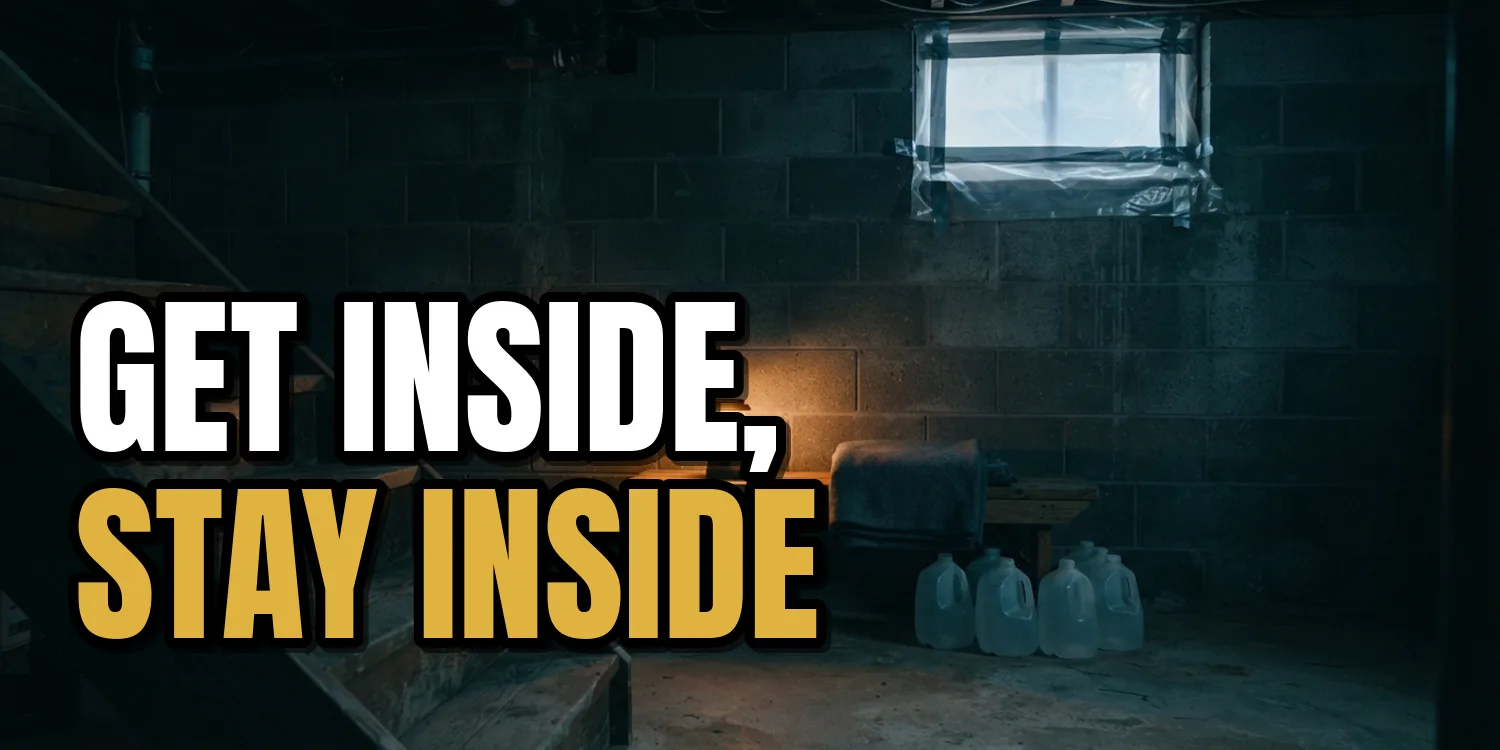
What to do in a nuclear attack comes down to three steps the federal government repeats on every page it publishes about radiation: get inside, stay inside, stay tuned. Take cover from the blast if you have warning, reach the basement or the center of a brick or concrete building before fallout arrives, and stay there for at least the first 24 hours. Move sooner only if fire or a collapse forces you out, or if officials tell you to.
Everything below comes from pages you can read yourself: Ready.gov's radiation emergencies page, the EPA's guide to protecting yourself from radiation, the American Red Cross on nuclear explosions and the CDC's radiation newsletter. Where they differ, the difference is named.
Print the family emergency plan
Get inside, stay inside, stay tuned
Ready.gov is FEMA's public preparedness site, and its radiation page puts the whole plan in one sentence: the best way to stay safe in any radiation emergency is to get inside, stay inside and stay tuned. The EPA uses the same three steps and adds that they protect your loved ones and your pets as well, so the dog comes in with the family. The CDC goes further and ranks the advice. In a nuclear detonation, its radiation team wrote, the best protection is to avoid exposure by getting inside, staying inside and staying tuned for instructions from local officials. Shelter comes ahead of any pill or gadget.
The third step is the one households skip. Staying tuned is how you learn that your shelter time has been extended, that a route out has opened, or that a fire nearby means you have to move after all. None of that reaches you if the only device in the basement is a phone on a congested network. Ready.gov's basic kit lists a battery or hand-crank radio plus a NOAA Weather Radio, and our page on the NOAA weather radio covers which models take batteries and how the alerts work. Keep the radio and spare cells in the room you plan to shelter in.
Staying tuned also answers the urge to drive. A car has none of the walls, concrete or earth the EPA and Red Cross ask you to put between yourself and fallout. On a jammed highway, you would be stuck in traffic while the dust comes down. A radiation emergency is the clearest stay-put case in our bug in vs bug out guide: you leave when officials give a route, not on a guess.
Blast first, fallout next
A nuclear detonation is two dangers on two clocks. The flash and the blast arrive in seconds. Fallout is radioactive dust and debris thrown up by the explosion, and it settles over the following minutes and hours, wherever the wind carries it.
For the first clock, the instruction is short. If you have warning, the federal advice is to take cover from the blast behind anything that might offer protection. The Red Cross adds what to do if you are caught in the open: do not look at the flash or fireball, because it can blind you, take cover, lie flat and cover your head. Once the shockwave has passed, go into the nearest building. The Red Cross says to do that even if you are many miles from ground zero, because distance from the blast does not protect you from the dust that follows.
For the second clock, Ready.gov gives the number that matters: after a detonation, you will have 10 minutes or more to find adequate shelter before fallout arrives. Ten minutes is enough to walk down the basement stairs, call the kids and the dog in from the yard, or get from a parking lot into the core of an office block. It is not enough to load the car, and it is not enough to drive across town to a better building. Spend it moving toward walls and mass.
Fallout shelter basics in an ordinary house
Fallout shelter basics have nothing to do with a buried steel bunker. The goal is to put as much heavy material as possible between you and the dust that settles on the roof, the ground and the windowsills. The EPA frames it as three principles, time, distance and shielding: spend as little time near the fallout as you can, keep as much distance from it as the building allows, and put as much material between you and it as you can find.
In practice that ranks the rooms in your house:
- The basement, if you have one. The EPA calls the basement or the innermost room of a structurally sound building the safest place to be, and the Red Cross says an underground area offers more protection than the first floor.
- An interior room with no outside walls, as close to the middle of the house as you can get. The EPA's rule is simple: more walls provide more protection.
- As far as the house allows from the roof and the outside walls, where the dust settles. Distance is one of the EPA's three principles, and a bedroom right under the roof gives you the least of it.
Some buildings beat others outright. According to Ready.gov, the safest buildings have brick or concrete walls. Underground parking garages and subways can also give good shelter. A wood-frame house with no basement is thinner protection than a brick apartment building, which is worth knowing if both are within reach in those first minutes.
Density counts too. The Red Cross puts it plainly: the heavier and denser the materials between you and the fallout particles, the better, and it names thick walls, concrete, bricks, books and earth. In a basement, the earth outside the walls is part of that list. Bookcases, stored water and boxes of canned food stacked along the inside of an exterior wall add mass you already own.
In an apartment or a house with no basement, use the same logic: the innermost room, the center of the largest and sturdiest building available, the most walls between you and the outside. A hallway or bathroom in the middle of the unit, with walls on every side, beats a living room with a picture window.
Whether your city still designates public fallout shelters is a local question. Ask your county or city emergency management office what it plans, and pick your own room in the meantime.
How long to shelter after a nuclear blast
The federal default is a full day. Ready.gov says to remain in the most protective location, the basement or the center of a large building, for the first 24 hours unless an immediate hazard threatens you. A fire spreading toward the house, a gas leak, a building that is starting to fail or an injury that needs care are the kinds of threats that justify moving to a better spot. An official instruction overrides the 24 hours in either direction.
The reason for that number is physics, and Ready.gov states it directly: radiation levels decrease rapidly, becoming significantly less dangerous, during the first 24 hours. The hours right after fallout arrives carry most of the danger, which is why stepping out for a look in the first afternoon is the worst trade a household can make.
The Red Cross sets the same floor and warns that it may not be the ceiling. Expect to stay inside for at least 24 hours unless authorities say otherwise, it says, and in some circumstances you may need to shelter in place for as long as one month. Those two lines are the honest range. Plan the house for the first day, stock it for longer, and let your local officials tell you which one you are in.
The first 24 hours indoors
Emergency preparedness for a nuclear attack is mostly ordinary outage preparation done in one room. No source gives an hour-by-hour schedule, so treat the order below as my judgment about what to do first, built from what Ready.gov asks of a sheltering household.
First, close the house. The radiation page asks you to turn off fans, air conditioners and forced-air heating units that bring air in from outside, and to close windows, doors and fireplace dampers. Do it on the way down to the basement if you can, because once you are settled you should not be wandering past windows to find the thermostat.
Second, count heads. Everyone in the household, and the pets, should be downstairs with you. If someone is at work or at school, the plan is that they shelter where they are, which is why Ready.gov wants a kit at work as well as at home. Our printable plan and wallet cards have a place to write down where each person goes and how you will reach each other afterward.
Third, bring down water, food and medicine. Ready.gov's radiation list adds sealed food, water and medicine to the household kit, along with a spare change of clothes for each family member and a trash bag for contaminated clothing. Its food rule is reassuring: it is safe to eat and drink food that was inside a building. Sealed containers that were outdoors can be used after you wipe them off, and open food that sat outside should wait until officials say it is safe. If you already keep a two-week water plan and a pantry for blackouts, that stock is your nuclear supply as well. Move enough of it to your shelter spot that nobody has to go upstairs for a day.
Fourth, turn the radio on and leave it on. The power may already be out, so treat the shelter like any other blackout room: lights that run on batteries, a way to charge phones, and a bucket toilet if the plumbing is in doubt. The power outage checklist lists what that room needs, and it overlaps almost entirely with a shelter kit.
A long day in a basement is also hard on nerves, especially for children and older relatives. Give each adult a job, keep the news to the radio updates, and read our piece on staying calm in a crisis for the habits that hold a household together when there is nothing to do but wait.
Decontamination if you were outside
Anyone who was outdoors when fallout came down should clean up as soon as they are inside. By Ready.gov's estimate, removing your outer layer of clothing can remove up to 90% of radioactive material. Take the coat, outer shirt and trousers off carefully so the dust stays on them, put them in the trash bag from the kit, tie it, and set it away from where people are sitting.
Then wash. A shower is best, and soap and water on exposed skin and hair is the next choice if the water supply is uncertain. Hand sanitizer does not help here: Ready.gov says plainly that it does not protect against radioactive material. The Red Cross adds a detail almost nobody would guess. Use shampoo but not conditioner, because conditioner binds radioactive material to your hair and keeps it from rinsing out.
Put on the spare change of clothes from the kit once you are clean. That is why Ready.gov wants one set per family member in the kit: whoever went out for the dog or ran in from the car needs something clean to change into.
Potassium iodide: what it does and what it does not
Potassium iodide, or KI, is the item most people ask about first, and the one the official sources are most careful with. The CDC says you should take KI only if directed by public health or emergency response officials or a healthcare provider.
The reason is what KI covers. The CDC explains that KI protects only your thyroid, and only after you breathe in or swallow something contaminated with high amounts of radioactive iodine. Fallout from a detonation contains many different radioactive materials, and KI does nothing about the rest of them or about the dose your whole body takes from dust on the roof and the ground. That is why the same CDC newsletter puts getting inside, staying inside and staying tuned ahead of any medication.
So I would not buy KI and keep it in the medicine cabinet as a nuclear plan, and I would never dose a family member on my own judgment. If officials distribute it after an event, they will say who takes it and how much. Until then, a basement and a radio do far more for you than a bottle.
How this fits the other threats on this site
People often lump a nuclear attack and an EMP together, but they do different things to a house. A high-altitude burst produces a pulse that can damage the grid and electronics without any blast or fallout at your address. Our explainer on the EMP vs solar storm question covers what that pulse does, and the first 72 hours after an EMP follows the household through the blackout that comes after it. A ground detonation near you is the fallout case on this page. An attack could involve both, which is one more reason to keep the radio.
If officials extend sheltering past the first day, the problem becomes a long outage in a closed house: water, sanitation, food rotation and morale. Our guide to long-term power outage survival picks it up from there.
My take: where I'd start
I'd start by choosing your shelter tonight and saying it out loud to everyone in the house. Walk down to the basement, or to the room with the most walls around it, and look at it as the place you will spend a day: where people sit, where the water goes, which wall gets the bookcase. Then run a grid-down drill that ends in that room, timed against ten minutes.
I would not build a separate nuclear stash. Ready.gov's radiation list is the ordinary kit plus spare clothes and a trash bag, so extend the water and food you already keep for blackouts and put a hand-crank or battery radio down there with it. The one gap I can't close for you is local: most towns no longer advertise public fallout shelters, so find out from your emergency management office what yours plans, and count on your own walls in the meantime.
Print the family emergency plan
Questions readers ask
Should I try to drive out of the city after a detonation?
Not on your own. A vehicle offers little mass to hide behind, and the minutes before fallout are better spent reaching a basement. Leave when local officials announce a route.
Is an ordinary basement enough, or do I need to remodel?
An existing basement is the room the federal and Red Cross guidance points to first. Extra mass helps, and you can add it by stacking books, water and food against the walls.
Should I keep potassium iodide at home?
The CDC's line is to take it only when officials or a clinician tell you to. It shields one gland from one material and leaves the rest of the fallout untouched.
How is this different from an EMP blackout?
An EMP is a pulse that hits electronics and the grid with no dust to hide from. Fallout is radioactive debris, and the defense against it is walls, distance and time.
Sources

Written by
Walt Brenner
Grid-down threats, home security and family plans
Walt Brenner is the pen name of the writer who covers grid-down threats, home security and family emergency plans for Dark Grid Prep. He draws on FEMA and Ready.gov guidance, utility and government reports, manufacturer manuals and long-running prepper forums, and he says plainly where those sources disagree. His beat is the household: what a family of four in a suburb or on a rural lot should have, know and do before the lights go out.
Last checked 2026-11-24
Comments
No comments yet. Questions and your own experience are welcome.
Thank you. Your comment will appear once it has been reviewed.