Family emergency plans
Blackout readiness self-check
How ready is your house for a long blackout? Tick the 20 items below that you already have, taken from Ready.gov's kit, planning and power outage pages. Your score is the number you tick out of 20, and every box you leave empty comes back with the page on this site that fixes it.
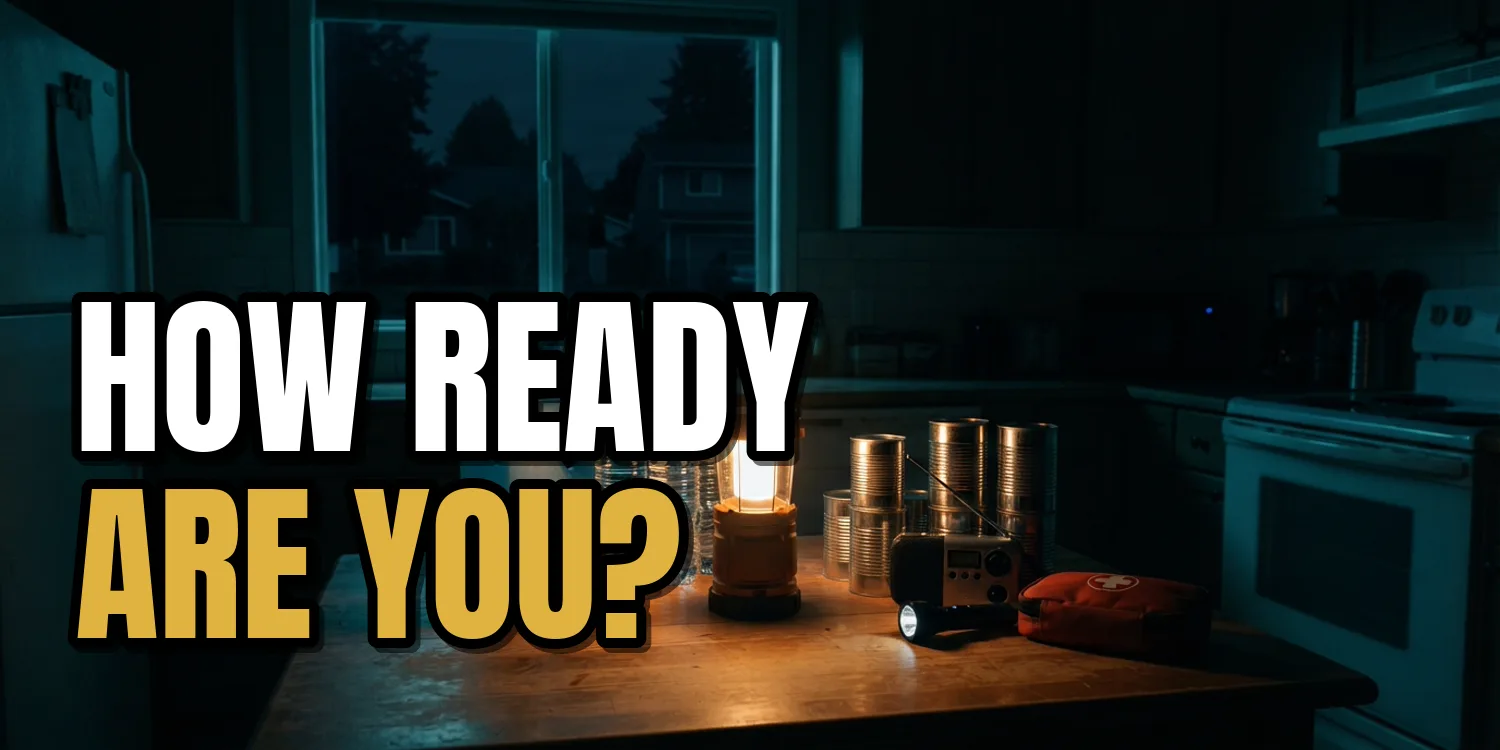
Most families think they are ready for a blackout until they try to name what is actually in the closet. There are a few flashlights somewhere, a case of water from last summer, and a plan that lives in one person's head. This self-check turns that guess into a count. It takes about five minutes, it asks only yes or no questions, and it shows you exactly which pieces are missing for a household that has to manage two weeks with no power and no store run.
If you already know the plan is the weak spot, start with the paper version and come back to score the rest.
Print your household plan and wallet cards
Score your household
This is a planning aid, built from public guidance. It does not replace your local emergency management office, your utility or the person who prescribes your medicine, and it cannot see inside your closets.
How the score works
Each of the 20 items comes from one of four Ready.gov pages: Build a Kit, Make a Plan, Power Outages and Safety Skills. Together they cover what the federal government asks every household to have on hand and to know before the power fails. We grouped the items into eight bands so you can see at a glance whether your gaps cluster in supplies, in safety or in the plan itself.
You tick a box for each item you have, and the count of ticked boxes is your score out of 20. There are no weights, no hidden points and no readiness levels with names attached. A carbon monoxide alarm and a can opener each count as one, because we have no source that ranks one above the other for every house, and inventing a weighting would make the number look more precise than it is. What matters is the list of empty boxes the result shows you, with a link beside each one.
This is also not a FEMA certification or an official assessment. Ready.gov publishes its kit as a list to read and print. What this page adds is the count, the outage-specific items from the power outage and safety skills pages that a basic kit list leaves out, and a path from each gap to a page on this site that walks through the fix.
Why the check asks for two weeks
Ready.gov's kit page frames the goal as being able to survive on your own for several days after an emergency, with one gallon of water per person per day for several days and at least a several-day supply of non-perishable food. That is the federal baseline, and it is a sound one for the storms most people face.
This site plans for longer: a grid-down event where the power and the supply chain stay off for two weeks. No federal page we have read sets a 14-day household standard, so treat the two-week figure as our planning scenario, not a government rule. The self-check keeps Ready.gov's rate of a gallon per person per day and simply asks whether you have it for 14 days. For a family of four that is 56 gallons. Our stockpile calculator for food, water, fuel and batteries works out your own totals, and the guide to water for a two-week grid-down covers where to keep that much.
If you meet the several-day baseline but not two weeks, leave the water and food boxes empty. The result will send you to the calculator, which is the honest answer to where you stand.
What each band is checking
Water and sanitation
Ready.gov counts the gallon a day as water for drinking and sanitation together. That second word is the one people skip. When a long outage stops the pumps that keep the pressure up, the toilet becomes the first thing in the house that does not work, so the self-check asks for a toilet plan as its own item. Our emergency toilet guide sets one up with buckets, bags and cover material.
Food and the can opener
Two weeks of food that needs no refrigerator matters because the fridge gives out quickly. Ready.gov says a closed refrigerator keeps food cold for about four hours, and a full freezer holds its temperature for about 48. By the third day of an outage, whatever was cold is gone or eaten, and the pantry is the whole menu. The manual can opener is on Ready.gov's kit list for an obvious reason: a shelf of cans and an electric opener is a shelf you cannot get into. Our two-week emergency food supply list builds the menu.
Light
Ready.gov asks for a flashlight for every household member, and a shared flashlight in a kitchen drawer does not meet that. Each person needs a light they can find from bed in the dark. Spare batteries count only if they fit the lights and the radio you own, and our power outage checklist walks through the hours after the lights go out.
Heat, air and carbon monoxide
Three of the 20 items sit here because Ready.gov's power outage page spends its firmest warnings on this band. It says never to use a gas stove or oven to heat the home, to put carbon monoxide detectors with battery backup in central locations on every level, and to run generators, camp stoves and charcoal grills only outdoors, at least 20 feet from windows, doors and attached garages. A hardwired alarm with no battery stops working at the exact moment you start a generator. Read the carbon monoxide safety guide before the first cold night, and our guide to staying warm without power in winter for heat that does not involve the stove.
Medicine
About half of all Americans take a prescription medicine every day, according to Ready.gov, so this band applies to most houses. The first item asks whether those medicines are gathered and organized for an emergency. The second comes straight from the federal outage guidance: talk to your medical provider about a plan for powered medical devices and refrigerated medicines. If nobody in the house uses either, tick it. If someone does, our pages on storing insulin without power and an oxygen concentrator plan for outages are the next reads, and the emergency medication stockpile guide covers building a reserve.
Communications
Ready.gov's plan page starts with the question of how you will receive emergency alerts and warnings, and its kit page lists a battery or hand-crank radio along with a NOAA Weather Radio with tone alert. A phone with no charge cannot receive anything, so the power bank counts here too. The written communication plan is the item families most often lack: an out-of-area contact everyone can reach and a place to meet when calls do not go through. Our family communication plan guide fills it in.
The written plan and the shutoffs
Ready.gov asks households to write the plan down and practice it together. A plan nobody has rehearsed tends to fall apart on its first real test, which is why practice is its own box. The shutoff item comes from Ready.gov's safety skills page, which says every household member should know where the main water valve and the electrical shutoff are, and how the gas shut-off works for your meter. Our guide to writing a family emergency plan that works when phones are down covers the writing, and our weekend with the main breaker off covers the practice.
Cash and tools
Ready.gov's financial preparedness page says to keep a small amount of cash at home in a safe place, in small bills, because ATMs and credit cards may not work during a disaster when you need to buy supplies, fuel or food. The wrench or pliers is on the basic kit list to turn off utilities, so keep it with the flashlights where anyone can grab it in the dark. Our article on how much cash to keep at home works through the amount.
A worked example: a family of four scores 15 of 20
Picture a suburban family of two adults and two children. They have 60 gallons of water in the basement, a pantry built for two weeks, a can opener, four flashlights, batteries, a bucket toilet kit and a written plan on the fridge. They know where the water main is, the adults have walked through the gas meter, and both phones have power banks. They tick 15 boxes.
The five empty boxes are the useful part. Their result reads:
- Carbon monoxide alarms with battery backup on every level: their alarm is hardwired with no battery, so it goes to the CO safety guide.
- NOAA Weather Radio: they rely on phone alerts alone, so it links to the NOAA radio guide.
- Cash in small bills: they have none at home, so it links to the cash article.
- Practiced plan: the plan has never been run, so it goes to the grid-down drill.
- Provider talk: one child takes a medicine that needs refrigeration and nobody has asked the pediatrician what to do in an outage, so it links to the medication guide.
Notice where the gaps sit: the water, food and light bands are full, and every miss is in safety, communication or rehearsal, the kind of item that costs little and gets skipped because nothing in the closet reminds you. With the refrigerator good for about four hours and the freezer for about two days, that child's medicine is the first problem this family would hit, long before the water or the food. The score of 15 does not show that. The list does.
What a high score cannot tell you
A ticked box records that you answered yes. It does not prove the water is still sealed, the batteries still hold a charge or the person named on the plan still lives nearby. The self-check counts what you have, and only a test shows whether it works. That is why a rehearsal matters more than any score: a weekend with the main breaker off turns up the dead flashlight and the forgotten prescription while the stores are still open.
The 20 items are also a floor for a typical house. A household with an older parent living alone, a baby, a well pump or a powered medical device has needs the list only touches. Our guide to emergency planning for aging parents who live alone is the place to start for the first of those.
Finally, the answers you send are stored without anything that identifies you. We read them in aggregate to see which gaps come up most, and that shapes what we write next.
What I would do with the result
I would not try to fix every empty box in one weekend. I would fix the three heat and air items first, because they cost little and carbon monoxide is the danger Ready.gov warns about most firmly on a cold night with the power off. Then I would take the empty plan boxes and do them on paper the same evening, since they cost nothing but an hour at the kitchen table.
The long threads on prepper forums about real outages keep circling the same failures: the medicine nobody packed, the generator nobody knew how to fuel in the dark, the gas valve nobody could find under stress. None of that is about owning the wrong gear. It is about not having rehearsed. So once the score is where you want it, I would run the drill and then take this check again with the drill's notes in hand. The second score is the one I would trust.
Start with the plan on paper. It is the one fix that moves several boxes at once.
Frequently asked questions
Does 20 out of 20 mean we can ride out two weeks safely?
We rent. What if we cannot reach the shutoffs?
Should the kids answer the questions too?
How often is it worth doing again?

Written by
Walt Brenner
Grid-down threats, home security and family plans
Walt Brenner is the pen name of the writer who covers grid-down threats, home security and family emergency plans for Dark Grid Prep. He draws on FEMA and Ready.gov guidance, utility and government reports, manufacturer manuals and long-running prepper forums, and he says plainly where those sources disagree. His beat is the household: what a family of four in a suburb or on a rural lot should have, know and do before the lights go out.
Last checked 2026-11-22
Comments
No comments yet. Questions and your own experience are welcome.
Thank you. Your comment will appear once it has been reviewed.