Threats and scenarios
Get ready for a wildfire shutoff
What the shutoff is, how long the lights can stay off, and the account check to finish before fire weather arrives.
Your utility can turn the power off on purpose when wildfire weather could make a line spark. PG&E calls that temporary outage a Public Safety Power Shutoff. The step to take today is to open the wildfire or shutoff page of the company that bills you and confirm the phone, the text number and the email that should receive the alert.
A rolling blackout works by a different rule. The grid is short of supply, and the operator sheds load in short turns, which is the subject of our page on rolling blackouts and load shedding. In a PSPS, the utility de-energizes specific lines because the weather could start a fire.
If PG&E serves the address, their shutoff page is the place to start, then correct the contacts on the account. If another company serves you, open that company's wildfire or PSPS page and correct the same three fields.
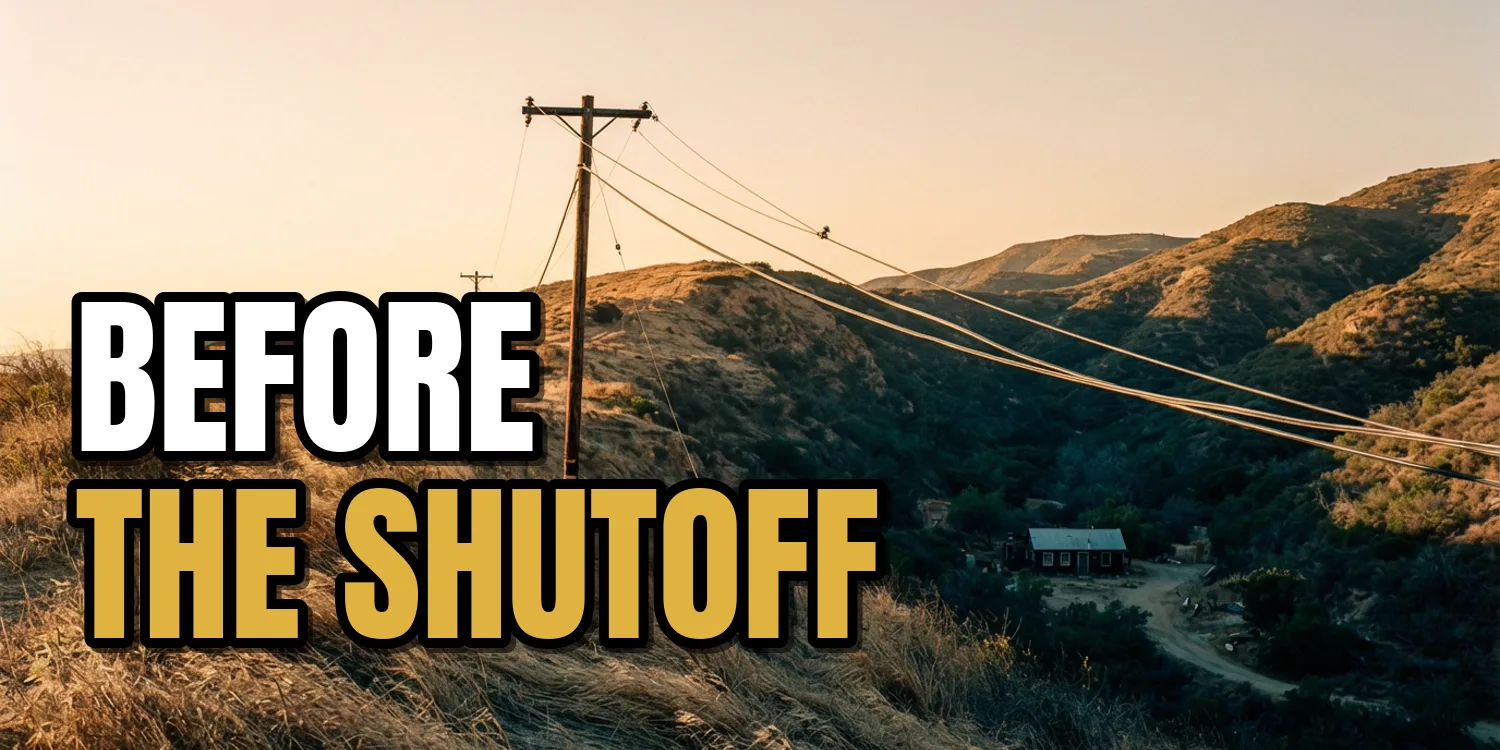
What is a PSPS?
A PSPS is a temporary de-energization. The utility switches chosen lines off so its own equipment is less likely to throw a spark into dry fuel. PG&E's page says it plainly: they may need to turn the power off to keep you safe, and that temporary outage is the shutoff.
The call rests on weather and on what is growing around the lines. PG&E says it plans one when severe weather may put you at risk of wildfires, and it names the inputs it watches.
- Low humidity, so the air itself is dry and a spark has an easier time finding fuel that will burn.
- Forecast high winds, which can throw branches into lines and carry a spark farther than a still day would.
- Dry material on the ground, the grass and litter that become the fuel bed under the wires.
- Vegetation near power lines, growth that can blow into the equipment when the wind picks up.
- A Red Flag Warning from the National Weather Service, the fire-weather flag forecasters issue when those conditions line up.
- Real-time observations from the field, what crews and sensors see when the forecast and the hillside disagree.
One item on that list can be true on a day the lights stay on. The utility is weighing them together against the lines in its high-fire country.
In California, the addresses most likely to see this are the high fire-threat areas the state utility commission marks as Tier 2 and Tier 3. PG&E says homes and businesses in those tiers are more likely to experience a shutoff. That sentence is about likelihood on California's map. Other utilities in the West run similar wildfire shutoffs under their own names and their own clocks. The notice times quoted here are the ones PG&E publishes. If another company prints your bill, its wildfire page is the one that applies to your street.
How this differs from other blackouts
Three dark blocks can look alike from the sidewalk and come from three different decisions. Knowing which one you are in tells you whether to expect a text ahead of time, a short rotation, or a crew with a chainsaw.
Fire weather on particular lines is what leads the utility to cut them. It runs an alert program for the customers on those lines, and the outage stays in place until the weather eases and power can be restored safely. How long that wait can run is the next section.
CoServ, a Texas electric cooperative, describes load shedding on the ERCOT system, the cut utilities make when supply runs short. When there is not enough generation to serve demand, and every other option has been exhausted, ERCOT instructs utilities to reduce power on the system so supply and demand balance. Brownsville's municipal utility says rotating outages of that kind typically come with little or no advance notice, because they come out of an emergency and nobody scheduled them. When the rotation works as designed, each area is dark for a short turn and then another area takes the turn. The household routine for those hours, on and off, lives on the rolling blackouts page. Power plants and gas supply can freeze until operators order the same kind of rotations. That pattern is covered in the winter storm grid failure briefing.
Ice, a falling tree or a broken pole leaves the wire unable to carry power, and the lights stay off until someone repairs that span. Wind that triggers a shutoff can also break hardware, so a house can sit in both events on the same day: a deliberate de-energization, and a line that still needs a crew after the weather passes.
The first shelf at home overlaps even when the cause does not. Water, light, a radio and a written plan are the same opening moves, and the power outage checklist is where that shelf is written room by room. What a shutoff changes is the warning you can sometimes get, and the chance the dark stretch runs past a single evening. The wider set of events, from a freeze to a supply shock, sits on the threats hub.
How long public safety power shutoffs last
How long power stays off depends on the weather at the time and on the work of turning the lines back on.
PG&E states the range it will publish: outages may last several hours or several days, depending on weather conditions and the time needed to restore power safely. Safe restoration means the severe weather has to pass and the lines have to be checked before they are energized again. A forecast that looked like an afternoon event can still become a multi-day outage if the wind holds. You find out the length only after the weather and the patrol are finished, so the jugs are full and the battery packs are topped up before the forecast tightens.
I'd stock for the span PG&E publishes, and treat an earlier return as hours you got back. A single hour-count passed around online is a weaker figure than that span. If the outage runs into a second and third day of the same routine, multi-day blackout planning picks up water, cooking and sanitation from there.
How you get notice
If the PG&E account is in your name, shutoff alerts are already part of it. They reach you when the phone and the email on the account are the ones you actually answer. A number from a house you sold, or a work inbox you left, turns the warning into a message nobody sees. PG&E asks customers to keep the contacts current and gives a phone line for the update, 1-800-743-5000. The shutoff page also describes address alerts for places that are not the billing address, such as a school, a job or a relative's house. Add those if someone you are responsible for spends the day there.
On its medical-devices page, PG&E says it will aim to begin notifications for potentially affected customers about 48 hours before the power is turned off. Customers in the medical program get a tighter set of messages, spelled out in the next section. Those clocks are goals the company states. A plan that needs two quiet days for drinking water and a topped-up radio can lose those days.
Forecasts move. PG&E warns that because of this, in some cases it may not send the first alert until the same day your power is shut off. The kit below is built before a wind event, on a weekday when the stores are ordinary and the car can still take fuel. Waiting for the text is how a household discovers the window has already closed.
A Red Flag Warning is one of the inputs in the list above. A NOAA Weather Radio is how you hear that warning when the phone network is busy with everyone else refreshing the same outage map. Emergency alerts on your phone travel on the wireless alert channel. Keep the utility contacts current anyway, because those alerts tell you the weather, and the account is how the company tells you about your line. They tell you the weather has entered the range where a shutoff becomes likely.
PSPS medical baseline
Medical Baseline does not keep your power on. During a shutoff, PG&E's medical-devices page says every customer on an affected line has the power turned off, and that includes people enrolled in the program. Many families hope the utility will leave a medical address powered. PG&E switches the whole line.
What the enrollment changes is the alerts and the bill. PG&E files the program under financial assistance. Eligibility follows medical conditions or needs, the standard PG&E states instead of an income test, and a practitioner has to certify the application. The program's stated goal is customer alerts at the opening notice above, again at 24 hours, and once more just before the shutoff. Read the qualifying conditions and devices on that page before you apply. PG&E names them there.
Ready.gov tells households to talk with a medical provider about a power outage plan for devices that run on electricity and for medicines that have to stay cold. If a ventilator is in the house, that conversation is where you ask whether a hand resuscitation bag belongs beside it, and which one the clinician wants. You still have to power the device and keep the medicine cold yourself. Our oxygen concentrator outage plan and the page on storing insulin without power cover the household side of those two needs.
California readers apply through the utility that serves the meter. Southern California Edison and San Diego Gas & Electric run parallel medical programs. If one of them bills you, search its site for Medical Baseline or for its shutoff medical program and use the notice times printed there. The 24-hour and just-before goals above are PG&E's. Outside California, run the same search on the utility named on your bill.
A household checklist before the wind
PSPS preparedness is the outage kit packed on a calm day, plus two checks that belong to a planned shutoff: the contacts on the account, and a garage door you have already opened by hand.
PG&E's outage prep page says to pack nonperishable food, one gallon of water per person per day, medications, flashlights and batteries. The wider list that page lines up with Ready.gov also includes a radio, cash, fuel in the car and a manual garage release. Charge phones and power banks while the lines are still hot, because the text you want during the event is the one that says where a charging site opened.
Water runs out first in a house that expected the taps to last. The gallon figure is drinking and sanitation per person per day. Fill your water containers on a calm day, because the published span can run past the first night. If the taps depend on a well, the pump stops with the electricity. The page on a well pump during a power outage covers storage and what it takes to run the pump from a generator.
Food on this list is the kind that does not need a cold box: the meals you can eat if the shutoff outlasts whatever is already in the refrigerator. Medications are the prescriptions you would miss if the pharmacy shut its doors for the wind. Put a flashlight where each person sleeps, with batteries that live in the kit. A dead lamp in a junk drawer is the same as no lamp at 9 p.m.
A battery radio sits with those lights so the Red Flag and the evacuation order are not trapped inside a phone you are trying to save. Cash is on the prep list for purchases while card terminals on a dark block have nothing to plug into. Top off the gas tank before the wind. A shutoff can share an afternoon with an order to leave, and the car is the way out. Practice the manual release on the garage door while the opener still works, so the vehicles can leave if the door motor is dead. Write the meeting place into the family emergency plan on the same afternoon. The shutoff is a bad moment to invent one.
The medical plan is the Ready.gov conversation above, done before fire season, with the backup power and the cold-storage method written where another adult can find them. A concentrator and a vial of insulin fail in different ways, which is why they have their own pages rather than one line on a kit card.
Ready.gov's power outage page puts generators, camp stoves and charcoal grills outside only, at least 20 feet from windows, doors and attached garages. Placement and carbon monoxide alarms are on our carbon monoxide page. Plugging a generator into household wiring with a homemade cord backfeeds the panel. Use the transfer method on the generator safety page, or run only the cords you can plug in at the outdoor distance above.
While the power is off
PG&E opens Community Resource Centers while the lines are off. Its alerts page on ways it can help says every center provides an ADA-accessible restroom and a hand-washing station, charging for medical equipment, charging for phones and other devices, Wi-Fi, bottled water and snacks. The street address is posted when an event is called, so it is not a location you can memorize in spring for a wind event in October. If a device at home has no backup you trust, that charging station is why the alerts page belongs in the phone before you need a ride to it.
For a meal replacement, a ride or a place to sleep, PG&E points customers to 211 in California. The line can arrange food replacement, transportation or hotel stays. What it can find depends on what is open in the county that day. It is a referral, and the kit at home is what you have if the referral comes up empty.
A shutoff and an evacuation order can land together. Fire weather serious enough to de-energize lines can be serious enough for the sheriff or the fire authority to tell you to leave. If they order an evacuation, leave. A charged phone at a resource center is useful on the way out. It is a weak reason to remain in the path. Routes, the close meeting place, the one outside the neighborhood and the paper map are on the evacuation routes page, practiced on a calm weekend.
My take
I'd start with the account contacts this week, before any wind forecast. I'd skip a plan that waits on a two-day warning, because PG&E says the first alert can arrive the same day the power goes off. You often hear sooner than you would in a load-shed emergency, and a forecast change can still move that first message onto the day the lines go dark.
I'd judge the house ready when those three fields are current, address alerts cover the school or the relative's house, and water, light and medications are packed for the span the utility publishes. Earlier messages buy time to start the backup you already arranged with the clinician. They leave the device itself for you to power.
Questions readers ask
What is a PSPS?
PSPS means Public Safety Power Shutoff: the utility cuts power when fire weather could let its equipment start a fire. The weather list and the California tier note are in the opening section.
How long can the power stay off?
Add the weather to the time crews need to inspect the lines before they turn them back on. The span to use is the one in the length section.
Does a medical baseline enrollment stop the shutoff?
All the accounts on the affected line lose power at the same time, enrollment included. The program changes the alert pattern and sits under bill assistance, which is spelled out above from the utility's own pages.
How is this different from rolling blackouts?
When supply falls short of demand, operators cut areas in turn, and the warning is often short because the shortage is already underway. The fire-weather version is a decision about particular lines, with messages aimed at the customers on those lines.
Sources
- PG&E, Public Safety Power Shutoffs
- PG&E, Medical devices and shutoff notices
- PG&E, Medical Baseline program
- PG&E, Tips to prepare for a power outage
- PG&E alerts, Community resource centers
- PG&E, Food, lodging and transportation (211)
- Ready.gov, Power outages
- CoServ, Texas electric grid and load shed
- Brownsville Public Utilities Board, Rotating outages

Written by
Walt Brenner
Grid-down threats, home security and family plans
Walt Brenner is the pen name of the writer who covers grid-down threats, home security and family emergency plans for Dark Grid Prep. He draws on FEMA and Ready.gov guidance, utility and government reports, manufacturer manuals and long-running prepper forums, and he says plainly where those sources disagree. His beat is the household: what a family of four in a suburb or on a rural lot should have, know and do before the lights go out.
Last checked 2026-11-25
Comments
No comments yet. Questions and your own experience are welcome.
Thank you. Your comment will appear once it has been reviewed.